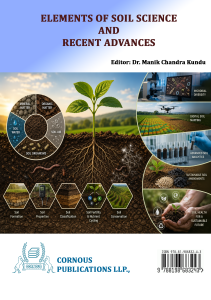
Elements of Soil Science and Recent Advances
- Manik Chandra Kundu
- Assistant Professor of Soil Science, Department of Soil Science and Agricultural Chemistry, Institute of Agriculture (Palli Siksha Bhavana), Visva-Bharati, Sriniketan, West Bengal, India.
Soil is the base of life and an indispensable natural resource. The exploitation and mismanagement of the soil have resulted in the degradation of the soil in different ways, such as erosion, pollution, and salinization; thus, the land areas have become a problem that needs to be solved urgently for sustainable agriculture. Our country went through a green revolution that was largely driven by seed, fertilizer, and water management. Nonetheless, the output has hit a plateau and no additional increase in yield is seen. Therefore, the sole method to boost food production is solely by implementing proper soil management. Nevertheless, insufficient focus was given to soil and its management. This is due to the limited knowledge and understanding of soil, which is either insufficient or not utilized for practical use. No development strategy can succeed unless it is founded on trustworthy information regarding soil types and ecology. It is essential to present soils to agriculture students and the general public to help them understand the basics of soil. Soil science is a distinct field of agriculture connected to various aspects of soil pedology, soil physics, soil chemistry, soil biology, soil fertility, plant nutrition, and more. Consequently, it is important to grasp the characteristics and dynamics of soil as one of the valuable natural resources for sustaining agricultural productivity. The book “Elements of Soil Science and Recent Advances” provides a comprehensive overview of soil as both a natural resource and a managed ecosystem. It covers the fundamental principles of soil formation, composition, and properties, as well as key processes that influence its productivity and health. The book also addresses soil management challenges, such as degradation, salinity, pollution, and erosion, and presents strategies for sustainable conservation and improving soil fertility. Incorporating recent developments like biofertilizers, biochar, nanotechnology, conservation agriculture, and remote sensing, this book bridges classical soil science with emerging innovations. It offers an integrated understanding of the physical, chemical, biological, and technological aspects of soils, linking theory with practical applications.
The book is written in very simple and easy-to-understand language. Illustrations and photographs have been cited wherever they were expected to facilitate comprehension of the subject under discussion, and back references have been quoted in each chapter. I hope that this book will serve as ready-to-handout study material for Undergraduate students of Agriculture, Environmental Science and Master's and Doctoral degree students of Soil Science and Agricultural Chemistry, as well as study material for various state and national-level competitive examinations in Agriculture and Environmental Science. I am extremely happy and grateful to the publishing house for giving me the opportunity to edit and to be part of this excellent book.
-
Introduction
PAID ACCESS | Published on : 06-Jan-2026 | Doi :10.37446/edibook222025/1-4 | Pages : 1-4
-
Concept of Soil - Definition, Importance, Composition
PAID ACCESS | Published on : 06-Jan-2026 | Doi :10.37446/edibook222025/5-10 | Pages : 5-10
-
Weathering and Soil Formation - Factors and Processes
PAID ACCESS | Published on : 06-Jan-2026 | Doi :10.37446/edibook222025/11-23 | Pages : 11-23
-
Soil Water - Potential, Constants and Movement
OPEN ACCESS | Published on : 06-Jan-2026 | Doi :10.37446/edibook222025/24-40 | Pages : 24-40
-
Chemistry of Micronutrients in Soil and their Application Protocol
PAID ACCESS | Published on : 06-Jan-2026 | Doi :10.37446/edibook222025 /41-57 | Pages : 41-57
-
Soil Salinity and Alkalinity - Causes, Impacts and Management strategies
PAID ACCESS | Published on : 06-Jan-2026 | Doi :10.37446/edibook222025/58-70 | Pages : 58-70
-
Soil Quality - Its Assessment and Management
PAID ACCESS | Published on : 06-Jan-2026 | Doi :10.37446/edibook222025/71-88 | Pages : 71-88
-
Biochar - Its Role in Enhancing Soil Health and Climate Change Mitigation
OPEN ACCESS | Published on : 06-Jan-2026 | Doi :10.37446/edibook222025/89-106 | Pages : 89-106
-
Conservation Agriculture - It’s Importance in Sustaining Soil Health
PAID ACCESS | Published on : 06-Jan-2026 | Doi :10.37446/edibook222025/107-117 | Pages : 107-117
-
Understanding the Physical Characteristics of Soil
OPEN ACCESS | Published on : 19-Jan-2026 | Doi :10.37446/edibook222025/118-132 | Pages : 118-132
-
Soil Quality and Soil Resilience
PAID ACCESS | Published on : 27-Feb-2026 | Doi :10.37446/edibook222025/133-144 | Pages : 133-144
-
Invisible contaminants, visible impact - soil health under microplastic stress
PAID ACCESS | Published on : 01-Apr-2026 | Doi :10.37446/edibook222025/145-154 | Pages : 145-154
Indexing In




Types of Books We Publish




Uniqueness of our Publication

DOI Assignment

ISBN Registration

Online Publication

High Visibility

Open & Closed Access
DOI Assignment
ISBN Registration
Online Publication
High Visibility
Open & Closed Access