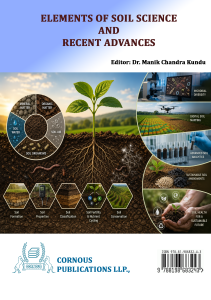
Editorial Book
Book Title: Elements of Soil Science and Recent Advances
OPEN ACCESS | Published on : 06-Jan-2026 | Pages: 89-106 | Doi : 10.37446/edibook222025/89-106
Biochar - Its Role in Enhancing Soil Health and Climate Change Mitigation
- Biplab .
- ICAR-Central Agroforestry Research Institute, Jhansi, Uttar Pradesh, India.
- Avinaba Maji
- Department of Agricultural Chemistry and Soil Science, Faculty of Agriculture, Bidhan Chandra Krishi Viswavidyalaya, Mohanpur, West Bengal, India.
- Sovan Debnath
- ICAR-Central Agroforestry Research Institute, Jhansi, Uttar Pradesh, India.
- Badre Alam
- ICAR-Central Agroforestry Research Institute, Jhansi, Uttar Pradesh, India.
- Asha Ram
- ICAR-Central Agroforestry Research Institute, Jhansi, Uttar Pradesh, India.
- Akash Yadav
- ICAR-Central Agroforestry Research Institute, Jhansi, Uttar Pradesh, India.
- Ayyanadar Arunachalam
- ICAR-Central Agroforestry Research Institute, Jhansi, Uttar Pradesh, India.
Abstract
Soil serves as a crucial foundation for effective agricultural practices, and enhancing its quality is essential to boost both crop yields and soil fertility. One effective method to achieve this is the application of biochar. Biochar is a carbon-dense material formed through the pyrolysis of crop residues, organic waste, or wood in low-oxygen conditions. It contributes significantly to carbon sequestration and offers benefits such as recycling agricultural waste, increasing soil nutrient retention and decreasing emissions of greenhouse gases. The diverse uses of biochar support the safe and sustainable enhancement of soil health and productivity. This chapter offers a comprehensive overview of biochar’s characteristics, its production processes, and its valuable contributions to agriculture. This serves as an informative tool for those studying or implementing biochar in agricultural practices.
Keywords
Biochar, pyrolysis, soil health, climate change
References
Beyer, L., Wachendorf, C., Elsner, D. C., & Knabe, R. (1993). Suitability of dehydrogenase activity assay as an index of soil biological activity. Biology and Fertility of Soils, 16(1), 52-56.
Bolan, N., Hoang, S. A., Beiyuan, J., Gupta, S., Hou, D., Karakoti, A., & Van Zwieten, L. (2022). Multifunctional applications of biochar beyond carbon storage. International Materials Reviews, 67(2), 150-200.
Bourke, J. (2007). Preparation and properties of natural, demineralized, pure, and doped carbons from biomass; Model of the chemical structure of carbonized charcoal (Doctoral dissertation, The University of Waikato).
Castellini, M., Giglio, L., Niedda, M., Palumbo, A. D., & Ventrella, D. (2015). Impact of biochar addition on the physical and hydraulic properties of a clay soil. Soil and Tillage Research, 154, 1-13.
El–Metwally, I., Geries, L., & Saudy, H. (2022). Interactive effect of soil mulching and irrigation regime on yield, irrigation water use efficiency and weeds of trickle–irrigated onion. Archives of Agronomy and Soil Science, 68(8), 1103-1116.
Gaskin, J. W., Speir, R. A., Harris, K., Das, K. C., Lee, R. D., Morris, L. A., & Fisher, D. S. (2010). Effect of peanut hull and pine chip biochar on soil nutrients, corn nutrient status, and yield. Agronomy Journal, 102(2), 623-633.
Glaser, B., Lehmann, J., & Zech, W. (2002). Ameliorating physical and chemical properties of highly weathered soils in the tropics with charcoal–a review. Biology and Fertility of Soils, 35(4), 219-230.
Graber ER, Meller Harel Y, Kolton M, Cytryn E, Silber A, Rav David D, Tsechansky L, Borenshtein M, & Elad Y. (2010). Biochar impact on development and productivity of pepper and tomato grown in fertigated soilless media. Plant and Soil, 337(1), 481–496.
Hale, L., Luth, M., & Crowley, D. (2015). Biochar characteristics relate to its utility as an alternative soil inoculum carrier to peat and vermiculite. Soil Biology and Biochemistry, 81, 228-235.
Lehmann, J., & Rondon, M. (2006). Bio-char soil management on highly weathered soils in the humid tropics. Biological Approaches to Sustainable Soil Systems, 113(517), e530.
Lehmann, J., Cowie, A., Masiello, C. A., Kammann, C., Woolf, D., Amonette, J. E., & Whitman, T. (2021). Biochar in climate change mitigation. Nature Geoscience, 14(12), 883-892.
Lehmann, J., Pereira da Silva Jr, J., Steiner, C., Nehls, T., Zech, W., & Glaser, B. (2003). Nutrient availability and leaching in an archaeological Anthrosol and a Ferralsol of the Central Amazon basin: fertilizer, manure and charcoal amendments. Plant and Soil, 249(2), 343-357.
Lehmann, J., Rillig, M. C., Thies, J., Masiello, C. A., Hockaday, W. C., & Crowley, D. (2011). Biochar effects on soil biota–a review. Soil Biology and Biochemistry, 43(9), 1812-1836.
Malghani, S., Gleixner, G., & Trumbore, S. E. (2013). Chars produced by slow pyrolysis and hydrothermal carbonization vary in carbon sequestration potential and greenhouse gases emissions. Soil Biology and Biochemistry, 62, 137-146.
Obia, A., Mulder, J., Martinsen, V., Cornelissen, G., & Børresen, T. (2016). In situ effects of biochar on aggregation, water retention and porosity in light-textured tropical soils. Soil and Tillage Research, 155, 35-44.
Painter, T. J. (2001). Carbohydrate polymers in food preservation: an integrated view of the Maillard reaction with special reference to the discoveries of preserved foods in Sphagnum dominated peat bogs. Carbohydrate Polymers, 36, 335–347.
Pandian, K., Subramaniayan, P., Gnasekaran, P., & Chitraputhirapillai, S. (2016). Effect of biochar amendment on soil physical, chemical and biological properties and groundnut yield in rainfed Alfisol of semi-arid tropics. Archives of Agronomy and Soil Science, 62(9), 1293-1310.
Peters, G. P., Davis, S. J., & Andrew, R. (2012). A synthesis of carbon in international trade. Biogeosciences, 9(8), 3247-3276.
Properties, M., Amonette, J. E., & Joseph, S. (2009). Characteristics of Biochar. Biochar for Environmental Management: Science and Technology, 33.
Salem, E. M., Kenawey, K. M., Saudy, H. S., & Mubarak, M. (2021). Soil mulching and deficit irrigation effect on sustainability of nutrients availability and uptake, and productivity of maize grown in calcareous soils. Communications in Soil Science and Plant Analysis, 52(15), 1745-1761.
Srinivasarao, C., Venkateswarlu, B., Lal, R., Singh, A. K., & Kundu, S. (2013). Sustainable management of soils of dryland ecosystems for enhancing agronomic productivity and sequestering carbon. Advances in Agronomy, 121, 254–329.
Ulusal, A., Apaydın Varol, E., Bruckman, V. J., & Uzun, B. B. (2021). Opportunity for sustainable biomass valorization to produce biochar for improving soil characteristics. Biomass Conversion and Biorefinery, 11(3), 1041-1051.
Uzoma, K. C., Inoue, M., Andry, H., Fujimaki, H., Zahoor, A., & Nishihara, E. (2011). Effect of cow manure biochar on maize productivity under sandy soil condition. Soil Use and Management, 27, 205–212.
Wang, X., Song, D., Liang, G., Zhang, Q., Ai, C., & Zhou, W. (2015). Maize biochar addition rate influences soil enzyme activity and microbial community composition in a fluvo-aquic soil. Applied Soil Ecology, 96, 265-272.
Xu, N., Tan, G., Wang, H., & Gai, X. (2016). Effect of biochar additions to soil on nitrogen leaching, microbial biomass and bacterial community structure. European Journal of Soil Biology, 74, 1-8.
Yadav, S. P. S., Bhandari, S., Bhatta, D., Poudel, A., Bhattarai, S., Yadav, P., ... & Oli, B. (2023). Biochar application: A sustainable approach to improve soil health. Journal of Agriculture and Food Research, 11, 100498.
Indexing In




Types of Books We Publish




Uniqueness of our Publication

DOI Assignment

ISBN Registration

Online Publication

High Visibility

Open & Closed Access
DOI Assignment
ISBN Registration
Online Publication
High Visibility