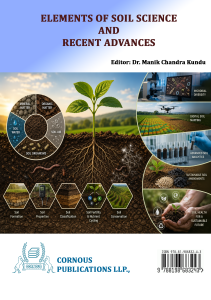
Editorial Book
Book Title: Elements of Soil Science and Recent Advances
PAID ACCESS | Published on : 06-Jan-2026 | Pages: 58-70 | Doi : 10.37446/edibook222025/58-70
Soil Salinity and Alkalinity - Causes, Impacts and Management strategies
- Haripada Mondal
- Department of Agriculture Chemistry and Soil Science, Bidhan Chandra Krishi Viswavidyalaya, Mohanpur, Nadia, West Bengal, India.
- Manik Chandra Kundu
- Department of Soil Science and Agricultural Chemistry, Palli Shiksha Bhavana (Institute of Agriculture), Visva-Bharati, Sriniketan, West Bengal, India.
Abstract
Soil salinity and alkalinity are major factors limiting agriculture's potential to provide food, especially in areas with dry and semi-dry climates. These conditions result mainly from activities of humans and nature that increase the levels of soluble salts and sodium in the soil. The chapter describes in detail what salt-affected soils are, explaining the different types of such soils, namely saline, sodic, saline-sodic, and degraded alkali, based on their differences. In addition to natural causes such as source rock and precipitation, it recognizes human causes like insufficient irrigation and deforestation. The adverse effects on soil structure, nutrient availability, and microbial activity are explained, with examples of how salinity and sodicity prevent plants from growing by causing osmotic stress and ion toxicity. Diagnostic indices like Electrical Conductivity (EC) and Sodium Adsorption Ratio (SAR) are mentioned for measurement. The management of these problems entails using different methods, viz., physical, chemical, and biological, which primarily aim at implementing sustainable practices, such as crop rotation and the use of salt-tolerant species, in order to rehabilitate the soil efficiently. The use of integrated management is crucial to achieving long-term solutions.
Keywords
Salt-affected soils, characteristics, formation, reclamation, sustainable management
References
Agassi, M., Shainberg, I., & Morin, J. (1981). Effect of electrolyte concentration and soil sodicity on infiltration rate and crust formation. Soil Science Society of America Journal, 45(5), 848–851.
Arle, J., & Wagner, F. (2013). Effects of anthropogenic salinisation on the ecological status of macroinvertebrate assemblages in the Werra River (Thuringia, Germany). Hydrobiologia, 701(1), 129–148.
Arora, S., & Vanza, M. (2017). Microbial approach for bioremediation of saline and sodic soils. In Bioremediation of salt affected soils: An Indian perspective (pp. 87–100). Springer International Publishing.
Atta, K., Mondal, S., Gorai, S., Singh, A. P., Kumari, A., Ghosh, T., Roy, A., Hembram, S., Gaikwad, G. J., Mondal, S., Bhattacharya, S., Jha, U. C., & Jespersen, D. (2023). Impacts of salinity stress on crop plants: Improving salt tolerance through genetic and molecular dissection. Frontiers in Plant Science, 14, 1241736.
Balasubramaniam, T., Shen, G., Esmaeili, N., & Zhang, H. (2023). Plants’ response mechanisms to salinity stress. Plants, 12(12), 2253.
Baliuk, S. A., Romashchenko, M. I., & Stashuk, V. A. (Eds.). (2013). A complex of anti-degradation measures on irrigated lands of Ukraine. Agrarian Science.
Bezborodov, G. A., Shadmanov, D. K., Mirhashimov, R. T., Yuldashev, T., Qureshi, A. S., Noble, A. D., & Qadir, M. (2010). Mulching and water quality effects on soil salinity and sodicity dynamics and cotton productivity in Central Asia. Agriculture, Ecosystems & Environment, 138(1–2), 95–102.
Cary, J. W., & Evans, D. D. (1974). Soil crusts (Technical Bulletin No. 214). University of Arizona.
Chatterjee, N., Nair, P. R., Chakraborty, S., & Nair, V. D. (2018). Changes in soil carbon stocks across the forest–agroforest–agriculture/pasture continuum: A meta-analysis. Agriculture, Ecosystems & Environment, 266, 55–67.
Chatterjee, S., Sahu, B., & Barman, M. (2019). Response of major plant nutrients to salt-affected environment. International Journal of Current Microbiology and Applied Sciences, 8(12), 1244–1253.
Choudhary, O. P., & Kharche, V. K. (2018). Soil salinity and sodicity. In Soil science: An introduction (pp. 353–384).
Corwin, D. L. (2021). Climate change impacts on soil salinity in agricultural areas. European Journal of Soil Science, 72, 842–862.
de la Reguera, E., Veatch, J., Gedan, K., & Tully, K. L. (2020). The effects of saltwater intrusion on germination success of standard and alternative crops. Environmental and Experimental Botany, 180, 104254.
Ding, Y., & Mao, X. Y. (2017). Global soda ash market analysis report (2011–2016). Shandong Chemical Industry, 46, 128–130.
Egamberdieva, D., Wirth, S., Bellingrath-Kimura, S. D., Mishra, J., & Arora, N. K. (2019). Salt-tolerant plant growth-promoting rhizobacteria for enhancing crop productivity of saline soils. Frontiers in Microbiology, 10, 2791.
El-Swaify, S. A. (2000). Soil and water salinity. In Plant nutrient management in Hawaii’s soils (pp. 151–158).
Endo, A., & Kang, D. J. (2015). Salt removal from salt-damaged agricultural land using scraping method combined with natural rainfall. Geoderma Regional, 4, 66–72.
FAO. (2021). Global map of salt-affected soils (GSASmap) v1.0. FAO, Rome.
FAO. (2024). Global status of salt-affected soils: Main report. FAO, Rome. https://doi.org/10.4060/cd3044en
Francois, L. E., & Maas, E. V. (1994). Crop response and management. In Handbook of plant and crop stress (pp. 149–159).
Gorji, T., Yildirim, A., Hamzehpour, N., Tanik, A., & Sertel, E. (2020). Soil salinity analysis using Landsat-8 and Sentinel-2A. Ecological Indicators, 112, 106173.
Hatton, T. J., Ruprecht, J., & George, R. J. (2003). Preclearing hydrology of the Western Australia wheatbelt. Plant and Soil, 257(2), 341–356.
Kumar, P., & Sharma, P. K. (2020). Soil salinity and food security in India. Frontiers in Sustainable Food Systems, 4, 533781.
Lakhdar, A., Scelza, R., Scotti, R., Rao, M. A., Jedidi, N., Gianfreda, L., & Abdelly, C. (2010). Effect of compost and sewage sludge on soil biological activities in salt-affected soil. Revista de la Ciencia del Suelo y Nutrición Vegetal, 10(1), 40–47.
Minhas, P. S., & Tyagi, N. K. (1998). Guidelines for irrigation with saline and alkali waters. CSSRI.
Oster, J. D., & Jayawardane, N. S. (1998). Agricultural management of sodic soils. In Sodic soils: Distribution, properties, management, and environmental consequences (pp. 125–147).
Rengasamy, P., & Olsson, K. A. (1991). Sodicity and soil structure. Australian Journal of Soil Research, 29(6), 935–952.
Richards, L. A. (1954). Diagnosis and improvement of saline and alkali soils (Agricultural Handbook No. 60). USDA.
Stavi, I., Thevs, N., & Priori, S. (2021). Soil salinity and sodicity in drylands. Frontiers in Environmental Science, 9, 712831.
Szabolcs, I. (1989). Salt-affected soils. CRC Press.
Zhang, K., Shi, Y., Cui, X., Yue, P., Li, K., Liu, X., Tripathi, B. M., & Chu, H. (2019). Salinity as a determinant of soil microbial communities. mSystems, 4(1), e00220-18.
Zhang, X., Zuo, Y., Wang, T., & Han, Q. (2024). Salinity effects on soil structure and hydraulic properties. Land, 13(12), 2077.
Zhao, X., Gao, J., Yu, X., et al. (2024). Evaluation of microbial communities in saline-alkaline soils. Scientific Reports, 14, 28931.
Indexing In




Types of Books We Publish




Uniqueness of our Publication

DOI Assignment

ISBN Registration

Online Publication

High Visibility

Open & Closed Access
DOI Assignment
ISBN Registration
Online Publication
High Visibility