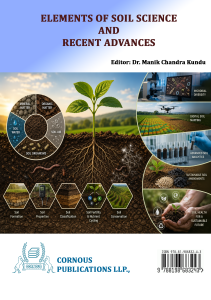
Editorial Book
Book Title: Elements of Soil Science and Recent Advances
PAID ACCESS | Published on : 01-Apr-2026 | Pages: 145-154 | Doi : 10.37446/edibook222025/145-154
Invisible contaminants, visible impact - soil health under microplastic stress
- Krishanu Pal
- Faculty of Agriculture, JIS University, Agarpara, Kolkata, West Bengal, India.
- Deblina Ghosh
- Faculty of Agriculture, JIS University, Agarpara, Kolkata, West Bengal, India.
- Suparna Sarkar
- Faculty of Agriculture, JIS University, Agarpara, Kolkata, West Bengal, India.
- Devayan Chatterjee
- Faculty of Agriculture, JIS University, Agarpara, Kolkata, West Bengal, India.
Abstract
The increasing production and widespread use of plastics have led to the accumulation of microplastics (MPs) in terrestrial ecosystems, particularly in agricultural soils. Agricultural land has recently been recognized as a major sink for microplastics due to the extensive use of plastic materials such as mulch films, irrigation systems, polymer-coated fertilizers, and the application of sewage sludge, biosolids, and wastewater irrigation. The presence of microplastics in soil has raised growing environmental concerns because of their potential impacts on soil health, ecosystem functioning, and agricultural sustainability. This chapter reviews the major sources and pathways of microplastic contamination in agricultural soils and examines their migration and distribution within soil systems. It further evaluates the effects of microplastics on soil physical, chemical, and biological properties. Microplastics can alter soil structure, bulk density, pore distribution, water-holding capacity, and hydraulic conductivity. Chemically, they influence soil pH, nutrient availability, and the sorption behavior of contaminants through mechanisms such as hydrophobic and electrostatic interactions. Biologically, microplastics may affect plant growth, root morphology, microbial communities, and symbiotic interactions such as arbuscular mycorrhizal fungi colonization. In addition, soil fauna including earthworms, nematodes, and other invertebrates may ingest microplastics, leading to physiological stress, reduced growth, and impaired reproduction. Microplastics may also accumulate in plant tissues and potentially enter the food chain, posing risks to food safety and ecosystem stability. Overall, the growing presence of microplastics in agricultural soils represents a significant threat to soil quality and sustainable crop production. Continued monitoring, improved waste management practices, and further research are necessary to better understand the long-term ecological consequences of microplastic pollution and to develop effective mitigation strategies for protecting soil ecosystems.
Keywords
Microplastic, soil health, soil ecosystem, soil contamination, migration, sources
References
Andrady, A. L. (2011). Microplastics in the marine environment. Marine Pollution Bulletin, 62, 1596–1605. https://doi.org/10.1016/j.marpolbul.2011.05.030
Allison, S. D., & Jastrow, J. D. (2006). Activities of extracellular enzymes in physically isolated fractions of restored grassland soils. Soil Biology and Biochemistry, 38, 3245–3256. https://doi.org/ 10.1016/j.soilbio.2006.04.011
Belzagui, F., Crespi, M., Álvarez, A., Gutiérrez-Bouzán, C., & Vilaseca, M. (2019). Microplastics’ emissions: Microfibers’ detachment from textile garments. Environmental Pollution, 248, 1028– 1035. https://doi.org/10.1016/j.envpol.2019.02.059
Bosker, T., Bouwman, L. J., Brun, N. R., Behrens, P., & Vijver, M. G. (2019). Microplastics accumulate on pores in seed capsule and delay germination and root growth of the terrestrial vascular plant Lepidium sativum. Chemosphere, 226, 774–781. https://doi.org/10.1016/ j.chemosphere.2019.03.163
Cao, D., Xiao, W., Luo, X., Liu, G., & Zheng, H. (2017). Effects of polystyrene microplastics on the fitness of earthworms in an agricultural soil. IOP Conference Series: Earth and Environmental Science, 61, 012148.
https://doi.org/10.1088/1755-1315/61/1/012148
Cole, M., Lindeque, P., Fileman, E., Halsband, C., Goodhead, R., Moger, J., & Galloway, T. S. (2013). Microplastic ingestion by zooplankton. Environmental Science & Technology, 47, 6646– 6655. https://doi.org/10.1021/es400663f
Cózar, Z., Echevarría, F., González-Gordillo, J. I., Irigoien, X., Ubeda, B., Hernández-León, S., Palma, Á. T., Navarro, S., García-de-Lomas, J., Ruiz, A., Fernández-de-Puelles, M. L., & Duarte, C. (2014). Plastic debris in the open ocean. Proceedings of the National Academy of Sciences, 111, 10239–10244. https://doi.org/10.1073/pnas.1314705111
De Souza Machado, A. A., Lau, C. W., Kloas, W., Bergmann, J., Bachelier, J. B., Faltin, E., Becker, R., Görlich, A. S., & Rillig, M. C. (2019). Microplastics can change soil properties and affect plant performance. Environmental Science & Technology, 53, 6044–6052. https://doi.org/10.1021/ acs.est.9b01339
Geyer, R., Jambeck, J. R., & Law, K. L. (2017). Production, use, and fate of all plastics ever made. Science Advances, 3, e1700782. https://doi.org/10.1126/sciadv.1700782
Groh, K. J., Backhaus, T., Carney-Almroth, B., Geueke, B., Inostroza, P. A., Lennquist, A., & Muncke, J. (2019). Overview of known plastic packaging-associated chemicals and their hazards. Science of the total environment, 651, 3253-3268.
Hahladakis, J. N., Velis, C. A., Weber, R., Iacovidou, E., & Purnell, P. (2018). An overview of chemical additives present in plastics: Migration, release, fate and environmental impact during their use, disposal and recycling. Journal of Hazardous Materials, 344, 179–199. https://doi.org/ 10.1016/j.jhazmat.2017.10.014
Hahladakis, J. N., & Iacovidou, E. (2018b). Closing the loop on plastic packaging materials: What is quality and how does it affect their circularity? Science of the Total Environment, 630, 1394–1400. https://doi.org/10.1016/j.scitotenv.2018.02.330
Hartline, N. L., Bruce, N. J., Karba, S. N., Ruff, E. O., Sonar, S. U., & Holden, P. A. (2016). Microfiber masses recovered from conventional machine washing of new or aged garments. Environmental science & technology, 50(21), 11532-11538.
Hays, H., & Cormons, G. (1974). Plastic particles found in tern pellets, on coastal beaches and at factory sites. Marine Pollution Bulletin, 5, 44–46. https://doi.org/10.1016/0025-326X(74)90234-3
Huang, Y., Zhao, Y., Wang, J., Zhang, M., Jia, W., & Qin, X. (2019). LDPE microplastic films alter microbial community composition and enzymatic activities in soil. Environmental Pollution, 254, 112983.
Huerta Lwanga, E., Vega, J. M., Quej, V. K., Chi, J. D. L. A., Cid, L. S. D., Chi, C., Segura, G. E., Gertsen, H., Salánki, T., van der Ploeg, M., Koelmans, A. A., & Geissen, V. (2017). Field evidence for transfer of plastic debris along a terrestrial food chain. Scientific Reports, 7, 1–7. https:// doi.org/10.1038/s41598-017-14588-2
Ingraffia, R., Amato, G., Iovino, M., Rillig, M. C., Giambalvo, D., & Frenda, A. S. (2022). Polyester microplastic fibers in soil increase nitrogen loss via leaching and decrease plant biomass production and N uptake.
Environmental Research Letters, 17(5), 054012.
Jambeck, J. R., Geyer, R., Wilcox, C., Siegler, T. R., Perryman, M., Andrady, A., Narayan, R., & Law, K. L. (2015). Plastic waste inputs from land into the ocean. Science, 347, 768–771. https:// doi.org/10.1126/science.1260352
Judy, J. D., Williams, M., Gregg, A., Oliver, D., Kumar, A., Kookana, R., & Kirby, J. K. (2019). Microplastics in municipal mixed-waste organic outputs induce minimal short- to long-term toxicity in key terrestrial biota. Environmental Pollution, 252, 522–531. https://doi.org/10.1016/ j.envpol.2019.05.027
Kole, P. J., Löhr, A. J., Van Belleghem, F., & Ragas, A. (2017). Wear and tear of tyres: A stealthy source of microplastics in the environment. International Journal of Environmental Research and Public Health, 14(10), 1265. https://doi.org/10.3390/ijerph14101265
Liu, H., Yang, X., Liu, G., Liang, C., Xue, S., Chen, H., Ritsema, C. J., & Geissen, V. (2017). Response of soil dissolved organic matter to microplastic addition in Chinese loess soil. Chemosphere, 185, 907–917. https://doi.org/10.1016/j.chemosphere.2017.07.064
Maaß, S., Daphi, D., Lehmann, A., & Rillig, M. C. (2017). Transport of microplastics by two collembolan species. Environmental Pollution, 225, 456-459.
Panebianco, A., Nalbone, L., Giarratana, F., & Ziino, G. (2019). First discoveries of microplastics in terrestrial snails. Food Control, 106, 106722. https://doi.org/10.1016/j.foodcont.2019.106722
Plastics Europe (2017) Plastics the facts 2017. Available at: https://plasticseurope.org/wp-content/uploads/2021/10/2017-Plastics-the-facts.pdf. Accessed on 9th March 2026.
Rillig, M. C., Abel, D. S. M. A., Lehmann, A., & Klümper, U. (2018). Evolutionary implications of microplastics for soil biota. Environmental Chemistry. https://doi.org/10.1071/EN18118
Salmon, S., & Ponge, J. F. (2001). Earthworm excreta attract soil springtails: laboratory experiments on Heteromurus nitidus (Collembola: Entomobryidae). Soil Biology and Biochemistry, 33(14), 1959-1969.
Song, Y, Cao, C., Qiu, R., Hu, J., Liu, M., Lu, S., Shi, H. H., Raley-Susman, K. M., & He, D. (2019). Uptake and adverse effects of polyethylene terephthalate microplastic fibers on terrestrial snails (Achatina fulica) after soil exposure. Environmental Pollution, 250, 447–455. https://doi.org/ 10.1016/j.envpol.2019.04.066
Sutherland, W. J., Clout, M., Isabelle, M., Daszak, P., Depledge, M. H., Fellman, L., Fleishman, E., Garthwaite, R., Gibbons, D. W., De Lurio, J., Impey, A. J., Lickorish, F., Lindenmayer, D., Madgwick, J., Margerison, C., Maynard, T., Peck, L. S., Pretty, J., Prior, S., Redford, K. H., Scharlemann, J. P. W., Spalding, M., & Watkinson, A. R. (2010). A horizon scan of global conservation issues for 2010. Trends in Ecology & Evolution, 25(1), 1–7. https://doi.org/10.1016/ j.tree.2009.10.003
Trasar-Cepeda, C., Leirós, M. C., Seoane, S., & Gil-Sotres, F. (2008). Biochemical properties of soils under crop rotation. Applied Soil Ecology, 39(2), 133-143.
UNEP (2015) Guidance on Organizational Life Cycle Assessment. Life-Cycle Initiative, United Nations Environment Programme and Society for Environmental Toxicology and Chemistry, Paris, France, http://www.lifecycleinitiative.org/wp-content/uploads/2015/04/o-lca_24.4.15-web.pdf
Wang, J., Liu, X., Li, Y., Powell, T., Wang, X., Wang, G., & Zhang, P. (2019). Microplastics as contaminants in the soil environment: A mini-review. Science of the Total Environment, 691, 848– 859. https://doi.org/10.1016/j.scitotenv.2019.07.209
Zhu, D., Bi, Q. F., Xiang, Q., Chen, Q. L., Christie, P., Ke, X., Wu, L. H., & Zhu, Y. G. (2017). Trophic predator–prey relationships promote transport of microplastic compared with the single Hypoaspis aculeifer and Folsomia candida. Environmental Pollution, 235, 150–154. https://doi.org/ 10.1016/j.envpol.2017.12.058.
Indexing In




Types of Books We Publish



Uniqueness of our Publication

DOI Assignment

ISBN Registration

Online Publication

High Visibility

Open & Closed Access
DOI Assignment
ISBN Registration
Online Publication
High Visibility