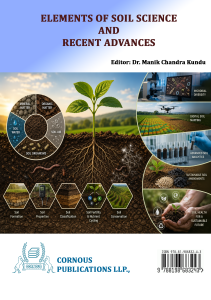
Editorial Book
Book Title: Elements of Soil Science and Recent Advances
PAID ACCESS | Published on : 06-Jan-2026 | Pages: 41-57 | Doi : 10.37446/edibook222025 /41-57
Chemistry of Micronutrients in Soil and their Application Protocol
- Susmit Saha
- Department of Agricultural Chemistry and Soil Science, College of Agriculture, Bidhan Chandra Krishi Viswavidyalaya Bardhaman Sadar, West Bengal, India.
- Manik Chandra Kundu
- Department of Soil Science and Agricultural Chemistry, Palli Siksha Bhavana (Institute of Agriculture), Visva-Bharati, Sriniketan, West Bengal, India.
Abstract
Micronutrients, which are vital for plant growth and health, need to be supplied in trace quantities, and deficiency can impact significantly on crop yield and quality. This chapter describes the chemistry of essential micronutrients - iron (Fe), zinc (Zn), copper (Cu), manganese (Mn), boron (B), molybdenum (Mo), chlorine (Cl), and nickel (Ni) - in terms of their necessity, functions, source, and forms present in the soil. It describes the dynamic soil processes like oxidation-reduction reactions, precipitation-dissolution equilibria, and adsorption-desorption along with soil properties like pH, redox potential, cation exchange capacity, and organic carbon, regarding the solubility and accessibility of micronutrients. Emphasis is also given on the practical management of micronutrients regarding application protocols for both soil and foliar applications. This includes selecting the source, determining the recommended amount, and detecting the symptoms of toxicity and deficiency of several micronutrients in plants. This chapter will be an essential resource for researchers and decision-makers seeking to enhance the advantages of micronutrients in fostering soil fertility and agricultural sustainability.
Keywords
Micronutrients chemistry, soil properties, deficiency, toxicity, nutrient management
References
Baietto, M., & Wilson, A. D. (2015). Electronic-nose applications for fruit identification, ripeness and quality grading. Sensors, 15(1), 899–931.
Bakumenko, A., Bakhchevnikov, V., Derkachev, V., Kovalev, A., Lobach, V., & Potipak, M. (2021). Remote sensing of agricultural crops seeds for size determination within radar technology. SPIE Future Sensing Technologies 2021, 11914, 341–352.
Boelt, B., Shrestha, S., Salimi, Z., Jørgensen, J. R., Nicolaisen, M., & Carstensen, J. M. (2018). Multispectral imaging–a new tool in seed quality assessment? Seed Science Research, 28(3), 222–228.
Bradford, K. J., & Bewley, J. D. (2002). Seeds: Biology, technology and role in agriculture. In Plants, Genes and Crop Biotechnology, 2nd Ed. (pp. 210–239). Jones and Bartlett.
Cseresnyés, I., Rajkai, K., Takács, T., & Vozáry, E. (2018). Electrical impedance phase angle as an indicator of plant root stress. Biosystems Engineering, 169, 226–232.
ElMasry, G., Mandour, N., Al-Rejaie, S., Belin, E., & Rousseau, D. (2019a). Recent applications of multispectral imaging in seed phenotyping and quality monitoring - An overview. Sensors, 19(5), 1090.
Gancarz, M., Wawrzyniak, J., Gawrysiak-Witulska, M., Wiącek, D., Nawrocka, A., Tadla, M., & Rusinek, R. (2017). Application of electronic nose with MOS sensors to prediction of rapeseed quality. Measurement, 103, 227–234.
Gough, R. E. (2020). Seed quality: Basic mechanisms and agricultural implications. CRC Press.
Griffo, A., Sehmisch, S., Laager, F., Pagano, A., Balestrazzi, A., Macovei, A., & Börner, A. (2024). Non-invasive methods to assess seed quality based on ultra-weak photon emission and delayed luminescence. Scientific Reports, 14(1), 26838.
Hamed, K. Ben, Zorrig, W., & Hamzaoui, A. H. (2016). Electrical impedance spectroscopy: A tool to investigate the responses of one halophyte to different growth and stress conditions. Computers and Electronics in Agriculture, 123, 376–383.
Harshitha, S. N., & Sandal, S. S. (2022). DNA fingerprinting and its applications in crop improvement: A review. The Pharma Innovation Journal, 11(5), 792–797.
Hemender, S. S., Mor, V. S., & Bhuker, A. (2018). Image analysis: a modern approach to seed quality testing. Current Journal of Applied Science and Technology, 27(1), 1–11.
Jia, Z., Sun, M., Ou, C., Sun, S., Mao, C., Hong, L., Wang, J., Li, M., Jia, S., & Mao, P. (2022). Single seed identification in three Medicago species via multispectral imaging combined with stacking ensemble learning. Sensors, 22(19), 7521.
Kazmi, R. H., Ligterink, W., & Hilhorst, H. W. M. (2013). General discussion; creating system-level models of tomato seed quality. In Genes for Seed Quality (p. 201).
Korir, N. K., Han, J., Shangguan, L., Wang, C., Kayesh, E., Zhang, Y., & Fang, J. (2013). Plant variety and cultivar identification: Advances and prospects. Critical Reviews in Biotechnology, 33(2), 111–125.
Li, L., Zhang, Q., & Huang, D. (2014). A review of imaging techniques for plant phenotyping. Sensors, 14(11), 20078–20111.
Liang, S., & Wang, J. (2019). Advanced remote sensing: Terrestrial information extraction and applications. Academic Press.
Lister, R. M. (1978). Application of the enzyme-linked immunosorbent assay for detecting viruses in soybean seed and plants. Phytopathology, 68(139), 10–1094.
McDonald, M. B. (1998). Seed quality assessment. Seed Science Research, 8(2), 265–276.
Medeiros, A. D. de, Silva, L. J. da, Ribeiro, J. P. O., Ferreira, K. C., Rosas, J. T. F., Santos, A. A., & Silva, C. B. da. (2020). Machine learning for seed quality classification: An advanced approach using merger data from FT-NIR spectroscopy and X-ray imaging. Sensors, 20(15), 4319.
Nambara, E., & Nonogaki, H. (2012). Seed biology in the 21st century: Perspectives and new directions. Plant and Cell Physiology, 53(1), 1–4.
Powell, A. A. (2017). A review of the principles and use of the Q2 Seed Analyser. International Seed Testing Association.
Ren, T., Liu, Z., Zhang, L., Liu, D., Xi, X., Kang, Y., Zhao, Y., Zhang, C., Li, S., & Zhang, X. (2020). Early identification of seed maize and common maize production fields using sentinel-2 images. Remote Sensing, 12(13), 2140.
S., V., Sandra, N., Ravishankar, K. V., & Chidambara, B. (2023). Molecular techniques for testing genetic purity and seed health. In M. Dadlani & D. K. Yadava (Eds.), Seed science and technology (Chapter 15, pp. 365–389). Springer, Singapore.
Satturu, V., Rani, D., Gattu, S., Md, J., Mulinti, S., Nagireddy, R. K., Eruvuri, R., & Yanda, R. (2018). DNA fingerprinting for identification of rice varieties and seed genetic purity assessment. Agricultural Research, 7(4), 379–390.
Singh, S. K., Jha, R., Pandey, S., Mohan, C., Ghosh, S., Singh, S. K., Kumari, S., & Singh, A. (2025). Artificial intelligence-based tools for next-generation seed quality analysis. Crop Design, 100094.
Staerz, A., Roeck, F., Weimar, U., & Barsan, N. (2020). Electronic nose: Current status and future trends. In Surface and Interface Science: Volume 9: Applications of Surface Science I (Vol. 9, pp. 335–379).
Vasile, V., Ciucă, M., VOAIDEȘ, C., & Cornea, C. P. (2020). DNA-based methods used for varietal purity detection in wheat cultivars. Agro Life Scientific Journal, 9(1).
Verma, L. K., Bahadur, V., & Samiksha. (2023). DNA fingerprinting and its applications in crop improvement (Training Manual, p. 65).
Vozáry, E., Paine, D. H., Kwiatkowski, J., & Taylor, A. G. (2007). Prediction of soybean and snap bean seed germinability by electrical impedance spectroscopy. Seed Science and Technology, 35(1), 48–64.
Wang, F., Tian, H., Yi, H., Zhao, H., Huo, Y., & Kueng, M. (2019). Principle and strategy of DNA fingerprint for identification of plant variety. Molecular Plant Breeding.
Wilkes, T., Nixon, G., Bushell, C., Waltho, A., Alroichdi, A., & Burns, M. (2016). Feasibility study for applying spectral imaging for wheat grain authenticity testing in pasta. Food and Nutrition Sciences, 7(05), 355.
Xu, J., Liu, K., & Zhang, C. (2021). Electronic nose for volatile organic compounds analysis in rice aging. Trends in Food Science & Technology, 109, 83–93.
Yadav, M. P. (2024). Latest seed testing equipments used in seed testing and their maintenance (Training Manual, p. 65).
Zhang, Y. P., Tan, H. H., Cao, S. Y., Wang, X. C., Yang, G., & Fung, J. G. (2012). A novel strategy for identification of 47 pomegranate (Punica granatum) cultivars using RAPD markers. Genetics and Molecular Research, 11, 3032–3041.
Indexing In




Types of Books We Publish




Uniqueness of our Publication

DOI Assignment

ISBN Registration

Online Publication

High Visibility

Open & Closed Access
DOI Assignment
ISBN Registration
Online Publication
High Visibility