Editorial Book
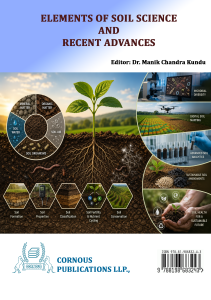
Book Title: Elements of Soil Science and Recent Advances
PAID ACCESS | Published on : 06-Jan-2026 | Pages: 71-88 | Doi : 10.37446/edibook222025/71-88
Soil Quality - Its Assessment and Management
- Sagardeep Sinha
- Department of Soil Science and Agricultural Chemistry, Uttar Banga Krishi Viswavidyalaya, Pundibari, Cooch Behar, West Bengal, India.
- Sushovan Paul
- Department of Soil Science and Agricultural Chemistry, Uttar Banga Krishi Viswavidyalaya, Pundibari, Cooch Behar, West Bengal, India.
- Mandira Saha
- Department of Soil Science and Agricultural Chemistry, Uttar Banga Krishi Viswavidyalaya, Pundibari, Cooch Behar, West Bengal, India.
- Srijayee Hazra
- Department of Soil Science and Agricultural Chemistry, Uttar Banga Krishi Viswavidyalaya, Pundibari, Cooch Behar, West Bengal, India.
- Samima Akhtar
- Department of Soil Science and Agricultural Chemistry, Uttar Banga Krishi Viswavidyalaya, Pundibari, Cooch Behar, West Bengal, India.
- Anusha P
- Department of Soil science and agricultural chemistry, Professor Jayashankar Telangana Agricultural university (PJTAU), Hyderabad, India.
Abstract
Soil quality underpins sustainable agriculture, environmental stewardship, and ecosystem resilience. This chapter outlines core definitions and the evolution of soil quality assessment, emphasizing the transition from a primary focus on productivity and fertility to a multidimensional approach incorporating physical, chemical, and biological indicators. The Soil Quality Index (SQI) is introduced as an integrated tool, enabling objective aggregation of key soil attributes using data-driven and expert methods. Methods for assessing physical, chemical, and biological properties including conventional laboratory tests, near-infrared spectroscopy, and remote sensing are discussed, illustrating advances in monitoring soil condition at scale. Critical factors influencing soil quality, such as intrinsic soil parameters, management practices, and climate change impacts, are analyzed for their effects on structure, nutrient cycling, carbon dynamics, and degradation risk. The chapter highlights the essential roles of soil microorganisms in nutrient mineralization, structural stability, and bioremediation, alongside climate change’s implications for organic matter retention and ecosystem services. Current policy frameworks for soil quality monitoring are evaluated, with emphasis on linking robust assessment tools to governance strategies supporting land management and climate resilience. The synthesis offers pragmatic guidance for advancing soil quality monitoring, ensuring long-term productivity and environmental health.
Keywords
Soil quality, soil quality index, nutrient cycling, climate resilience, soil microorganism
References
Abrahams, P. W. (2002). Soils: Their implications to human health. Science of the Total Environment, 291(1–3), 1–32.
Abshiba, K., Sharma, V. K., Kumar, P., Syam, S., Barnwal, P. P., & Kumar, S. (2025). A comprehensive review of soil quality indicators under diverse land uses in rainfed areas. Discover Soil, 2(1), 1–27.
Ahukaemere, C. M., Akamigbo, F. O. R., & Onweremadu, E. U. (2013). Soil color and organic matter content as indicators of soil quality in False bedded Sandstones soils in Southeastern Nigeria. Nigerian Journal of Agriculture, Food and Environment, 9, 6–11.
Alexander, M. (1999). Biodegradation and bioremediation. Elsevier Science.
Anandakumar, S., Bakhoum, N., Chinnadurai, C., Malarkodi, M., Arulmozhiselvan, K., Karthikeyan, S., & Balachandar, D. (2022). Impact of long-term nutrient management on sequestration and dynamics of soil organic carbon in a semi-arid tropical Alfisol of India. Applied Soil Ecology, 177, 104549.
Andrews, S. S., Karlen, D. L., & Cambardella, C. A. (2004). The soil management assessment framework: A quantitative soil quality evaluation method. Soil Science Society of America Journal, 68(6), 1945–1962.
Andrews, S. S., Karlen, D. L., & Mitchell, J. P. (2002). A comparison of soil quality indexing methods for vegetable production systems in Northern California. Agriculture, Ecosystems & Environment, 90(1), 25–45.
Arshad, M., & Coen, G. (1992). Characterization of soil quality: Physical and chemical criteria. American Journal of Alternative Agriculture, 7, 25–31.
Bardgett, R. D., & Van der Putten, W. H. (2014). Belowground biodiversity and ecosystem functioning. Nature, 515(7528), 505–511.
Basak, N., Mandal, B., Rai, A. K., et al. (2021). Soil quality and productivity improvement: Indian story. Proceedings of the Indian National Science Academy, 87, 2–10.
Bayer Crop Science. (2021, September 25). No-till—A conservation tillage method. https://www.cropscience.bayer.us/articles/bayer/understanding-conservation-tillage-practices
Brejda, J. J., Karlen, D. L., Smith, J. L., & Allan, D. L. (2000). Identification of regional soil quality factors and indicators II: Northern Mississippi Loess Hills and Palouse Prairie. Soil Science Society of America Journal, 64, 2125–2135.
Brunner, A. C., Park, S. J., Ruecker, G. R., & Vlek, P. L. G. (2018). Erosion modelling approach to simulate the effect of land management options on soil loss by considering catenary soil development and farmer perception. Land Degradation & Development, 19, 623–631.
Bünemann, E. K., Bongiorno, G., Bai, Z., Creamer, R. E., De Deyn, G., de Goede, R., ... & Brussaard, L. (2018). Soil quality—A critical review. Soil Biology and Biochemistry, 120, 105–125.
Bünemann, E. K., Mäder, P., Wohlfahrt, J., Brussaard, L., Bongiorno, G., de Goede, R., ... & Caspari, T. (2016). Concepts and indicators of soil quality: A review. FiBL.
Busari, M. A., Kukal, S. S., Kaur, A., Bhatt, R., & Dulazi, A. A. (2015). Conservation tillage impacts on soil, crop and the environment. International Soil and Water Conservation Research, 3(2), 119–129.
Dey, A., Dwivedi, B. S., Bhattacharyya, R., Datta, S. P., Meena, M. C., Jat, R. K., ... & Singh, R. G. (2020). Effect of conservation agriculture on soil carbon sequestration and lability in rice–wheat systems. Soil Use and Management, 36(3), 429–438.
Doran, J. W., & Parkin, T. B. (1994). Defining and assessing soil quality. In J. W. Doran et al. (Eds.), Defining soil quality for a sustainable environment (pp. 3–21). SSSA.
Doran, J. W., & Zeiss, T. (2000). Soil health and sustainability: Managing the biotic component. Applied Soil Ecology,15(1),3–11.
Doran, J. W., & Parkin, T. B. (1997). Quantitative indicators of soil quality: A minimum data set. Methods for Assessing Soil Quality, 49, 25–37.
Doran, J. W., Sarrantonio, M., & Liebig, M. A. (1996). Soil health and sustainability. Advances in Agronomy, 56, 1–54.
Dowling, T., Summerell, G. K., & Walker, J. (2003). Soil wetness as an indicator of stream salinity: A landscape position index approach. Environmental Modelling & Software, 18, 587–593.
Fagodiya, R. K., Sharma, G., Verma, K., Singh, A., Singh, R., Sheoran, P., ... & Chaudhari, S. K. (2024). Fourteen years’ impact of crop establishment, tillage and residue management on carbon input and sequestration. European Journal of Agronomy, 161, 127324.
Fan, J., McConkey, B., Wang, H., & Janzen, H. (2015). Development of soil quality assessment framework using minimum data set and indices. Ecological Indicators, 48, 491–497.
Gentsch, N., Riechers, F. L., Boy, J., Schweneker, D., Feuerstein, U., Heuermann, D., & Guggenberger, G. (2024). Cover crops improve soil structure and carbon distribution in macroaggregates. Soil, 10(1), 139–150.
Giller, K. E. (2001). Nitrogen fixation in tropical cropping systems (2nd ed.). CABI.
Glick, B. R. (2012). Plant growth-promoting bacteria: Mechanisms and applications. Scientifica, Article 963401.
Haney, R. L., Haney, E. B., Smith, D. R., Harmel, R. D., & White, M. J. (2018). The soil health tool—Theory and application. Applied Soil Ecology, 125, 162–168.
Harman, G. E., Howell, C. R., Viterbo, A., Chet, I., & Lorito, M. (2004). Trichoderma species—Opportunistic, avirulent plant symbionts. Nature Reviews Microbiology, 2(1), 43–56.
Islam, K., Singh, B., & McBratney, A. (2020). Simultaneous estimation of soil properties by VIS–NIR spectroscopy. Geoderma, 365, 114230.
Jastrow, J. D., Boutton, T. W., & Miller, R. M. (1998). Carbon accumulation in semi-arid grasslands. Soil Biology and Biochemistry, 30(2), 221–228.
Karlen, D. L., Andrews, S. S., & Doran, J. W. (2001). Soil quality: Current concepts and applications. Advances in Agronomy, 74, 1–40.
Karlen, D. L., Rice, C. W., & Doran, J. W. (2008). Soil quality: Current concepts and applications. Advances in Agronomy, 97, 1–40.
Kemper, W. D., & Koch, E. J. (1966). Aggregate stability of soils from Western U.S. and Canada (Tech. Bull. 1355). USDA.
Knowles, R. (1982). Denitrification. Microbiological Reviews, 46(1), 43–70.
Lal, R. (1993). Tillage effects on soil degradation, soil resilience, and sustainability. Soil & Tillage Research, 27, 1–8.
Lal, R. (2015). Restoring soil quality to mitigate degradation. Sustainability, 7(5), 5875–5895.
Lal, R. (2016). Beyond COP21: Potential and challenges of the “4 per Thousand” initiative. Journal of Soil and Water Conservation, 71(1), 20A–25A.
Lal, R., & Stewart, B. A. (1995). Soil management: Experimental basis for sustainability and environmental quality. CRC Press.
Lavelle, P. (1998). Earthworm activities and the soil system. Biology and Fertility of Soils, 6, 237–251.
Lowery, B., Hickey, W. J., Arshad, M. A., & Lal, R. (1997). Soil water parameters. In Methods for Assessing Soil Quality (pp. 143–155). SSSA.
Madigan, M. T., Bender, K. S., Buckley, D. H., Sattley, W. M., & Stahl, D. A. (2018). Brock biology of microorganisms (15th ed.). Pearson.
Mandal, B., Majumder, B., Bandyopadhyay, P. K., Hazra, G. C., Gangopadhyay, A., Samantaray, R. N., et al. (2007). Carbon sequestration potential under long-term experiments in India. Global Change Biology, 13(2), 357–369.
Mandal, D., Dadhwal, K. S., Khola, O. P. S., & Dhayni, B. L. (2006). Adjusted T values for conservation planning in Northwest Himalayas. Journal of Soil and Water Conservation, 61(6), 391–397.
Miller, R. M., & Jastrow, J. D. (2000). Mycorrhizal fungi influence soil aggregate stability. Soil Biology and Biochemistry, 32, 1775–1783.
Motta, A. C., Reeves, D. W., Burmester, C., & Feng, Y. (2007). Conservation tillage and soil quality. Communications in Soil Science and Plant Analysis, 38(19–20), 2831–2847.
Nascente, A. S., Li, Y., & Crusciol, C. A. C. (2015). Soil aggregation and organic carbon as affected by cover crops. Revista Brasileira de Ciência do Solo, 39(3), 871–879.
National Research Council. (1993). Soil and water quality: An agenda for agriculture. National Academies Press.
Natural Resources Conservation Service. (2023). Soil health assessment. USDA. https://www.nrcs.usda.gov/conservation-basics/natural-resource-concerns/soil/soil-health/soil-health-assessment
Ouyang, Y., Reeve, J. R., & Norton, J. M. (2022). Organic amendments affect soil microbiome and nitrogen-cycling bacteria. Frontiers in Soil Science, 2, 869136.
Pandey, R., Kori, S., Jejal, A. D., Kurmi, P., Patel, R., Raj, S., ... & Nandeha, N. (2023). Soil quality: A critical review. International Journal of Environment and Climate Change, 13(11), 4501–4510.
Parr, J., Papendick, R., Hornick, S., & Meyer, R. (1992). Soil quality and sustainable agriculture. American Journal of Alternative Agriculture, 7, 5–11.
Paul, E. A. (2015). Soil microbiology, ecology, and biochemistry. In Soil microbiology, ecology and biochemistry (pp. 1–14).
Postgate, J. R. (1998). Nitrogen fixation (3rd ed.). Cambridge University Press.
Prăvălie, R., Patriche, C., Borrelli, P., Panagos, P., Roșca, B., Dumitraşcu, M., ... & Bandoc, G. (2021). Arable lands under multiple degradation pressures: Global perspective. Environmental Research, 194, 110697.
Raiesi, F. (2017). Minimum data set and soil quality index for land use conversion. Ecological Indicators, 75, 307–320.
Ray, R. L., Kularathna, K. M., Griffin, R. W., Abeysingha, N., Woldesenbet, S., Elhassan, A., ... & Fares, A. (2025). Enhancing soil health through organic amendments in humid environments. Rhizosphere, Article 101126.
Sadiq, M., Rahim, N., Tahir, M. M., Alasmari, A., Alqahtani, M. M., Albogami, A., ... & Li, G. (2024). Conservation tillage improves yield and reduces global warming potential in wheat agroecosystems. Frontiers in Microbiology, 15, 1356426.
Saurabh, K., Rao, K. K., Mishra, J. S., Kumar, R., Poonia, S. P., Samal, S. K., ... & Malik, R. K. (2021). Influence of tillage and residue management on soil quality indices. Soil and Tillage Research, 206, 104841.
Shepherd, T. G. (2000). Visual soil assessment: Volume 1. Field guide.
Shukla, P. R., Skea, J., Buendia, E. C., Masson‐Delmotte, V., Pörtner, H. O., Roberts, D. C., ... & Malley, J. (2019). Climate change and land: An IPCC special report.
Smith, S. E., & Read, D. J. (2008). Mycorrhizal symbiosis (3rd ed.). Academic Press.
Srivastava, R. K. (2025). Conservation tillage practices on GHG emissions and soil health. Soil Use and Management, 41(2), e70096.
Stevenson, F. J. (1994). Humus chemistry: Genesis, composition, reactions (2nd ed.). John Wiley & Sons.
Thomashow, L. S., & Weller, D. M. (1996). Antibiotics in biological control of plant diseases. Annual Review of Phytopathology, 34(1), 505–532.
Topp, G. C., Reynolds, W. D., Cook, F. J., Kirby, J. M., & Carter, M. R. (1997). Physical attributes of soil quality. Developments in Soil Science, 25, 21–58.
Torsvik, V., & Øvreås, L. (2002). Microbial diversity in soil: A review. Journal of Industrial Microbiology & Biotechnology, 29(1), 59–72.
United Nations. (2021). United Nations climate change annual report.
Van Loon, L. C., Bakker, P. A. H. M., & van Rijn, C. J. (1998). Systemic resistance induced by PGPR. Annual Review of Phytopathology, 36(1), 453–480.
Van Vliet, M. T., Thorslund, J., Strokal, M., Hofstra, N., Flörke, M., Macedo, H. E., ... & Mosley, L. M. (2023). Global river water quality under climate change. Nature Reviews Earth & Environment, 4(10), 687–702.
Vasu, D., Tiwari, G., Sahoo, S., Dash, B., Jangir, A., Sharma, R. P., ... & Chandran, P. (2021). Minimum data set of soil morphological properties. Catena, 198, 105042.
Weller, D. M. (1988). Biological control of soilborne pathogens in the rhizosphere. Annual Review of Phytopathology, 26(1), 379–407.
Zhang, W. L., Tian, Z. X., Zhang, N., & Li, X. Q. (1996). Nitrate pollution of groundwater in Northern China. Agriculture, Ecosystems & Environment, 59, 223–231.
Zong, D., Zhou, Y., Zhou, J., Zhao, Y., Hu, X., & Wang, T. (2024). Soil microbial community composition under rotation diversification. BMC Microbiology, 24(1), 435.
Indexing In




Types of Books We Publish




Uniqueness of our Publication

DOI Assignment

ISBN Registration

Online Publication

High Visibility

Open & Closed Access
DOI Assignment
ISBN Registration
Online Publication
High Visibility