Editorial Book
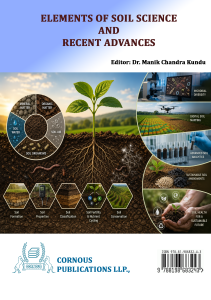
Book Title: Elements of Soil Science and Recent Advances
PAID ACCESS | Published on : 06-Jan-2026 | Pages: 11-23 | Doi : 10.37446/edibook222025/11-23
Weathering and Soil Formation - Factors and Processes
- Umalaxmi Thingujam
- Department of Soil Science and Agricultural Chemistry, Palli Siksha Bhavana (Institute of Agriculture), Visva-Bharati, Sriniketan, West Bengal, India.
- Animesh Ghosh Bag
- Department of Agriculture, Swami Vivekananda University, Barrackpore, West Bengal, India.
- Deep Prabha
- Department of Soil Science and Agricultural Chemistry, Palli Siksha Bhavana (Institute of Agriculture), Visva-Bharati, Sriniketan, West Bengal, India.
- Manik Chandra Kundu
- Department of Soil Science and Agricultural Chemistry, Palli Siksha Bhavana (Institute of Agriculture), Visva-Bharati, Sriniketan, West Bengal, India.
- Victor Thingujam
- ICAR - Research Complex for Eastern Region-Farming System Research Centre for Hill and Plateau Region, Plandu, Ranchi, Jharkhand, India.
- Lamneithem Hangshing
- Department of Agricultural Engineering, Palli Siksha Bhavana (Institute of Agriculture), Visva Bharati, Sriniketan, West Bengal, India.
Abstract
The chapter is about the Earth's surface weathering and soil formation processes. It specifically concentrates on transforming rocks into soil through physical, chemical, and biological changes. It defines weathering as the very first step of soil formation. Further, it explains that there are three kinds of weathering: physical weathering (which is influenced by temperature and mechanical forces), chemical weathering (where hydrolysis, oxidation, carbonation, and hydration are involved), and biological weathering (where the growth of organisms is the driving factor). The chapter describes the traditional equation for soil formation, which relates the properties of soil to the factors that are still active (climate and organisms) and factors that have become passive (parent material, topography, and time), and thus shows their different effects on the development of soil. Moreover, it also explains the soil forming processes such as humification, mineral transformation, eluviation, illuviation, and horizon differentiation, describing how these processes reshape soil profiles and maintain ecosystems.
Keywords
Weathering, soil forming factors, physical and chemical processes, soil genesis
References
Biswas, T. D., & Mukherjee, S. K. (2017). Textbook of soil sciences. Tata McGraw-Hill Education.
Das, D. K. (2020). Introductory soil science. Kalyani Publishers.
Sehgal, J. L. (2023). Pedology: Concepts and application. Kalyani Publishers.
Sidhu, P. S., Dhir, R. P., & Bhattacharyya, T. (2017). Weathering and soil formation. In Fundamentals of soil science (Indian Society of Soil Science).
Indexing In




Types of Books We Publish




Uniqueness of our Publication

DOI Assignment

ISBN Registration

Online Publication

High Visibility

Open & Closed Access
DOI Assignment
ISBN Registration
Online Publication
High Visibility