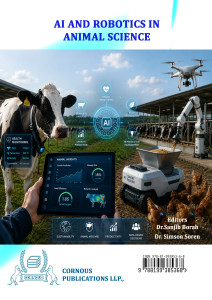
AI and Robotics in Animal Science
- Sanjib Borah
- Associate Professor, Department of Veterinary Physiology and Biochemistry, Lakhimpur College of Veterinary Science, North Lakhimpur, Assam, India.
- Simson Soren
- Assistant Professor in the Department of Veterinary Physiology and Biochemistry at Lakhimpur College of Veterinary Science, Assam Agricultural University, Joyhing, North Lakhimpur, Assam, India.
Artificial Intelligence (AI) and Robotics represent two of the most transformative technological advancements of the 21st century. While AI enables machines to mimic human intelligence-learning, reasoning and problem-solving; robotics provides physical embodiment to these intelligent systems, allowing them to perform complex tasks in the real world. Together, AI and robotics have revolutionized industries ranging from healthcare and agriculture to defence, manufacturing and space exploration. In industrial automation, AI-powered robots have improved precision, and safety. Smart robots in manufacturing lines can detect defects, optimize production speed and perform quality checks with minimal human input. In healthcare, surgical robots guided by AI assist surgeons in performing delicate procedures with extreme accuracy. Service robots are increasingly being used for elderly care, rehabilitation and hospital logistics, enhancing patient comfort and reducing workload on healthcare staff.
The convergence of artificial intelligence and robotics with animal science marks a transformative era in agriculture, veterinary medicine and wildlife conservation. This book, AI and Robotics in Animal Science, is a timely and comprehensive exploration of how intelligent technologies are reshaping the way we care for, manage and understand animals across diverse domains. From the historical evolution of mechanization in animal husbandry to the cutting-edge deployment of autonomous systems and predictive analytics, this volume offers a panoramic view of innovation. Each chapter is designed to guide readers through foundational concepts, applications and emerging trends from smart barns to AI-driven diagnostics, wearable sensors and drone-assisted herd management.
The book is intended for veterinary students, researchers, educators and professionals in animal agriculture who seek to understand and harness the power of intelligent systems. It also serves as a resource for policymakers and technologists interested in ethical integration and sustainable development. Special attention is given to the challenges of implementation, the nuances of human-robot collaboration and the ethical considerations that must accompany technological advancement. As we stand at the threshold of a new frontier, this book invites readers to envision a future where precision, empathy and innovation coalesce where AI and robotics not only optimize productivity but also elevate animal welfare and ecological stewardship. We hope this work inspires curiosity, critical thinking and collaborative action toward a smarter and more resilient animal science ecosystem.
-
Introduction to Robotics and AI in Animal Science
PAID ACCESS | Published on : 20-Jan-2026 | Doi :10.37446/edibook202024/1-10 | Pages : 1-10
-
Autonomous Feeding Systems in Animal Husbandry
PAID ACCESS | Published on : 20-Jan-2026 | Doi :10.37446/edibook202024/11-20 | Pages : 11-20
-
Wearable Sensors and AI - Real-Time Animal Health Monitoring
OPEN ACCESS | Published on : 20-Jan-2026 | Doi :10.37446/edibook202024/21-28 | Pages : 21-28
-
AI in Veterinary Diagnostics - From Lab to Clinic
PAID ACCESS | Published on : 20-Jan-2026 | Doi :10.37446/edibook202024/29-36 | Pages : 29-36
-
Robotics For Animal Behavior and Welfare
OPEN ACCESS | Published on : 20-Jan-2026 | Doi :10.37446/edibook202024/37-46 | Pages : 37-46
-
Robotic Automation in Animal Waste Management
PAID ACCESS | Published on : 20-Jan-2026 | Doi :10.37446/edibook202024/47-53 | Pages : 47-53
-
Robotics and AI in Wildlife Conservation
PAID ACCESS | Published on : 20-Jan-2026 | Doi :10.37446/edibook202024/54-66 | Pages : 54-66
-
Challenges in Integrating Robotics and AI in Animal Husbandry
OPEN ACCESS | Published on : 20-Jan-2026 | Doi :10.37446/edibook202024/67-73 | Pages : 67-73
-
AI-based Image Recognition for Sperm Morphology and Motility
OPEN ACCESS | Published on : 02-Mar-2026 | Doi :10.37446/edibook202024/74-78 | Pages : 74-78
-
Artificial Intelligence in Sperm Sorting and Sexed Semen Technology in Livestock
PAID ACCESS | Published on : 02-Mar-2026 | Doi :10.37446/edibook202024/79-88 | Pages : 79-88
-
Application of Artificial Intelligence in Food Safety
PAID ACCESS | Published on : 02-Mar-2026 | Doi :10.37446/edibook202024/89-99 | Pages : 89-99
-
AI in Disease Diagnosis and Treatment
OPEN ACCESS | Published on : 08-Aug-2026 | Doi :10.37446/edibook202024/100-111 | Pages : 100-111
Indexing In




Types of Books We Publish




Uniqueness of our Publication

DOI Assignment

ISBN Registration

Online Publication

High Visibility

Open & Closed Access
DOI Assignment
ISBN Registration
Online Publication
High Visibility
Open & Closed Access