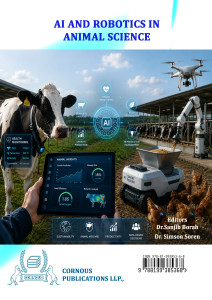
Editorial Book
Book Title: AI and Robotics in Animal Science
PAID ACCESS | Published on : 02-Mar-2026 | Pages: 89-99 | Doi : 10.37446/edibook202024/89-99
Application of Artificial Intelligence in Food Safety
- Rashmi Rekha Saikia
- Lakhimpur College of Veterinary Science, AAU, Joyhing, North Lakhimpur, Assam, India.
- Kushal Jyoti Thakuria
- Technical Assistant, AICRP-PHET, College of Veterinary Science, Khanapara, Assam Agricultural University, Guwahati, India.
- Simson Soren
- Lakhimpur College of Veterinary Science, AAU, Joyhing, North Lakhimpur, Assam, India.
- Suraksha Subedi Deka
- Lakhimpur College of Veterinary Science, AAU, Joyhing, North Lakhimpur, Assam, India.
- Arunoday Das
- Lakhimpur College of Veterinary Science, AAU, Joyhing, North Lakhimpur, Assam, India.
- Arindam Chakraborty
- KVK, AAU, North Lakhimpur, Assam, India.
Abstract
The integration of robotics into animal behaviour analysis and welfare is transforming the way animals are monitored, studied, and cared for across sectors such as agriculture, laboratory research, and wildlife conservation. This chapter explores the rising significance of robotics especially when combined with Artificial Intelligence (AI) and the Internet of Things (IoT) in enhancing animal welfare through non-invasive, automated, and adaptive systems. Key applications include robotic milking and feeding systems, biomimetic robots in behavioural studies, drone-based wildlife tracking, and AI-driven behaviour monitoring. These technologies improve efficiency, standardize experimental protocols, and reduce human-induced stress in animals. The chapter also examines emerging innovations such as therapeutic robots, conservation bots, and AI systems capable of interpreting animal emotions and social behaviours. While robotics offers vast potential, it also presents challenges including biological variability, ethical considerations, and the need for cross-disciplinary collaboration. Emphasizing the importance of animal-centric design, the chapter calls for ethical frameworks like the Five Freedoms and the Three Rs to guide responsible deployment. The future of animal welfare lies in the collaborative evolution of robotics, science, and compassion.
Keywords
Artificial Intelligence, Machine learning, Food safety, Computer vision system, Deep learning, Animal-based food
References
Apeiranthitis, S., Zacharia, P., Chatzopoulos, A., and Papoutsidakis, M. (2024). Predictive maintenance of machinery with rotating parts using convolutional neural networks. Electronics (Switzerland), 13(2). https://doi.org/10.3390/electronics13020460.
Chołodowicz, E., and Orłowski, P. (2024). Neural network control of perishable inventory with fixed shelf- life products and fuzzy order refinement under time-varying uncertain demand. Energies, 17(4). https://doi.org/10.3390/en17040849.
Han, H., Sha, R., Dai, J., Wang, Z., Mao, J., and Cai, M. (2024). Garlic origin traceability and identification based on fusion of multi-source heterogeneous spectral information. Foods, 13(7). https://doi.org/10.3390/foods13071016.
Hwang, Y.-H., Samad, A., Muazzam, A., Alam, A. N. A. M., and Joo, S.-T. (2025). A Comprehensive Review of Artificial Intelligence (AI)-Driven Approaches to Meat Quality and Safety. Food Science of Animal Resources, 45(4), 998–1013. DOI: 10.5851/kosfa.2025.e32.
Janga, J. K., Reddy, K. R., and Raviteja, K. V. N. S. (2023). Integrating artificial intelligence, machine learning, and deep learning approaches into remediation of contaminated sites: A review. In Chemosphere (Vol. 345) Elsevier Ltd. https://doi. org/10.1016/j.chemosphere.2023.140476.
Karami, H., Kamruzzaman, M., Covington, J. A., ´elynda Hassouna, M., Darvishi, Y., Ueland, M., Gancarz, M. (2024). Advanced evaluation techniques: Gas sensornetworks, machine learning, and chemometrics for fraud detection in plant and animal products. Sensors and Actuators A: Physical, 370, 115192.
Luo, J., Zhao, C., Chen, Q., and Li, G. (2022). Using deep belief network to construct the agricultural information system based on Internet of Things. The Journal of Supercomputing, 78(1), 379–405. https://doi.org/10.1007/s11227-021-03898-y.
Lv, S., Ouyang, B., Deng, Z., Liang, T., Jiang, S., Zhang, K., Chen, J and Li, Z. (2024). A dataset for deep learning-based detection of printed circuit board surface defect. Scientific Data, 11(1). https://doi.org/10.1038/s41597-024-03656-8.
Ma, P., Tsai, S., He, Y., Jia, X., Zhen, D., Yu, N., Wang, Q., Ahuja, J KC, Wei, C-I. (2024). Large language models in food science: Innovations, applications, and future. In Trends in food science and technology (Vol. 148). Elsevier Ltd. https://doi.org/10.1016/j.tifs.2024.104488.
Manning L (2023). Artificial Intelligence (AI) and Food Safety. Technical Brief. Institute of Food Science and Technology.
McLean, S., Read, G. J. M., Thompson, J., Baber, C., Stanton, N. A., and Salmon, P. M. (2023). The risks associated with artificial general intelligence: A systematic review. Journal of Experimental &Theoretical Artificial Intelligence, 35(5), 649–663. https:// doi.org/10.1080/0952813X.2021.1964003.
Meng, W., Yang, Y., Zhang, R., Wu, Z., and Xiao, X. (2023). Triboelectric-electromagnetic hybrid generator based self-powered flexible wireless sensing for food monitoring. Chemical Engineering Journal, 473. https://doi.org/10.1016/j.cej.2023.145465.
Molenaar, A., Lukose, D., Brennan, L., Jenkins, E. L., and McCaffrey, T. A. (2024). Using Natural Language Processing to explore social media opinions on food security: Sentiment analysis and topic modeling study. Journal of Medical Internet Research, 26 (1). https://doi.org/10.2196/47826.
Mousefi, M., and Jafari, S. M. (2019). Recent advances in application of differenthydrocolloids in dairy products to improve their techno-functional properties. In Trends in food science and technology (Vol. 88, pp. 468–483). Elsevier Ltd. https://doi. org/10.1016/j.tifs.2019.04.015.
Mu, W., Kleter, G. A., Bouzembrak, Y., Dupouy, E., Frewer, L. J., Radwan Al Natour, F. N., and Marvin H. J. P. (2024). Making food systems more resilient to food safety risks by including artificial intelligence, big data, and internet of things into food safety early warning and emerging risk identification tools. In Comprehensive reviews in food science and food safety (Vol. 23, pp. 1–18). John Wiley and Sons Inc. https://doi.org/ 10.1111/1541-4337.13296, 1.
Naseem S and Rizwan M (2025). The role of artificial intelligence in advancing food safety: A strategic path to zero contamination. Food Control 175 (2025) 111292.
Neethirajan, S. (2024). Net zero dairy farming—advancing climate goals with big data and artificial intelligence. In Climate (Vol. 12) Multidisciplinary Digital Publishing Institute (MDPI). https://doi.org/10.3390/cli12020015. Issue 2.
Othman, S., Mavani, N. R., Hussain, M. A., Rahman, N. A., and Mohd Ali, J. (2023). Artificial intelligence-based techniques for adulteration and defect detections in food and agricultural industry: A review. In Journal of agriculture and food research (Vol.12) Elsevier B.V. https://doi.org/10.1016/j.jafr.2023.100590.
Sarker T, Deen RA, Ghosh D, Mia N, Rahman MM, and Hashem MA. (2024). AI driven approach and NIRS: A review on meat quality and safety. Meat Res 4:1-6.
Shuyuti, N. A. S. A., Salami, E., Dahari, M., Arof, H., and Ramiah, H. (2024). Application of artificial intelligence in particle and impurity detection and removal: A survey. IEEE Access, 12, 31498–31514. https://doi.org/10.1109/ACCESS.2024.3351858.
Singh, P., Pandey, S., and Manik, S. (2024). A comprehensive review of the dairy pasteurization process using machine learning models. In Food control (Vol. 164) Elsevier Ltd. https://doi.org/10.1016/j.foodcont.2024.110574.
Wang M and Li X. (2024). Application of artificial intelligence techniques in meat processing: A review. J Food Process Eng 47: e14590.
Wang, Y., Gu, H. W., Yin, X. L., Geng, T., Long, W., Fu, H., and She, Y. (2024). Deep leaning in food safety and authenticity detection: An integrative review and future prospects. In Trends in food science and technology (Vol. 146). Elsevier Ltd. https://doi.org/ 10.1016/j.tifs.2024.104396.
Wu, S., Cao, J., and Shao, Q. (2024). How to select remanufacturing mode: End-of-life or used product? Environment, Development and Sustainability. https://doi.org/10.1007/s10668-024-04515-7.
Zhang, R., Wang, M., Zhu, T., Wan, Z., Chen, X., and Xiao, X. (2024). Wireless charging flexible in-situ optical sensing for food monitoring. Chemical Engineering Journal, 488. https://doi.org/10.1016/j.cej.2024.150808.
Indexing In




Types of Books We Publish



Uniqueness of our Publication

DOI Assignment

ISBN Registration

Online Publication

High Visibility

Open & Closed Access
DOI Assignment
ISBN Registration
Online Publication
High Visibility