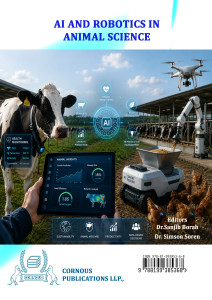
Editorial Book
Book Title: AI and Robotics in Animal Science
PAID ACCESS | Published on : 20-Jan-2026 | Pages: 11-20 | Doi : 10.37446/edibook202024/11-20
Autonomous Feeding Systems in Animal Husbandry
- Anand Kumar Pathak
- Faculty of Veterinary Sciences and A.H., SKUAST-J, R. S. Pura, Jammu, India.
Abstract
Autonomous feeding systems are revolutionizing animal husbandry by enhancing precision, efficiency, and sustainability in livestock nutrition. These systems utilize advanced technologies such as artificial intelligence (AI), Internet of Things (IoT), robotics, and data analytics to automate feed distribution, monitor animal consumption patterns, and optimize nutritional intake. By delivering precise feed portions tailored to individual animal needs, autonomous systems minimize feed wastage, improve growth performance, and enhance overall animal health. Real-time monitoring through smart sensors and machine learning algorithms enables early detection of health issues and dietary deficiencies, allowing timely interventions. Automated feeders integrated with robotic systems ensure consistent feed delivery, reducing labour costs and improving operational efficiency. Additionally, these systems contribute to environmental sustainability by reducing excess nutrient excretion and optimizing resource utilization. The adoption of autonomous feeding technology is particularly beneficial in poultry, dairy, and swine farming, where feed efficiency directly impacts production economics. Innovations such as radio frequency identification (RFID)-based individual animal tracking, automated silage dispensers, and adaptive feeding programs further enhance precision livestock farming. However, challenges such as high initial investment, technical expertise requirements, and data security concerns remain. As advancements continue, integrating autonomous feeding with block-chain and cloud-based platforms will further improve traceability and transparency in livestock nutrition. The future of animal husbandry lies in fully automated, intelligent feeding systems that promote sustainable production, ensure animal welfare, and maximize profitability. This shift towards precision feeding represents a transformative step in modern livestock management, paving the way for more efficient and ethical farming practices.Induced plant volatile, nectar food management, landscape for conservation of natural enemy and use of ecological engineering technique is predominant to manage insect pest problems of crop. The application of habitat manipulations are very common practices for management insect pests in rice, pulses, oilseed and fruit crops by most of the progressive growers in western countries.
Keywords
Artificial intelligence, Autonomous Feeding System, Internet of Things, Machine Learning, Robotics, Sensors
References
Alameer, Ali, Kyriazakis, Ilias, Dalton, H. A., Miller, Amy L. and Bacardit, J. 2020. Automatic recognition of feeding and foraging behaviour in pigs using deep learning. Biosystems Engineering, 197: 91-104.
Barmore J.A. 2002. Fine-tuning the ration mixing and feeding of high production herds. In: Proc. of Tri-state dairy nutrition conference, Fort Wayne, Grand Wayne Center, Indiana, USA, 16-17 April.
Bisaglia, C., Brambilla, M., Cutini, M. and Assirelli, A. 2021. Adoption of Automatic Feeding Systems in Bovine Livestock Farms: an On-Farm Survey on Italian Situation. https://cabidigitallibrary.org by 2405: 205: b005:c7bb:c8ao, pp. 129-133.
Chebli, Y., El Otmani, S., Hornick, J. L., Bindelle, J., Cabaraux, J. F. and Chentouf, M. 2022. Estimation of grazing activity of dairy goats using accelerometers and global positioning system. Sensors, 22, 5629.
Chelotti, J. O., Martinez-Rau, L. S., Ferrero, M., Vignolo, Leandro D., Galli, J.R., Planisich, Alejandra M., Rufiner, H. L. and Giovanini, L. L. 2024. Livestock feeding behaviour: A review on automated systems for ruminant monitoring. Biosystems Engineering 246, 150–177.
Chelotti, J. O., Vanrell, S. R., Galli, J. R., Giovanini, L. L. and Rufiner, H. L. 2018. A pattern recognition approach for detecting and classifying jaw movements in grazing cattle. Computers and Electronics in Agriculture, 145, 83–91.
Chelotti, J. O., Vanrell, S. R., Milone, D. H., Utsumi, S. A., Galli, J. R. and Rufiner, H. L. 2016. A real-time algorithm for acoustic monitoring of ingestive behavior of grazing cattle. Computers and Electronics in Agriculture, 127, 64–75.
Chu, J. 2016. The Applied Research of Full-automatic Computer Food Controlling System Based on PLC. Advance Journal of Food Science and Technology, 11(10), pp.661-663.
Cornou, C., Vinther, J. and Kristensen, A. R. 2008. Automatic detection of oestrus and health disorders using data from electronic sow feeders. Livestock Science, 118(3): 262-271.
Da Borso F., Chiumenti A., Sigura M., Pezzuolo A. 2017. Influence of automatic feeding systems on design and management of dairy farms. Journal of Agricultural Engineering, XLVIII (s1):642, 48-52.
Lean, I., Golder, H. and Hall, M. 2014. Feeding, Evaluating, and Controlling Rumen Function. Veterinary Clinics of North America: Food Animal Practice, 30(3): pp.539-575.
Marcon, M., Brossard, L. and Quiniou, N. 2015. Precision feeding based on individual daily body weight of group housed pigs with an automatic feeder developed to allow for restricting feed allowance. Precision Livestock Farming, 15: 592-601.
Matthews, S. G., Miller, A. L., Pl € O tz, T. and Kyriazakis, I. 2017. Automated tracking to measure behavioural changes in pigs for health and welfare monitoring. Scientific Reports, 7(1): 17582.
Mittek, M., Psota, E. T., Carlson, J. D., Perez, L. C., Schmidt, T. and Mote, B. 2017. Tracking of group-housed pigs using multiellipsoid expectation maximisation. IET Computer Vision, 12(2): 121e128.
Oh, J., Hofer, R. and Fitch, W. 2017. An open-source automatic feeder for animal experiments. system. Applied Animal Behaviour Science, 30 (3-4): pp.223-246.
Pompe J.C.A.M., Nieuwenhuizen A.T., Lokhorst C., Kettenis D.L. 2004. Discrete-event simulation model for automatic precision feeding of dairy cows. AgEng Leuven 2004 - Engineering the Future, Technologisch Instituut vzw, Leuven, pp. 574-575 (Extended abstract in hard copy of proceedings, Vol. 572; full paper on CD ROM).
Rajput, A. R., Dhawale, N. M., Magdum, P. M., Kumbhar, D. B. Rajput, A. J. and Patil, S. S. 2021. Automatic animal food feeding system. International Journal of Advances in Engineering and Management, 3 (10), pp: 69-76.
Sa, J., Choi, Y., Lee, H., Chung, Y., Park, D. and Cho, J. 2019. Fast pig detection with a top-view camera under various illumination conditions. Symmetry, 11(2): 266.
Serap G., Özgül A. and Gökhan G. 2017. Futuristic applications for profitable beef production systems. Journal of Environmental Science and Engineering A 6, 625-634.
Wierenga, H.K. and Hopster, H. 1991. Behaviour of dairy cows when fed concentrates with an automatic feeding system, Applied Animal Behaviour Science, 30(1-2): 223-246,
Yang, Q., Xiao, D. and Lin, S. 2018. Feeding behavior recognition for group-housed pigs with the faster r-cnn. Computers and Electronics in Agriculture, 155: 453-460.
Indexing In




Types of Books We Publish




Uniqueness of our Publication

DOI Assignment

ISBN Registration

Online Publication

High Visibility

Open & Closed Access
DOI Assignment
ISBN Registration
Online Publication
High Visibility