Editorial Book
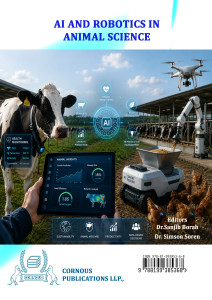
Book Title: AI and Robotics in Animal Science
OPEN ACCESS | Published on : 20-Jan-2026 | Pages: 37-46 | Doi : 10.37446/edibook202024/37-46
Robotics For Animal Behavior and Welfare
- Keregallikoppalu Hemanth Gowda
- Department of Veterinary Physiology & Biochemistry, Veterinary College, KVAFSU, Hassan, Karnataka, India.
- Rachaiah Guruprasad
- Department of Livestock Production Management, Veterinary College, KVAFSU, Hassan, Karnataka, India.
- Vankayala Jagadeeswary
- Department of Veterinary & A.H. Extension Education, Veterinary College, KVAFSU, Bengaluru, Karnataka, India.
Abstract
The integration of robotics into animal behaviour analysis and welfare is transforming the way animals are monitored, studied, and cared for across sectors such as agriculture, laboratory research, and wildlife conservation. This chapter explores the rising significance of robotics especially when combined with Artificial Intelligence (AI) and the Internet of Things (IoT) in enhancing animal welfare through non-invasive, automated, and adaptive systems. Key applications include robotic milking and feeding systems, biomimetic robots in behavioural studies, drone-based wildlife tracking, and AI-driven behaviour monitoring. These technologies improve efficiency, standardize experimental protocols, and reduce human-induced stress in animals. The chapter also examines emerging innovations such as therapeutic robots, conservation bots, and AI systems capable of interpreting animal emotions and social behaviours. While robotics offers vast potential, it also presents challenges including biological variability, ethical considerations, and the need for cross-disciplinary collaboration. Emphasizing the importance of animal-centric design, the chapter calls for ethical frameworks like the Five Freedoms and the Three Rs to guide responsible deployment. The future of animal welfare lies in the collaborative evolution of robotics, science, and compassion.
Keywords
Animal Welfare, Artificial Intelligence, Behavioural monitoring, Internet of things, Precision livestock farming, Robotics
References
Associated Press. (2024, May 14). Animal-inspired swarms of drones could be a game-changer for defense. AP News. https://apnews.com/article/autonomous-drones-animal-swarms 0e146f4221e81f4442674a125f86501d
Berckmans, D. (2017). General introduction to precision livestock farming. Animal Frontiers, 7(1), 6–11.
Bierbach, D., Landgraf, T., Romanczuk, P., Lukas, J., Nguyen, H., Wolf, M., & Krause, J. (2018). Insights into the social behaviour of fish: A robotic platform to study animal–robot interactions. Ethology, 124(6), 389–398. https://doi.org/10.1111/eth.12741
Butail, S., Polverino, G., Phamduy, P., Del Sette, F., & Porfiri, M. (2013). Influence of robotic shoal size, configuration, and activity on zebrafish behaviour in a free-swimming environment. Behavioural Brain Research, 250, 78–86. https://doi.org/10.1016/j.bbr.2013.04.005
Christie, K. S., Gilbert, S. L., Brown, C. L., Hatfield, M., & Hanson, L. (2016). Unmanned aircraft systems in wildlife research: Current and future applications of a transformative technology. Frontiers in Ecology and the Environment, 14(5), 241–251.
Crespi, A., Karakasiliotis, K., Guignard, A., & Ijspeert, A. J. (2013). Swimming and crawling with an amphibious snake robot. IEEE Transactions on Robotics, 29(3), 710–720. https://doi.org/10.1109/TRO.2013.2240170
d’Isa, R. (2025). Robotic animals as new tools in rodent neuroscience research: Proposed applications of zooinspired robots for mouse behavioural testing. Frontiers in Behavioural Neuroscience, 19, 1545352. https://doi.org/10.3389/fnbeh.2025.1545352
Dilaver, H., & Dilaver, K. F. (2024). Robotics systems and artificial intelligence applications in livestock farming. Journal of Animal Science and Economics, 3(2), 63–72.
Graving, J. M., Chae, D., Naik, H., Li, L., Koger, B., Costelloe, B. R., & Couzin, I. D. (2019). DeepPoseKit: A software toolkit for fast and robust animal pose estimation using deep learning. Nature Methods, 16, 605–608. https://doi.org/10.1038/s41592-019-0502-x
Jacobs, B., & Bradley, M. (2023). Transparent AI in animal welfare: Challenges and best practices. AI & Ethics, 4(2), 89–105.
Jonas, P., Luder, V., Davis, L. R., Schulthess, L., & Magno, M. (2025). Smart feeding station: Non-invasive, automated IoT monitoring of Goodman's mouse lemurs in a semi-natural rainforest habitat. In Proceedings of the IEEE International Instrumentation and Measurement Technology Conference. https://doi.org/10.48550/arXiv.2503.09238
Krause, J., Winfield, A. F. T., & Deneubourg, J. L. (2011). Robotic fish in animal behavioural research: A review. Ethology, 117(8), 679–685. https://doi.org/10.1111/j.1439-0310.2011.01915.x
Lee, S. Y., Kim, Y., Kim, H. T., & Lee, H. (2021). Development of a mobile robot to support cattle movement and monitor behavior. Biosystems Engineering, 207, 20–32. https://doi.org/10.1016/j.biosystemseng.2021.04.011
Li, L., Ravi, S., & Wang, C. (2022). Editorial: Robotics to understand animal behaviour. Frontiers in Robotics and AI, 9, 963416. https://doi.org/10.3389/frobt.2022.963416
Mannioui, A., Zizioli, D., Fassi, I., Boudaoud, M., Legnani, G., & Haliyo, S. (2024). Robotic sorting of zebrafish embryos. Journal of Micro-Bio Robotics, 20(3), Article 3. https://doi.org/10.1007/s12213-024-00167-y
Mathis, A., Mamidanna, P., Cury, K. M., Abe, T., Murthy, V. N., Mathis, M. W., & Bethge, M. (2018). DeepLabCut: Markerless pose estimation of user-defined body parts with deep learning. Nature Neuroscience, 21(9), 1281–1289. https://doi.org/10.1038/s41593-018-0209-y
Miller, L. J., Vicino, G. A., Sheftel, J., & Lauderdale, L. K. (2020). Animal individuality and behavior: Translating variability into welfare insight. Animal Behaviour, 166, 99–109. https://doi.org/10.1016/j.anbehav.2020.05.019
Patricelli, G. L. (2010). Robotics in the study of animal behavior. In M. D. Breed & J. Moore (Eds.), Encyclopedia of Animal Behaviour (Vol. 3, pp. 91–99). Academic Press. http://www.elsevier.com/locate/permissionusematerial
Romano, D., Donati, E., Benelli, G., & Stefanini, C. (2017). A review on animal–robot interaction: From bio-hybrid organisms to mixed societies. Biological Cybernetics, 111(3), 177–195.
Sandini, G., & Vernon, D. (2018). The human and the robot in the loop. Nature Machine Intelligence, 1(1), 6–7.
Sandøe, P., Gjerris, M., & Christiansen, S. B. (2019). Ethics of animal use in science: Balancing interests and minimizing harm. Veterinary Record, 184(3), 95–100. https://doi.org/10.1136/vr.104571
Seymour, A. C., Dale, J., Hammill, M., Halpin, P. N., & Johnston, D. W. (2017). Automated detection and enumeration of marine wildlife using unmanned aircraft systems (UAS) and thermal imagery. Scientific Reports, 7(1), 45127.
Tuyttens, F. A. M., Ampe, B., Ruelokke, M., Song, X., & Viazzi, S. (2022). Precision livestock farming: The importance of a multidisciplinary approach. Animal, 16(1), 100386. https://doi.org/10.1016/j.animal.2021.100386
Van Hertem, T., Norton, T., Berckmans, D., & Vranken, E. (2017). Early warning systems for tail biting in pigs: Current status and future perspectives. Agricultural Systems, 160, 66–75. https://doi.org/10.1016/j.agsy.2017.01.004
Wathes, C. M., Kristensen, H. H., Aerts, J. M., & Berckmans, D. (2008). Is precision livestock farming an engineer’s daydream or nightmare, an animal’s friend or foe, and a farmer’s panacea or pitfall? Computers and Electronics in Agriculture, 64(1), 2–10.
Indexing In




Types of Books We Publish




Uniqueness of our Publication

DOI Assignment

ISBN Registration

Online Publication

High Visibility

Open & Closed Access
DOI Assignment
ISBN Registration
Online Publication
High Visibility