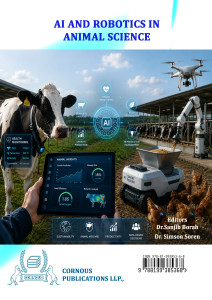
Editorial Book
Book Title: AI and Robotics in Animal Science
PAID ACCESS | Published on : 20-Jan-2026 | Pages: 1-10 | Doi : 10.37446/edibook202024/1-10
Introduction to Robotics and AI in Animal Science
- Sudha .
- Department of Zoology, National College, Tiruchirappalli-1, Tamil Nadu, India.
Abstract
Robotics is used in animal science to boost animal welfare, increase productivity, and support research efforts. Robots handle repetitive tasks like milking, feeding, and manure management, other activities in animal husbandry. Robots allow researchers to create standardized and repeatable experiments, isolating specific variables to study animal behaviour in a controlled environment. AI improves nutritional levels and production efficiency by using data analysis to create exact feed formulation. Automated tracking and predictive analytics enabling greater insight into biological systems. AI is being used more and more in animal science; it can be used to monitor wildlife populations and detect diseases in livestock early. In Aquaculture, Automated feeding systems like Reel Appetite AI reduce food waste and ensure fish eat an appropriate amount of food. AI technology in animal husbandry practices enhances animal welfare and improving economic benefits. Advanced technology has expanded new opportunities for innovative ideas in the animal sciences field.
Keywords
Aquaculture, Economic Benefits, Food Waste, Increase Productivity, Robots
References
Abubakar, U.O., Moses, T., &Muhammad, A. (2023). Smart agriculture: Revolutionizing food production through smart farming technology in Nigeria. In International Conference on Communication and E-Systems for Economic Stability (CeSES) (p. 1).
Balwan, W. K., & Saba, N. (2024). Review-based study on artificial intelligence and the future of zoology. Cross Current International Journal of Medical and Biosciences, 6(6), 127–131.
Daigle, C. (2020). Technology designed to enhance poultry welfare. In Improving Animal Welfare (p. 588).
de Bruin, J. (2024). Impact of ammonia reduction measures on farmer income, governmental costs and ammonia reduction.
George, A. S. (2024). Humanoid robots as poultry partners: Enhancing welfare through collaboration on the farm. Partners Universal International Research Journal, 3(1), 183–199.
Gonsalves, H., Santos, A. F. D., Azevedo, L. H., & Corrêa, L. (2025). [Article on ScienceDirect]. Oral Surgery, Oral Medicine, Oral Pathology and Oral Radiology, 139(5), e131.https://www.sciencedirect.com/science/article/pii/S2212440325006418
Leonie, N. B., & Hagenodorff, T. (2021). Animals and AI: The role of animals in AI research and application—An overview and ethical evaluation. Technology in Society, 67, 101678.
Paulson, O. (2023). AI and the future of animal science careers. https://aiwhim.com
Sam, E. F., Hamidu, O., & Daniels, S. (2018). SERVQUAL analysis of public bus transport services in Kumasi metropolis, Ghana: Core user perspectives. Case Studies on Transport Policy, 6(1), 25–31.
https://www.sciencedirect.com/science/article/pii/S2213624X17301232
Sourek, M. (n.d.). Artificial intelligence in architecture and development of the built environment: From misconceptions to productive prospects.
Indexing In




Types of Books We Publish




Uniqueness of our Publication

DOI Assignment

ISBN Registration

Online Publication

High Visibility

Open & Closed Access
DOI Assignment
ISBN Registration
Online Publication
High Visibility