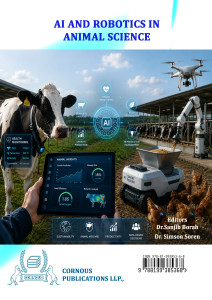
Editorial Book
Book Title: AI and Robotics in Animal Science
PAID ACCESS | Published on : 02-Mar-2026 | Pages: 79-88 | Doi : 10.37446/edibook202024/79-88
Artificial Intelligence in Sperm Sorting and Sexed Semen Technology in Livestock
- Nazir Ahmad Mir
- Subject Matter Specialist (Animal Science), KVK Bandipora-1, SKUAST-Kashmir, India.
- Simson Soren
- Lakhimpur College of Veterinary Science, AAU, Joyhing, North Lakhimpur, Assam, India.
- Sanjib Borah
- Lakhimpur College of Veterinary Science, AAU, Joyhing, North Lakhimpur, Assam, India.
- Arindam Chakraborty
- KVK, AAU, North Lakhimpur, Assam, India.
- Arunoday Das
- Lakhimpur College of Veterinary Science, AAU, Joyhing, North Lakhimpur, Assam, India.
- Suraksha Subedi Deka
- Lakhimpur College of Veterinary Science, AAU, Joyhing, North Lakhimpur, Assam, India.
Abstract
Livestock reproduction is a key determinant of agricultural productivity, food security, and rural livelihoods, with cattle and buffalo being central to India’s dairy economy and cultural heritage. India, the world’s largest milk producer with 239.30 million tonnes annually, relies heavily on its vast bovine population, yet productivity per animal remains low compared to global standards. One major constraint is the inability to predetermine the sex of offspring, since both natural breeding and artificial insemination with unsorted semen yield an almost equal probability of male and female calves. For dairy farmers, female calves are far more valuable for herd replacement and milk production, while surplus male calves often have limited utility, reduced economic value, and raise ethical concerns in modern dairying. The advent of semen sexing technologies has been recognized as a game changer, enabling farmers and breeding organizations to preselect offspring sex, improve herd composition, accelerate genetic progress, and align production with economic goals. While dairy farmers benefit from more female calves, beef farmers like males for better growth and carcass yield. Conventional semen sexing techniques such as density gradients or immunological separation lacked accuracy and although flow cytometry introduced high precision (>90%), it remains costly, technically demanding, and is associated with reduced conception rates, particularly challenging in buffaloes due to minimal differences in X and Y chromosome DNA content. Recent advances in Artificial Intelligence (AI) are reshaping semen sexing by integrating machine learning, deep learning and computer vision into semen sexing systems, thereby automating sperm classification, enhancing fertility predictions and optimizing operational efficiency. These AI-driven innovations hold the promise of making semen sexing more accurate, affordable and scalable, thus offering a practical and farmer-friendly solution to boost livestock productivity and sustainability in India and globally.
Keywords
Artificial Intelligence, Semen sexing, flowcytometry, CASA, Sperm sorting, Sex pre selection
References
Abou Ghayda, R., Cannarella, R., Calogero, A. E., Shah, R., Rambhatla, A., Zohdy, W., & Forum, G. A. (2023). Artificial intelligence in andrology: From semen analysis to image diagnostics. World Journal of Men’s Health, 42(1), 39.
Anonymous. (2025, August 12). First sex-sorted semen lab opens in Bassi, will produce 10L doses annually. The Times of India.
https://timesofindia.indiatimes.com/city/jaipur/first-sex-sorted-semen-lab-opens-in-bassi-will-produce-10l-doses-annually/articleshow/123244324.cms
Anonymous. (2025, June 8). Pantnagar scientists develop indigenous sexed semen tech to boost dairy sector. The Times of India.
https://timesofindia.indiatimes.com/city/dehradun/pantnagar-scientists-develop-indigenous-sexed-semen-tech-to-boost-dairy-sector/articleshow/121698334.cms
Barth, A., Perry, V. E., Hamilton, L. E., Sutovsky, P., & Oko, R. (2025). Assessing bovine male fertility in a technological age. In Abnormal morphology of bovine spermatozoa (pp. 297–329). https://doi.org/10.1007/978-3-031-70126-9_7
Celebi, D., Omur, A. D., Akarsu, S. A., Celbis, S. C., Baser, S., Cinisli, K. T., & Celebi, O. (2022). Artificial intelligence in gamete cell selection and microbiologic analysis.
Choi, J. W., Alkhoury, L., Urbano, L. F., Masson, P., VerMilyea, M., & Kam, M. (2022). An assessment tool for computer-assisted semen analysis (CASA) algorithms. Scientific Reports, 12(1), 16830.
Department of Animal Husbandry and Dairying. (2024). Basic animal husbandry statistics (BAHS) 2024. https://dahd.gov.in/sites/default/files/2024-11/BAHS-2024.pdf
Finelli, R., Leisegang, K., Tumallapalli, S., Henkel, R., & Agarwal, A. (2021). The validity and reliability of computer-aided semen analyzers in performing semen analysis: A systematic review. Translational Andrology and Urology, 10(7), 3069.
Garner, D. L. (2009). Hoechst 33342: The dye that enabled differentiation of living X- and Y-chromosome bearing mammalian sperm. Theriogenology, 71(1), 11–21.
Jaruenpunyasak, J., Maneelert, P., Nawae, M., & Choksuchat, C. (2025). Artificial intelligence model for the assessment of unstained live sperm morphology. Reproduction and Fertility, 6(2).
Naik, N., Roth, B., & Lundy, S. D. (2025). Artificial intelligence for clinical management of male infertility: A scoping review. Current Urology Reports, 26(1), 17.
Olatunji, O., & More, A. (2022). A review of the impact of microfluidics technology on sperm selection technique. Cureus, 14(7).
Pozzi, P., Candeo, A., Paiè, P., Bragheri, F., & Bassi, A. (2023). Artificial intelligence in imaging flow cytometry. Frontiers in Bioinformatics, 3, 1229052.
Sharpe, J. C., & Evans, K. M. (2009). Advances in flow cytometry for sperm sexing. Theriogenology, 71(1), 4–10.
Teranishi, K., Wagatsuma, K., Toda, K., Nomaru, H., Yanagihashi, Y., Ochiai, H., Ota, S. (2024). Label-free ghost cytometry for manufacturing of cell therapy products. Scientific Reports, 14(1), 21848.
Umirbaeva, A., Kurenkov, A., Seisenov, B., Zhumanov, K., Tajiyev, K., Mustafin, M., & Barteneva, N. S. (2025). Deep learning-enabled sperm morphology analysis of bovine sperm for label-free imaging flow cytometry. bioRxiv.
Umut Çağın, A. R. I. (2025, June 10–12). Development of artificial intelligence and deep learning-based systems in sperm analysis. Paper presented at the 78th SISVET/TIAR 2025, Giardina Naxos, Sicily, Italy.
Urli, S., Pause, F. C., Dreossi, T., Crociati, M., & Stradaioli, G. (2025). Evaluation of an artificial intelligence system for bull sperm morphology evaluation. Theriogenology, 117504.
Valverde, A., Barquero, V., & Soler, C. (2020). The application of computer-assisted semen analysis (CASA) technology to optimise semen evaluation: A review. Journal of Animal and Feed Sciences, 29(3), 189–198.
Vishwanath, R., & Moreno, J. F. (2018). Semen sexing - Current state of the art with emphasis on bovine species. Animal, 12(S1), S85–S96.
Indexing In




Types of Books We Publish




Uniqueness of our Publication

DOI Assignment

ISBN Registration

Online Publication

High Visibility

Open & Closed Access
DOI Assignment
ISBN Registration
Online Publication
High Visibility