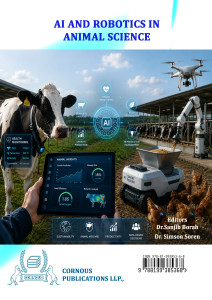
Editorial Book
Book Title: AI and Robotics in Animal Science
PAID ACCESS | Published on : 20-Jan-2026 | Pages: 29-36 | Doi : 10.37446/edibook202024/29-36
AI in Veterinary Diagnostics - From Lab to Clinic
- Sasmita Barik
- Assistant Professor, Department of Veterinary Biochemistry, COVS, Guru, Angad Dev Veterinary and Animal Sciences University, Ludhiana, India.
Abstract
Artificial Intelligence (AI) is emerging as a transformative technology in veterinary diagnostics, enabling rapid, accurate, and data-driven disease detection across companion animals, livestock, and wildlife. Advances in computing programming like machine learning, deep learning, computer vision, and data analytics have enabled automated interpretation of diagnostic images, laboratory results, genomic data, and behavioral patterns. AI-assisted diagnostic systems improve clinical decision-making, reduce diagnostic variability, and facilitate early disease detection, particularly in resource-limited settings. This chapter represents applications of AI in veterinary diagnostics, including imaging, pathology, laboratory medicine, disease surveillance, wearable technologies, and precision livestock farming. The benefits, challenges, ethical considerations, and future prospects of AI integration in veterinary healthcare are critically discussed. The growing role of AI in veterinary diagnostics highlights its importance in improving animal health, productivity, and the One Health framework.
Keywords
Artificial intelligence, Veterinary diagnostics, Machine learning, Deep learning, Precision livestock farming, One health
References
Alleman, R., Bilbrough, G., Hammond, J., McCrann, D. J., Myrick, C., & DeNicola, D. B. (2019). Qualitative evaluation of calcium oxalate dihydrate and struvite crystal numbers with an in-clinic automated urine sediment microscopy system. Veterinary Clinical Pathology, 48(2), 257–264. https://doi.org/10.1111/vcp.12782
Bouhali, O., Bensmail, H., Sheharyar, A., David, F., & Johnson, J. P. (2022). A review of radiomics and artificial intelligence and their application in veterinary diagnostic imaging. Veterinary Sciences, 9(11), 620. https://doi.org/10.3390/vetsci9110620
Burti, S., Banzato, T., Coghlan, S., Wodzinski, M., Bendazzoli, M., & Zotti, A. (2024). Artificial intelligence in veterinary diagnostic imaging: Perspectives and limitations. Research in Veterinary Science, 175, 105317. https://doi.org/10.1016/j.rvsc.2024.105317
Celniak, W., Wodziński, M., Jurgas, A., Burti, S., Zotti, A., Atzori, M., Müller, H., & Banzato, T. (2023). Improving the classification of veterinary thoracic radiographs through interspecies and interpathology self-supervised pretraining of deep learning models. Scientific Reports, 13, 19518. https://doi.org/10.1038/s41598-023-46345-z
Cheng, N., Schulte, A. J., Tillman, H. S., Kisseberth, W. C., London, C. A., & Dow, S. W. (2021). Machine learning application identifies novel gene signatures from transcriptomic data of spontaneous canine hemangiosarcoma. Briefings in Bioinformatics, 22(4), bbaa252. https://doi.org/10.1093/bib/bbaa252
Coghlan, S., & Quinn, T. (2024). Ethics of using artificial intelligence (AI) in veterinary medicine. AI & Society, 39, 2337–2348. https://doi.org/10.1007/s00146-023-01686-1
Fragoso-Garcia, M., Wilm, F., Bertram, C. A., Merz, S., Schmidt, A., Donovan, T., Fuchs-Baumgartinger, A., Bartel, A., Marzahl, C., Diehl, L., Puget, C., Maier, A., Aubreville, M., Breininger, K., & Klopfleisch, R. (2023). Automated diagnosis of seven canine skin tumors using machine learning on H&E-stained whole-slide images. Veterinary Pathology, 60(6), 865–875. https://doi.org/10.1177/03009858231189205
McGreevy, P., Thomson, P., Dhand, N. K., Raubenheimer, D., Masters, S., Mansfield, C. S., Baldwin, T., Soares Magalhães, R. J., Rand, J., Hill, P., Peaston, A., Gilkerson, J., Combs, M., Raidal, S., Irwin, P., Irons, P., Squires, R., Brodbelt, D., & Hammond, J. (2017). VetCompass Australia: A national big data collection system for veterinary science. Animals, 7(10), 74. https://doi.org/10.3390/ani7100074
Samek, W., Wiegand, T., & Müller, K. R. (2017). Explainable artificial intelligence: Understanding, visualizing and interpreting deep learning models. arXiv. https://doi.org/10.48550/arXiv.1708.08296
Scopio Labs. (2020). ScopioVet digital cytology system: Revolutionizing veterinary cytology with AI-assisted imaging and decision support. https://scopiolabs.com/veterinary
Xiao, S., Dhand, N. K., Wang, Z., Hu, K., Thomson, P. C., House, J. K., & Khatkar, M. S. (2025). Review of applications of deep learning in veterinary diagnostics and animal health. Frontiers in Veterinary Science, 12, 1511522. https://doi.org/10.3389/fvets.2025.1511522.
Indexing In




Types of Books We Publish




Uniqueness of our Publication

DOI Assignment

ISBN Registration

Online Publication

High Visibility

Open & Closed Access
DOI Assignment
ISBN Registration
Online Publication
High Visibility