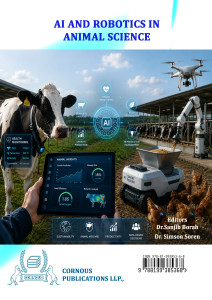
Editorial Book
Book Title: AI and Robotics in Animal Science
PAID ACCESS | Published on : 20-Jan-2026 | Pages: 54-66 | Doi : 10.37446/edibook202024/54-66
Robotics and AI in Wildlife Conservation
- Ranjana Bhaskar
- Zoological Survey of India, Southern Regional Centre, 130, Santhome High Road, Chennai, Tamil Nadu, India.
- Swetha Sivakumar
- Zoological Survey of India, Southern Regional Centre, 130, Santhome High Road, Chennai, Tamil Nadu, India.
Abstract
Artificial intelligence (AI) and robotics are emerging as powerful tools in wildlife conservation, offering innovative solutions to long-standing challenges in monitoring, protection, and management of biodiversity. These robotic counterparts can serve as invaluable proxies, enabling scientists to monitor wildlife in their natural habitats without causing disturbance or altering natural behaviors. AI-based systems can analyze vast amounts of data from camera traps, acoustic sensors, satellites, and drones to automatically identify species, track animal movements, detect poaching activities, and assess habitat changes with high accuracy and speed. Robotics, including drones and autonomous ground or underwater vehicles, enables conservationists to survey remote or dangerous areas with minimal human disturbance, monitor endangered species, and collect environmental data in real time. Together, AI and robotics enhance decision-making, reduce costs, and improve the effectiveness of conservation strategies, thereby supporting proactive, data-driven approaches to safeguard wildlife and ecosystems in a rapidly changing environment.
Keywords
Artificial Intelligence, Decision-making, Biodiversity, Monitoring, Protection
References
Adams, W. M. (2019). Geographies of conservation II: Technology, surveillance and conservation by algorithm. Progress in Human Geography, 43(2), 337–350.
Adom, D., Panin, K. B. O., & Dzakpasu, P. E. (2024). The use of digital technologies in wildlife conservation in Ghana. Journal of Emerging Technologies, 4(2), 77–84.
Ahumada, J. A., Hurtado, J., & Lizcano, D. (2013). Monitoring the status and trends of tropical forest terrestrial vertebrate communities from camera trap data: A tool for conservation. PLOS ONE, 8(9), e73707.
Ancin‐Murguzur, F. J., Munoz, L., Monz, C., & Hausner, V. H. (2020). Drones as a tool to monitor human impacts and vegetation changes in parks and protected areas. Remote Sensing in Ecology and Conservation, 6(1), 105–113.
Beery, S., Morris, D., & Yang, S. (2019). Efficient pipeline for camera trap image review. arXiv preprint. http://arxiv.org/abs/1907.06772
Benos, L., Bechar, A., & Bochtis, D. (2020). Safety and ergonomics in human-robot interactive agricultural operations. Biosystems Engineering, 200, 55–72.
Berhanu, K., & Teshome, E. (2018). Opportunities and challenges for wildlife conservation: The case of Alatish National Park, Northwest Ethiopia. African Journal of Hospitality, Tourism and Leisure, 7(1), 1–13.
Caravaggi, A., Banks, P. B., Burton, A. C., Finlay, C. M., Haswell, P. M., Hayward, M. W., ... & Wood, M. D. (2017). A review of camera trapping for conservation behaviour research. Remote Sensing in Ecology and Conservation, 3(3), 109–122.
Chappidi, J., & Sundaram, D. M. (2024). Advancing wild animal conservation through autonomous systems leveraging YOLOv7 with SGD optimization technique. In Multidisciplinary Applications of AI Robotics and Autonomous Systems (pp. 72–86). IGI Global.
Dorota, W., & Jóźków, G. (2025). Hoofed animal detection in UAV thermal images using Balanced Random Forest and CNN features. Reports on Geodesy and Geoinformatics, 120(1), 1–13. https://doi.org/10.2478/rgg-2025-0011
Dunbabin, M., & Marques, L. (2012). Robots for environmental monitoring: Significant advancements and applications. IEEE Robotics & Automation Magazine, 19(1), 24–39.
Goyal, A., Bhakhar, R., & Singh, S. (2025). Limitations and challenges of AI in wildlife conservation. In AI and Machine Learning Techniques for Wildlife Conservation (pp. 363–394). IGI Global.
Hafijull, M., & Das, S. K. (2024). Mapping the landscape of bibliometric research in India: A bibliometric analysis. Brainwave: A Multidisciplinary Journal, 5(3), 838–848.
Harvey, A. M., Morton, J. M., Mellor, D. J., Russell, V., Chapple, R. S., & Ramp, D. (2021). Use of remote camera traps to evaluate animal-based welfare indicators in individual free-roaming wild horses. Animals, 11(7), 2101. https://doi.org/10.3390/ani11072101
Hassanalian, M., & Abdelkefi, A. (2017). Classifications, applications, and design challenges of drones: A review. Progress in Aerospace Sciences, 91, 99–131.
Huang, G., Ping, X., Xu, W., Hu, Y., Chang, J., Swaisgood, R. R., ... & Wei, F. (2021). Wildlife conservation and management in China: Achievements, challenges and perspectives. National Science Review, 8(7), nwab042.
Huang, J. H., Chen, Y. Y., Huang, Y. T., Lin, P. Y., Chen, Y. C., Lin, Y. F., ... & Chen, L. J. (2010). Rapid prototyping for wildlife and ecological monitoring. IEEE Systems Journal, 4(2), 198–209.
Iqbal, M. A. (2024). Introductory chapter: Present and future of artificial intelligence in grasslands conservation. In Grasslands—Conservation and Development. IntechOpen.
Jegan, R., Kaushal, B., Birajdar, G. K., & Patil, M. D. (2025). An optimized deep neural network with explainable artificial intelligence framework for brain tumour classification. Network: Computation in Neural Systems, 1–35.
Jing, C. A. I., & Zhigang, J. I. A. N. G. (2006). Human–larger mammal’s conflict: A new challenge of wildlife conservation. Acta Theriologica Sinica, 26(2), 183.
Kerry, R. G., Montalbo, F. J. P., Das, R., Patra, S., Mahapatra, G. P., Maurya, G. K., ... & Rout, J. R. (2022). An overview of remote monitoring methods in biodiversity conservation. Environmental Science and Pollution Research, 29(53), 80179–80221.
Kissling, W. D., Evans, J. C., Zilber, R., Breeze, T. D., Shinneman, S., Schneider, L. C., ... & Geelen, L. H. (2024). Development of a cost-efficient automated wildlife camera network in a European Natura 2000 site. Basic and Applied Ecology, 79, 141–152. https://doi.org/10.1016/j.baae.2024.06.006
Kumar, B., & Ghosh, O. (2025). An overview of AI applications in wildlife conservation. In AI and Machine Learning Techniques for Wildlife Conservation (pp. 19–48).
Kumar, R. P., & Singh, J. S. (2020). Invasive alien plant species: Their impact on environment, ecosystem services and human health. Ecological Indicators, 111, 106020.
Kundu, K., Vishwakarma, V., Rai, A., Srivastava, M., & Mishra, A. (2023). Design and deployment of wild animal intrusion detection and repellent system employing IoT. In 2023 International Conference on Computational Intelligence and Sustainable Engineering Solutions (CISES) (pp. 763–767). IEEE.
Kuvlesky, W. P., Jr., Brennan, L. A., Morrison, M. L., Boydston, K. K., Ballard, B. M., & Bryant, F. C. (2007). Wind energy development and wildlife conservation: Challenges and opportunities. The Journal of Wildlife Management, 71(8), 2487–2498.
Lazard, O., & Youngs, R. (2021). The EU and climate security: Toward ecological diplomacy. Carnegie Europe.
LeCun, Y., Bottou, L., Bengio, Y., & Haffner, P. (1998). Gradient-based learning applied to document recognition. Proceedings of the IEEE, 86(11), 2278–2324.
Linxiang, S., Yu, W., Xiaolong, H., Xibo, M., Xuejian, B., & Tan, M. (2024). Underwater robots and key technologies for operation control. Cyborg and Bionic Systems, 5. https://doi.org/10.34133/cbsystems.0089
Mishra, K. (2012). A review study on wildlife conservation in India. IJFANS International Journal of Food and Nutritional Sciences.
Nandutu, I., Atemkeng, M., & Okouma, P. (2023). Integrating AI ethics in wildlife conservation AI systems in South Africa: A review, challenges, and future research agenda. AI & Society, 38(1), 1–13. https://doi.org/10.1007/s00146-021-01285-y
Nyhus, P. J., Fisher, H., Osofsky, S., & Madden, F. (2003). Taking the bite out of wildlife damage: The challenges of wildlife compensation schemes. Conservation Magazine, 37.
Oliver, R. Y., Meyer, C., Ranipeta, A., Winner, K., & Jetz, W. (2021). Global and national trends, gaps, and opportunities in documenting and monitoring species distributions. PLOS Biology, 19, e3001336.
Pacheco, X. P. (2018). How technology can transform wildlife conservation. In Green Technologies to Improve the Environment on Earth.
Patil, N. H., Patel, S. H., & Lawand, S. D. (2023). Research paper on artificial intelligence and its applications. Journal of Advanced Zoology, 44, 229–238.
Piel, A. K., Crunchant, A., Knot, I. E., Chalmers, C., Fergus, P., Mulero-Pázmány, M., & Wich, S. A. (2022). Noninvasive technologies for primate conservation in the 21st century. International Journal of Primatology, 43(1), 1–35.
Preethichandra, D. M. G., Piyathilaka, L., & Izhar, U. (2024). Review on robotic systems for environmental monitoring. IEEE Open Journal of Instrumentation and Measurement.
Russell, S. J., & Norvig, P. (2016). Artificial intelligence: A modern approach. Pearson.
Schulz, A. K., Shriver, C., Stathatos, S., Seleb, B., Weigel, E. G., Chang, Y. H., ... & Mendelson, J. R. III. (2023). Conservation tools: The next generation of engineering–biology collaborations. Journal of the Royal Society Interface, 20(205), 20230232.
Sharma, L. K., Gupta, R., & Pandey, P. C. (2021). Future aspects and potential of remote sensing technology to meet natural resource needs. In Advances in Remote Sensing for Natural Resource Monitoring (pp. 445–464). Wiley.
Sipper, M., & Moore, J. H. (2021). Conservation machine learning: A case study of random forests. Scientific Reports, 11, 3629.
Szeliski, R. (2022). Computer vision: Algorithms and applications (2nd ed.). Springer Cham.
Trolliet, F., Vermeulen, C., Huynen, M. C., & Hambuckers, A. (2014). Use of camera traps for wildlife studies: A review. Biotechnologie, Agronomie, Société et Environnement, 18(3).
Tuia, D., Kellenberger, B., Beery, S., Costelloe, B. R., Zuffi, S., Risse, B., ... & Berger-Wolf, T. (2022). Perspectives in machine learning for wildlife conservation. Nature Communications, 13, 792.
Vigna, I., Besana, A., Comino, E., & Pezzoli, A. (2021). Application of the socio-ecological system framework to forest fire risk management: A systematic literature review. Sustainability, 13(4), 2121.
Wang, T., Zuo, Y., Manda, T., Hwarari, D., & Yang, L. (2025). Harnessing artificial intelligence, machine learning and deep learning for sustainable forestry management and conservation: Transformative potential and future perspectives. Plants, 14(7), 998.
Yin, Z., et al. (2022). Toward city-scale litter monitoring using autonomous ground vehicles. IEEE Pervasive Computing, 21(3), 74–83.
Zellmer, A. J., & Goto, B. S. (2022). Urban wildlife corridors: Building bridges for wildlife and people. Frontiers in Sustainable Cities, 4, 954089.
Indexing In




Types of Books We Publish




Uniqueness of our Publication

DOI Assignment

ISBN Registration

Online Publication

High Visibility

Open & Closed Access
DOI Assignment
ISBN Registration
Online Publication
High Visibility