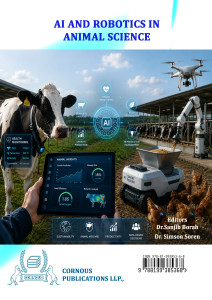
Editorial Book
Book Title: AI and Robotics in Animal Science
PAID ACCESS | Published on : 20-Jan-2026 | Pages: 47-53 | Doi : 10.37446/edibook202024/47-53
Robotic Automation in Animal Waste Management
- Suraksha Subedi Deka
- Assistant Professor, Department of Veterinary Biochemistry, LCVSc, AAU, Assam, India.
- Monjula Regon
- Associate Professor, Department of Veterinary Pathology, LCVSc, AAU, Assam, India.
- Kongkon Jyoti Dutta
- Assistant Professor, Department of Veterinary Pathology, LCVSc, AAU, Assam, India.
- Mridusmita Buragohain
- Assistant Professor, Department of Veterinary Pathology, CVSc, AAU, Assam, India.
- Aditya Baruah
- Assistant Professor, Department of Veterinary Public Health, LCVSc, AAU, Assam, India.
Abstract
Managing animal waste is a critical part of maintaining environmental sustainability, public health, and livestock productivity. However, traditional methods are often hazardous, labour-intensive, and not always effective in reducing pollution or maintaining hygiene. In modern days, robotic systems are transforming the way animal waste is handled on farms. Technologies like automated scrapers and mobile robots to drones and sensor-based systems are making it possible to clean, collect, and manage waste more efficiently and safely. By using artificial intelligence and smart sensors, modern robotic systems can navigate farm environments, adapt to different conditions, and even analyze data to improve overall farm operations. In addition to improving cleanliness and reducing labour costs, robotic waste management helps lower greenhouse gas emissions and supports better animal health and welfare. This chapter provides an insight about the evolution, practical application, and future prospects of robotic systems in animal waste management, emphasizing their transformative impact on contemporary livestock farming practices. It also looks at the challenges, such as the high cost of implementation and the need for regular maintenance, while offering insights into how these technologies can be tailored to different farm sizes and needs.
Keywords
Animal waste management, Robotic systems automation, Livestock, Sustainability, Farm technology
References
Ding, J., Wang, C., & Li, Z. (2020). Application of robotics and automation in livestock waste management: A review. Journal of Cleaner Production, 263, 121477. https://doi.org/10.1016/j.jclepro.2020.121477
Gerba, C. P., & Pepper, I. L. (2009). Wastewater treatment and biosolids reuse. In Environmental Biology (2nd ed., pp. 589–598). Academic Press.
Ghaly, A. E., & MacDonald, K. N. (2012). Performance evaluation of an integrated mechanical system for cleaning and sanitizing poultry houses. Journal of Agricultural Technology, 8(1), 15–35.
Gilkinson, S., & Frost, J. P. (2007). A review of livestock slatted floor cleaning equipment. Agricultural Engineering International: CIGR Journal, 9, Manuscript PM 06 008. https://www.cigrjournal.org/index.php/Ejounral/article/view/772
Johnson, E., Nguyen, P., & Patel, S. (2023). Privacy concerns in AI-driven wildlife conservation. Global Ecology and Conservation, 22(2), 205–218.
Lely Industries N.V. (2023). Lely Discovery – Automatic manure removal robot. https://www.lely.com
Monika, K. (2016). Smart dustbin – An efficient garbage monitoring system. International Journal of Engineering and Computer Science, 6(6).
Nguyen, K., & Patel, S. (2023). Indigenous rights and AI in wildlife conservation. Journal of Human Rights and the Environment, 14(2), 227–245.
Patinvoh, R. J., & Taherzadeh, M. J. (2019). Challenges of biogas implementation in developing countries. Current Opinion in Environmental Science & Health, 12, 30–37.
Sakar, S., & Ghosh, D. (2022). Robotic solutions in modern agriculture: Emerging trends in waste handling and livestock facility management. Automation in Agriculture, 15(2), 91–105.
Sakar, S., Roy, A., & Pal, S. (2021). Sustainable livestock waste management using robotics: Opportunities and challenges. Renewable Agriculture and Food Systems, 36(3), 271–280. https://doi.org/10.1017/S1742170520000432
Saravanan, S., Vignesh, S., Viknesh, Y., & Jenicksan, C. L. (2022). Waste management system using IoT for dairy animal (cow dung). International Journal of Electrical and Electronics Engineering, 14(1).
Sathish Kumar, N., Vijayalakshmi, B., Jeniferprarthana, R., & Shankar, A. (2016). IoT based smart garbage alert system using Arduino UNO. In Proceedings of IEEE Region 10 Conference (TENCON). IEEE.
Shrivastava, P., & Shukla, N. (2020). Animal waste management in dairy farm using Internet of Things. Journal of Emerging Technologies and Innovative Research, 7(12).
Thorpe, A. (2009). Enteric fermentation and ruminant eructation: The role (and control?) of methane in the climate change debate. Climatic Change, 93, 407–431.
United States Environmental Protection Agency. (2010). Inventory of U.S. greenhouse gas emissions and sinks: 1990–2008. https://www.epa.gov/ghgemissions/inventory-us-greenhouse-gas-emissions-and-sinks-1990-2008.
Indexing In




Types of Books We Publish



Uniqueness of our Publication

DOI Assignment

ISBN Registration

Online Publication

High Visibility

Open & Closed Access
DOI Assignment
ISBN Registration
Online Publication
High Visibility