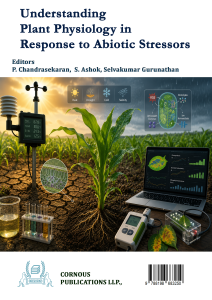
Understanding Plant Physiology in Response to Abiotic Stressors
- P. Chandrasekaran
- Assistant Professor of Crop Physiology in the Department of Basic Sciences at SRM College of Agricultural Sciences, Baburayanpettai, Chengalpattu, Tamil Nadu, India.
- S. Ashok
- Assistant Professor in Crop Physiology at the Department of Crop Physiology, Adhiparasakthi Agricultural College, Kalavai, Ranipet, Tamil Nadu, India.
- G. Selvakumar
- Assistant Professor (Genetics and Plant Breeding), SRM College of Agricultural Sciences, SRM Institute of Science and Technology, Vendhar Nagar, Baburayanpettai, Elapakkam (Post), Chengalpattu (Dt.), Tamil Nadu, India.
Plants are fundamental to life on Earth, serving as the foundation of ecosystems and the backbone of global food security. However, their growth and productivity are frequently challenged by various abiotic stressors such as drought, water logging, salinity, extreme temperatures, and Heavy metal and light imbalances. As these stresses intensify due to climate change and human activities, understanding how plants respond and adapt to such conditions has become more critical than ever. This book, Understanding Plant Physiology in Response to Abiotic Stressors, explores the intricate physiological mechanisms that enable plants to perceive, respond to, and mitigate the effects of adverse environmental factors. It provides a comprehensive analysis of key topics, including stress signal perception, hormonal regulation, osmotic adjustment, antioxidant defense systems, and molecular pathways driving stress tolerance. By integrating the latest research findings with foundational concepts, this work aims to bridge the gap between theory and practical applications in plant science. The content is structured to cater to a diverse audience. Researchers and students in plant biology, agricultural sciences, and environmental studies will find valuable insights into the complex interplay between plants and their environment. At the same time, policymakers and agricultural practitioners can draw inspiration for developing strategies to enhance crop resilience and productivity under changing climatic conditions.
As you delve into the chapters of this book, you will encounter the remarkable adaptability of plants and their ingenious survival strategies. This knowledge not only deepens our appreciation of plant life but also equips us to address the pressing challenges of ensuring food security and sustainable development in an era of unprecedented environmental stress. We hope this book inspires you to explore the boundless potential of plant physiology and to contribute to the growing body of knowledge dedicated to fostering a resilient and sustainable future.
-
Introduction to abiotic stresses in plants
PAID ACCESS | Published on : 15-Jan-2025 | Doi :10.37446/edibook242025/1-6 | Pages : 1-6
-
Heavy metal toxicity in plants - tolerance mechanisms and improvement approaches
PAID ACCESS | Published on : 28-Jan-2025 | Doi :10.37446/edibook242025/7-15 | Pages : 7-15
-
Response of plant to waterlogging stress
PAID ACCESS | Published on : 03-Feb-2025 | Doi :10.37446/edibook242025/16-22 | Pages : 16-22
-
High and low temperature stresses - effects and adaptive mechanisms
PAID ACCESS | Published on : 27-Feb-2025 | Doi :10.37446/edibook242025/23-32 | Pages : 23-32
-
Evaporation cooling and concept of cellular tolerance and protein stability
PAID ACCESS | Published on : 07-Mar-2025 | Doi :10.37446/edibook242025/33-45 | Pages : 33-45
-
Molecular Chaperons, HSPs, HSFs
PAID ACCESS | Published on : 13-Mar-2025 | Doi :10.37446/edibook242025/46-55 | Pages : 46-55
-
High light and high ionizing radiation - photo - oxidation and photo inhibition in plants
PAID ACCESS | Published on : 27-Mar-2025 | Doi :10.37446/edibook242025/56-66 | Pages : 56-66
-
High light and high ionizing radiation - mechanism of tolerances
PAID ACCESS | Published on : 08-Apr-2025 | Doi :10.37446/edibook242025/67-75 | Pages : 67-75
-
Plant adaptation to low light
PAID ACCESS | Published on : 20-Apr-2025 | Doi :10.37446/edibook242025/76-89 | Pages : 76-89
-
Concept of shade avoidance response
PAID ACCESS | Published on : 12-May-2025 | Doi :10.37446/edibook242025/90-98 | Pages : 90-98
Indexing In




Types of Books We Publish




Uniqueness of our Publication

DOI Assignment

ISBN Registration

Online Publication

High Visibility

Open & Closed Access
DOI Assignment
ISBN Registration
Online Publication
High Visibility
Open & Closed Access