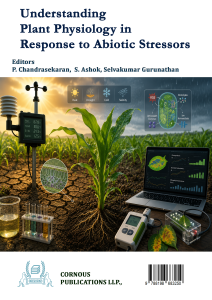
Editorial Book
Book Title: Understanding Plant Physiology in Response to Abiotic Stressors
PAID ACCESS | Published on : 27-Mar-2025 | Pages: 56-66 | Doi : 10.37446/edibook242025/56-66
High light and high ionizing radiation - photo - oxidation and photo inhibition in plants
- Hariharan K
- II M.Sc., (Agri.), Department of Genetics and Plant Breeding, SRM College of Agricultural Sciences, Baburayanpettai, Tamil Nadu, India.
- Solarasan R. M
- II M.Sc., (Agri.), Department of Genetics and Plant Breeding, SRM College of Agricultural Sciences, Baburayanpettai, Tamil Nadu, India.
- Hariharan B. I
- II M.Sc., (Agri.), Department of Genetics and Plant Breeding, SRM College of Agricultural Sciences, Baburayanpettai, Tamil Nadu, India.
Abstract
Plants, as primary producers in ecosystems, depend on photosynthesis to drive growth and energy production. While light is essential for photosynthesis, excessive exposure to high light intensity or ionizing radiation imposes significant stress, jeopardizing plant health and productivity. This paper delves into two critical phenomena caused by such environmental stressors: photo-oxidation and photo inhibition. Photo-oxidation occurs when light intensities surpass the photosynthetic capacity of plants, leading to an overexcitation of chlorophyll molecules and the generation of reactive oxygen species (ROS). These ROS, including singlet oxygen, superoxide anions, and hydroxyl radicals, inflict extensive damage on cellular structures such as lipids, proteins, and DNA, culminating in oxidative stress. Photo inhibition, on the other hand, involves damage to the photosynthetic apparatus, particularly Photosystem II (PSII), under excessive light conditions, impairing electron transport and reducing photosynthetic efficiency. High ionizing radiation further exacerbates these challenges by splitting water molecules through radiolysis, generating ROS that contribute to DNA mutations, chronic oxidative stress, and compromised growth. Plants have evolved intricate defense mechanisms to counteract these stressors. Enzymatic antioxidants like superoxide dismutase, catalase, and peroxidases, along with non-enzymatic antioxidants such as carotenoids and glutathione, neutralize ROS and protect cellular integrity.
Keywords
Highlight stress, photo-oxidation, photo inhibition, high ionizing radiation
References
Aro, E.-M., Virgin, I., & Andersson, B. (1993). Photoinhibition of photosystem II: Inactivation, protein damage and turnover. Biochimica et Biophysica Acta (BBA) - Bioenergetics, 1143(2), 113–134.
Barber, J., & Andersson, B. (1992). Too much of a good thing: Light can be bad for photosynthesis. Trends in Biochemical Sciences, 17(2), 61–66.
Davies, M. J. (2005). The oxidative environment and protein damage. Biochimica et Biophysica Acta (BBA) - Proteins and Proteomics, 1703(2), 93–109.
Demmig-Adams, B., & Adams, W. W. (1996). The role of xanthophyll cycle carotenoids in the protection of photosynthesis. Trends in Plant Science, 1(1), 21–26.
Esnault, M.-A., Legue, F., & Chenal, C. (2010). Ionizing radiation: Advances in plant response. Environmental and Experimental Botany, 68(3), 231–237.
Farooq, M., Hussain, M., Wahid, A., & Siddique, K. H. M. (2012). Drought stress in plants: An overview. In A. S. Basra (Ed.), Drought stress tolerance in plants: Physiology and biochemistry (Vol. 1, pp. 1–33). https://doi.org/10.1201/b11352-2
Gebbers, R., & Adamchuk, V. I. (2010). Precision agriculture and food security. Science, 327(5967), 828–831. https://doi.org/10.1126/science.1183899
Gill, S. S., & Tuteja, N. (2010). Reactive oxygen species and antioxidant machinery in abiotic stress tolerance in crop plants. Plant Physiology and Biochemistry, 48(12), 909–930.
Kim, J.-S., Lim, Y. P., Kim, H. H., & Lee, J. (2011). Effect of gamma irradiation on growth, photosynthesis, and antioxidative capacity of red pepper (Capsicum annuum L.) seedlings. Journal of Plant Biology, 54(6), 413–419.
Koul, O., Cuperus, G. W., & Elliott, N. C. (2008). Areawide pest management: Theory and implementation. CABI Publishing.
Lal, R. (2015). Restoring soil quality to mitigate soil degradation. Sustainability, 7(5), 5875–5895.
Li, T., Heuvelink, E., Dueck, T. A., Janse, J., Gort, G., & Marcelis, L. F. M. (2012). Enhancement of crop photosynthesis by diffuse light: Quantifying the contributing factors. Annals of Botany, 114(2), 145–156.
Mittler, R., Vanderauwera, S., Gollery, M., & Van Breusegem, F. (2004). Reactive oxygen gene network of plants. Trends in Plant Science, 9(10), 490–498.
Møller, I. M., Jensen, P. E., & Hansson, A. (2007). Oxidative modifications to cellular components in plants. Annual Review of Plant Biology, 58, 459–481.
Müller, P., Li, X. P., & Niyogi, K. K. (2001). Non-photochemical quenching: A response to excess light energy. Plant Physiology, 125(4), 1558–1566.
Murchie, E. H., & Niyogi, K. K. (2011). Manipulation of photoprotection to improve plant photosynthesis. Plant Physiology, 155(1), 86–92.
Nishiyama, Y., Allakhverdiev, S. I., & Murata, N. (2006). A new paradigm for the action of reactive oxygen species in the photoinhibition of photosystem II. Biochimica et Biophysica Acta (BBA) - Bioenergetics, 1757(7), 742–749.
Noctor, G., & Foyer, C. H. (1998). Ascorbate and glutathione: Keeping active oxygen under control. Annual Review of Plant Biology, 49, 249–279.
Pospíšil, P. (2016). Production of reactive oxygen species by photosystem II as a response to light and temperature stress. Frontiers in Plant Science, 7, 1950.
Powles, S. B. (1984). Photoinhibition of photosynthesis induced by visible light. Annual Review of Plant Physiology, 35(1), 15–44.
Sánchez-Martín, J., Heald, J., Kingston-Smith, A., & Winters, A. (2015). Strategies for enhancing the resilience of European grassland ecosystems to climate change through breeding. Agriculture, Ecosystems & Environment, 213, 209–218. https://doi.org/10.1016/j.agee.2015.07.027
Tjus, S. E., Møller, B. L., & Scheller, H. V. (1998). Photoinhibition in photosystem II: Mechanism and role of D1 protein. Physiologia Plantarum, 103(3), 369–377.
Indexing In




Types of Books We Publish




Uniqueness of our Publication

DOI Assignment

ISBN Registration

Online Publication

High Visibility

Open & Closed Access
DOI Assignment
ISBN Registration
Online Publication
High Visibility