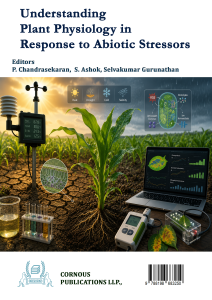
Editorial Book
Book Title: Understanding Plant Physiology in Response to Abiotic Stressors
PAID ACCESS | Published on : 07-Mar-2025 | Pages: 33-45 | Doi : 10.37446/edibook242025/33-45
Evaporation cooling and concept of cellular tolerance and protein stability
- Solarasan R M
- PG Scholar, SRM College of Agricultural Sciences, Department of Genetics and Plant Breeding, Baburayanpettai, Chengalpattu, Tamil Nadu, India.
- Hariharan B I
- PG Scholar, SRM College of Agricultural Sciences, Department of Genetics and Plant Breeding, Baburayanpettai, Chengalpattu, Tamil Nadu, India.
- Hariharan K
- PG Scholar, SRM College of Agricultural Sciences, Department of Genetics and Plant Breeding, Baburayanpettai, Chengalpattu, Tamil Nadu, India.
Abstract
The mechanisms of evaporation cooling, cellular tolerance and protein stability are deeply interconnected, working together to help plants survive and grow in tough environmental conditions. Evaporation cooling, primarily through transpiration, helps regulate the internal temperature of the plant, preventing overheating and protecting vital cellular structures. This cooling process works synergistically with cellular tolerance mechanisms, such as the activation of Heat Shock Proteins (HSPs), which stabilize proteins and prevent cellular damage from heat stress, drought and salinity. Furthermore, protein stability is crucial for maintaining cellular function under stress, with molecular chaperones and post-translational modifications playing key roles in preserving protein integrity. Together, these mechanisms allow plants to not only survive extreme conditions but also optimize their physiological processes for better growth and productivity. Understanding the intricate interplay between these systems is essential for improving crop resilience, the impact of climate change could drive the development of crops that are more resistant to drought and heat in the future.
Keywords
Cellular tolerance, HSP, drought, salinity, crop resilience, protein stability
References
Crispe, I. N., Giannandrea, M., Klein, I., John, B., Sampson, B., & Wuensch, S. (2006). Cellular and molecular mechanisms of liver tolerance. Immunological Reviews, 213(1), 101–118.
Hasegawa, P. M., Bressan, R. A., & Handa, A. K. (1986). Cellular mechanisms of salinity tolerance. HortScience, 21(6), 1317–1324.
Kramer, P. J., & Boyer, J. S. (1995). Water relations of plants and soils. Academic Press.
Mchaourab, H. S., Godar, J. A., & Stewart, P. L. (2009). Structure and mechanism of protein stability sensors: Chaperone activity of small heat shock proteins. Biochemistry, 48(18), 3828–3837.
Nobel, P. S. (2009). Physicochemical and environmental plant physiology (4th ed.). Academic Press.
Smith, A. M., & Stitt, M. (2007). Coordination of carbon supply and plant growth. Plant, Cell & Environment, 30(9), 1126–1135.
Taiz, L., & Zeiger, E. (2010). Plant physiology (5th ed.). Sinauer Associates.
Wang, W., Vinocur, B., Shoseyov, O., & Altman, A. (2004). Role of plant heat-shock proteins and molecular chaperones in the abiotic stress response. Trends in Plant Science, 9(5), 244–252. https://doi.org/10.1016/j.tplants.2004.03.006
Yang, J., Gao, Y., Zhao, C., & Chen, H. (2024). Leaf phenotypic plasticity and integration balance plant adaptation to water table decline: A mesocosm experiment. Plant and Soil, 497(1), 611–627.
Zhu, J. K. (2016). Abiotic stress signalling and responses in plants. Cell, 167(2), 313–324. https://doi.org/10.1016/j.cell.2016.08.029.
Indexing In




Types of Books We Publish




Uniqueness of our Publication

DOI Assignment

ISBN Registration

Online Publication

High Visibility

Open & Closed Access
DOI Assignment
ISBN Registration
Online Publication
High Visibility