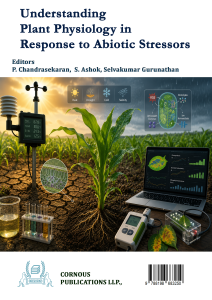
Editorial Book
Book Title: Understanding Plant Physiology in Response to Abiotic Stressors
PAID ACCESS | Published on : 03-Feb-2025 | Pages: 16-22 | Doi : 10.37446/edibook242025/16-22
Response of plant to waterlogging stress
- Susi M S
- II M.Sc., (Agri.), Department of Genetics and Plant Breeding, SRM College of Agricultural Sciences, Baburayanpettai, Tamil Nadu, India.
- Vasudev R
- II M.Sc., (Agri.), Department of Genetics and Plant Breeding, SRM College of Agricultural Sciences, Baburayanpettai, Tamil Nadu, India.
- Tamilarasan A
- II M.Sc., (Agri.), Department of Genetics and Plant Breeding, SRM College of Agricultural Sciences, Baburayanpettai, Tamil Nadu, India.
Abstract
Waterlogging represents a major abiotic stress for plants, leading to the prohibition of aerobic respiration and constraining energy metabolism, thereby impeding growth and various developmental processes. Anoxia is a condition developed, which ultimately allows fermentation i.e., anaerobic respiration due to the unavailability of oxygen. Plants can adapt to waterlogging by making changes to their morphological structure, energy production, photosynthesis, respiration, oxidative stress, hormone synthesis and signalling cascades following exposure to waterlogging stress. Morphological changes like epinasty, lenticle formation help to mitigate this stress. Flooding stress remains as a nightmare for major crops like Pigeon pea, millets and other crops. In this chapter, we outline the features of primary aerenchyma including schizogenous and lysigenous types, and discuss about other adaptative mechanism the plant exhibits to overcome waterlogging stress.
Keywords
Waterlogging, Anoxia, Oxidative stress, Epinasty, Aerenchyma
References
Ahsan, N., Lee, D. G., Lee, S. H., Kang, K. Y., Bahk, J. D., Choi, M. S., & Lee, B. H. (2007). A comparative proteomic analysis of tomato leaves in response to waterlogging stress. Physiologia Plantarum, 131(4), 555–570.
Akhtar, I., & Nazir, N. (2013). Effect of waterlogging and drought stress in plants. International Journal of Water Resources and Environmental Sciences, 2(2), 34–40.
De Castro, J., Hill, R. D., Stasolla, C., & Badea, A. (2022). Waterlogging stress physiology in barley. Agronomy, 12(4), 780.
Evans, D. E., & Gladish, D. K. (2017). Plant responses to waterlogging. In Encyclopedia of Applied Plant Sciences (Vol. 1, pp. 36–39).
Hasanuzzaman, M., Al Mahmud, J., Nahar, K., Anee, T. I., Inafuku, M., Oku, H., & Fujita, M. (2017). Responses, adaptation, and ROS metabolism in plants exposed to waterlogging stress. In Reactive oxygen species and antioxidant systems in plants: Role and regulation under abiotic stress (pp. 257–281).
Loreti, E., van Veen, H., & Perata, P. (2016). Plant responses to flooding stress. Current Opinion in Plant Biology, 33, 64–71.
Pan, J., Sharif, R., Xu, X., & Chen, X. (2021). Mechanisms of waterlogging tolerance in plants: Research progress and prospects. Frontiers in Plant Science, 11, 627331.
Parent, C., Capelli, N., Berger, A., Crèvecoeur, M., & Dat, J. F. (2008). An overview of plant responses to soil waterlogging. Plant Stress, 2(1), 20–27.
Shimamura, S., Yamamoto, R., Nakamura, T., Shimada, S., & Komatsu, S. (2010). Stem hypertrophic lenticels and secondary aerenchyma enable oxygen transport to roots of soybean in flooded soil. Annals of Botany, 106(2), 277–284.
Zhou, W., Chen, F., Meng, Y., Chandrasekaran, U., Luo, X., Yang, W., & Shu, K. (2020). Plant waterlogging/flooding stress responses: From seed germination to maturation. Plant Physiology and Biochemistry, 148, 228–236.
Indexing In




Types of Books We Publish




Uniqueness of our Publication

DOI Assignment

ISBN Registration

Online Publication

High Visibility

Open & Closed Access
DOI Assignment
ISBN Registration
Online Publication
High Visibility