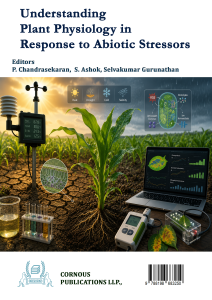
Editorial Book
Book Title: Understanding Plant Physiology in Response to Abiotic Stressors
PAID ACCESS | Published on : 15-Jan-2025 | Pages: 1-6 | Doi : 10.37446/edibook242025/1-6
Introduction to abiotic stresses in plants
- P. Chandrasekaran
- Assistant Professor, SRM College of Agricultural Sciences, SRMIST, Chengalpattu, Tamil Nadu, India.
- S. Ashok
- Assistant Professor, Adhiparasakthi Agricultural College, Kalavai, Ranipet, Tamil Nadu, India.
- G. Gayathri
- PG Scholar, Department of Genetics and Plant Breeding, SRM College of Agricultural Sciences, Baburayanpettai, Tamil Nadu, India.
Abstract
Abiotic stresses are any external non-living factors affects normal growth and development of plants. Currently, drought, waterlogging, heat and heavy metal stress are notable abiotic stresses due to climate change. As increase in global human population about 8.5 billion by 2030 and 9.7 billion by 2050, abiotic stress can reduce yields by more than 60% in the world. First and foremost, important abiotic stress is water stress. Due to climate change, one part of the world gets higher rainfall and another part of the world get lower rainfall when compare to annual average rainfall. These extreme events cause severe damage to the plants and ultimately reduce the yield. In addition to this, high and low-temperature stress, soil salinity, soil sodicity, high and low radiation stress and high & low light stress reduce the yield and quality of plants. On the other hand, heavy metal stress also heavily reduces the physiological and biochemical mechanisms of plants. These abiotic stresses produce a large number of reactive oxygen species (ROS) and accumulate in the different cell organelles. These ROS can react with cells and degrade and completely damage the cell membranes. Hence photosynthetic activity of the plant decreases as photosynthetic pigment is present in the thylakoid membrane of chloroplast and ultimately it reduces the food production and yield of the plants. This effect can be detoxified by the plant defense mechanisms such as the production of ROS scavenging enzymes/Antioxidants (Catalase, Peroxidase, Superoxide dismutase) and the production of Heat shock proteins (HSPs), Late embryogenesis abundant protein (LEA proteins) and accumulation of compatible osmolytes. This chapter explores the complexities of plant responses to abiotic stress, highlighting potential strategies for mitigating its effects.
Keywords
Abiotic stress classification, Physiological and biochemical changes, Temperature stress, Drought, Waterlogging, Salinity
References
Dawson, J., Pandey, S., Yu, Q., Schaub, P., Wüst, F., Moradi, A. B., & Welsch, R. (2022). Determination of protoplast growth properties using quantitative single-cell tracking analysis. Plant Methods, 18(1), 64. https://doi.org/10.1186/s13007-022-00888-6
Jarin, A. S., Islam, M. M., Rahat, A., Ahmed, S., Ghosh, P., & Murata, Y. (2024). Drought stress tolerance in rice: Physiological and biochemical insights. International Journal of Plant Biology, 15(3), 692–718. https://doi.org/10.3390/ijpb15030044
Kumar, S., Sachdeva, S., Bhat, K. V., & Vats, S. (2018). Plant responses to drought stress: Physiological, biochemical and molecular basis. In Biotic and abiotic stress tolerance in plants (pp. 1–25). Springer. https://doi.org/10.1007/978-981-10-9029-5_1
Mondal, S., Karmakar, S., Panda, D., Pramanik, K., Bose, B., & Singhal, R. K. (2023). Crucial plant processes under heat stress and tolerance through heat shock proteins. Plant Stress, 100227. https://doi.org/10.1016/j.stress.2023.100227
Saha, D., Choyal, P., Mishra, U. N., Dey, P., Bose, B., Prathibha, M. D., & Singhal, R. K. (2022). Drought stress responses and inducing tolerance by seed priming approach in plants. Plant Stress, 4, 100066. https://doi.org/10.1016/j.stress.2022.100066
Zhang, Y., Xu, J., Li, R., Ge, Y., Li, Y., & Li, R. (2023). Plants’ response to abiotic stress: Mechanisms and strategies. International Journal of Molecular Sciences, 24(13), 10915. https://doi.org/10.3390/ijms241310915
Zhou, H., Shi, H., Yang, Y., Feng, X., Chen, X., Xiao, F., & Guo, Y. (2024). Insights into plant salt stress signaling and tolerance. Journal of Genetics and Genomics, 51(1), 16–34. https://doi.org/10.1016/j.jgg.2023.10.005.
Indexing In




Types of Books We Publish




Uniqueness of our Publication

DOI Assignment

ISBN Registration

Online Publication

High Visibility

Open & Closed Access
DOI Assignment
ISBN Registration
Online Publication
High Visibility