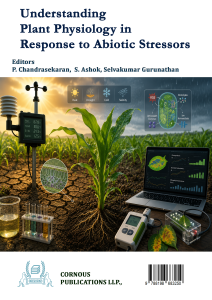
Editorial Book
Book Title: Understanding Plant Physiology in Response to Abiotic Stressors
PAID ACCESS | Published on : 12-May-2025 | Pages: 90-98 | Doi : 10.37446/edibook242025/90-98
Concept of shade avoidance response
- Hariharan B. I
- PG Scholar, SRM College of Agricultural Sciences, Department of Genetics and Plant Breeding, Baburayanpettai, Chengalpattu, Tamil Nadu, India.
- Solarasan R. M
- PG Scholar, SRM College of Agricultural Sciences, Department of Genetics and Plant Breeding, Baburayanpettai, Chengalpattu, Tamil Nadu, India.
- Hariharan K
- PG Scholar, SRM College of Agricultural Sciences, Department of Genetics and Plant Breeding, Baburayanpettai, Chengalpattu, Tamil Nadu, India.
Abstract
Changes in plant structure and function that take occur in response to the light signal from nearby vegetation and typically decrease the supply of shade now or in the future are known as shade avoidance reactions. The Shade Avoidance Mechanism reaction to light perception changes in branch reduction and leaf elongation. The genes PHYA, PHYB, and PHYC, respectively, encode in proteins of the three main types of phytochromes found in angiosperms: phyA, phyB, and phyC. In plants, cryptochromes are photoreceptor proteins that play essential roles in various light-dependent processes, including photomorphogenesis (light-induced changes in growth and development) and regulation of the circadian rhythm. Here are some key aspects of cryptochromes in plants changes in structure and function of the plant that take place in response to the light signal from nearby vegetation and tend to lessen the amount of shade now or in the future are known as shade avoidance reactions. Plants depend on the availability of photosynthetically-active radiation (PAR, 400-700 nm) for generating the carbohydrates needed for their activities. Photosynthesis is reduced and plant health may be gravely endangered when PAR is fallen below saturation levels. The sense of variations in light quality inside a plant canopy is one of the functions of phytochromes. As a plant canopy grows and fills an area, the ratio of R:FR light decreases because FR light is filtered through or reflected by surrounding vegetation. Phytochromes are used by highly evolved sensory systems in plants.
Keywords
Shade Avoidance Mechanism, Cryptochromes, Phytochromes, PAR, Light-dependent
References
Ballaré, C. L., & Pierik, R. (2017). The shade‐avoidance syndrome: Multiple signals and ecological consequences. Plant, Cell & Environment, 40(11), 2530–2543.
Casal, J. J. (2012). Shade avoidance. The Arabidopsis Book, 10, e0157.
Casal, J. J., & Balasubramanian, S. (2019). Thermomorphogenesis. Annual Review of Plant Biology, 70, 321–346.
Casal, J. J., & Fankhauser, C. (2023). Shade avoidance in the context of climate change. Plant Physiology, 191(3), 1475–1491.
de Wit, M., Spoel, S. H., Sanchez-Perez, G. F., & Gommers, C. M. (2016). PiF-ING about shade. Trends in Plant Science, 21(6), 468–476.
Franklin, K. A., & Whitelam, G. C. (2005). Phytochromes and shade-avoidance responses in plants. Annals of Botany, 96(2), 169–175.
Kozuka, T., Kobayashi, J., Horiguchi, G., Demura, T., Sakakibara, H., & Tsukaya, H. (2010). Involvement of auxin and brassinosteroid in plant architectural adaptation of tobacco plants grown in dense stands. Plant Signaling & Behavior, 5(12), 1608–1610.
Morelli, G., Ruberti, I., & Maier, A. (2020). Shade avoidance responses: Multiple phytohormone signalling pathways and their crosstalk. Plant, Cell & Environment, 43(2), 259–270.
Smith, H. (2000). Phytochromes and light signal perception by plants: An emerging synthesis. Nature, 407(6804), 585–591.
Smith, H., & Whitelam, G. C. (1997). The shade avoidance syndrome: Multiple responses mediated by multiple phytochromes. Plant, Cell & Environment, 20(6), 840–844.
Zhou, W., Chen, F., Meng, Y., Chandrasekaran, U., Luo, X., Yang, W., & Shu, K. (2020). Plant waterlogging/flooding stress responses: From seed germination to maturation. Plant Physiology and Biochemistry, 148, 228–236.
Indexing In




Types of Books We Publish




Uniqueness of our Publication

DOI Assignment

ISBN Registration

Online Publication

High Visibility

Open & Closed Access
DOI Assignment
ISBN Registration
Online Publication
High Visibility