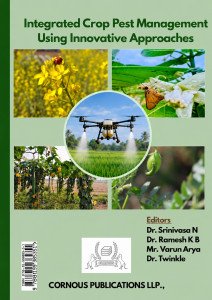
Integrated Crop Pest Management Using Innovative Approaches
- Dr. Srinivasa N
- Assistant Professor of Entomology at Banaras Hindu University, Uttar Pradesh, India.
- Dr. Ramesh K B
- Scientist (Agricultural Entomology) at Indian Institute of Vegetable Research, Varanasi, India.
- Mr. Varun Arya
- Ph. D. Research Scholar, from the Department of Entomology & Agricultural Zoology, Institute of Agricultural Sciences, Banaras Hindu University, Varanasi.
- Dr. Twinkle .
- DST WISE Post-Doctoral Fellow at Banaras Hindu University, Varanasi, Uttar Pradesh, India.
Crop pests remain major constraints to agricultural productivity, food security, and sustainable crop production. Increasing incidences of invasive and emerging pests, changing pest dynamics, insecticide resistance, climate-associated shifts in pest distribution, and concerns over intensive pesticide use have created a growing need for effective, environmentally responsible, and economically viable crop-protection strategies. Modern integrated pest management (IPM) is consequently moving beyond pesticide-centred approaches towards the integration of biological, ecological, molecular, and precision technologies. Integrated Crop Pest Management Using Innovative Approaches has been compiled to present selected perspectives on these emerging dimensions of contemporary crop protection. The volume brings together crop and pest-specific approaches alongside broader strategies for sustainable pest management. The chapters on mango, melon fruit fly (Zeugodacus cucurbitae Coquillett), litchi stink bug (Tessarotoma javanica Thunberg), and pumpkin beetle address noninsecticidal, sustainable, risk-based, and smart approaches for managing important agricultural pests. Complementing these contributions, the chapter on mites in plantation crops examines their diversity and significance while emphasizing sustainable management. The volume further presents innovative approaches to pest management and considers strategies relevant to organic farming, thereby highlighting the importance of reducing dependence on conventional chemical interventions. Biological and ecological approaches constitute another important theme. The potential of endophytic fungi and recent advances in biological control of weeds demonstrate the expanding role of beneficial organisms in sustainable crop protection. The chapter on recent invasive insects of India addresses emerging pest threats and emphasizes the importance of surveillance, risk assessment, timely identification, and appropriate management strategies. In addition, the chapter on vector-borne viral diseases of cucurbitaceous crops considers the relationship between insect vectors, viral diseases, and integrated management, reinforcing the need to address pest and disease complexes through coordinated approaches. The volume also highlights the growing contribution of biotechnology and precision technologies to modern IPM. Pheromone-mediated mating disruption is examined through a case study of cotton pink bollworm, while drone technologies offer emerging opportunities for precision crop protection and insect pest management in the Indian context. The chapter on emerging trends in fruit-fly diagnostics and sustainable management further highlights the importance of molecular and diagnostic tools for rapid pest identification. Collectively, these contributions demonstrate how biological control, sustainable production practices, invasive-pest management, behavioural technologies, molecular diagnostics, and precision tools can complement established IPM principles. The book is intended as a useful resource for researchers, agricultural scientists, entomologists, plant-protection specialists, extension professionals, policymakers, and students. By bringing together diverse perspectives on contemporary pest and disease management, this volume seeks to encourage further research and facilitate the adoption of innovative, precise, environmentally responsible, and technology-supported strategies for sustainable agriculture.
-
Integrated pest management in mango - emphasizing non-insecticidal control of major insect-pests
OPEN ACCESS | Published on : 24-Mar-2026 | Doi :10.37446/edibook252025/1-15 | Pages : 1-15
-
New approaches for sustainable management of the melon fruit fly, Zeugodacus cucurbitae Coquillett
OPEN ACCESS | Published on : 26-Mar-2026 | Doi :10.37446/edibook252025/16-28 | Pages : 16-28
-
Litchi stink bug, Tessarotoma javanica (Thunberg) (Hemiptera: Tessaratomidae) - present status, regional risk, and next-generation management strategies
OPEN ACCESS | Published on : 04-Apr-2026 | Doi :10.37446/edibook252025/29-42 | Pages : 29-42
-
Smart pest management - integrated and innovative approaches for managing pumpkin beetle infestation in cucurbits
OPEN ACCESS | Published on : 08-Apr-2026 | Doi :10.37446/edibook252025/43-52 | Pages : 43-52
-
Endophytic fungi - a promising approach for integrated pest management
OPEN ACCESS | Published on : 16-Apr-2026 | Doi :10.37446/edibook252025/53-62 | Pages : 53-62
-
Pest management strategies in organic farming
OPEN ACCESS | Published on : 16-Apr-2026 | Doi :10.37446/edibook252025/63-73 | Pages : 63-73
-
Recent Invasive Insects of India and Strategies for their Management
OPEN ACCESS | Published on : 16-Apr-2026 | Doi :10.37446/edibook252025/74-87 | Pages : 74-87
-
Recent advances in biological control of weeds
OPEN ACCESS | Published on : 17-Jun-2026 | Doi :10.37446/edibook252025/88-99 | Pages : 88-99
-
Pheromone-Mediated Mating Disruption for Area Wide Pest Management - Evidence from a Case Study of Cotton Pink Bollworm
OPEN ACCESS | Published on : 23-Jun-2026 | Doi :10.37446/edibook252025/100-111 | Pages : 100-111
-
Precision Crop Protection through Drone Technologies - Emerging Approaches in Insect Pest Management with Reference to Indian Context
OPEN ACCESS | Published on : 04-Jul-2026 | Doi :10.37446/edibook252025/112-125 | Pages : 112-125
-
Emerging Trends in Fruit Fly Diagnostics and its Sustainable Management
OPEN ACCESS | Published on : 24-Jul-2026 | Doi :10.37446/edibook252025/126-138 | Pages : 126-138
-
An Overview of Mites in Plantation Crops with Emphasis on Sustainable Management
OPEN ACCESS | Published on : 15-Sep-2026 | Doi :10.37446/edibook252025/139-162 | Pages : 139-162
-
Innovative Approaches in Pest Management
OPEN ACCESS | Published on : 15-Sep-2026 | Doi :10.37446/edibook252025/163-179 | Pages : 163-179
-
Vector-borne Viral Diseases of Cucurbitaceous Crops and their Integrated Management
OPEN ACCESS | Published on : 15-Sep-2026 | Doi :10.37446/edibook252025/180-190 | Pages : 180-190
Indexing In




Types of Books We Publish




Uniqueness of our Publication

DOI Assignment

ISBN Registration

Online Publication

High Visibility

Open & Closed Access
DOI Assignment
ISBN Registration
Online Publication
High Visibility
Open & Closed Access