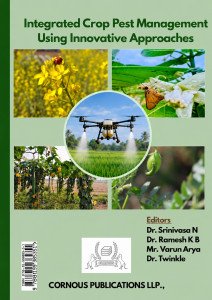
Editorial Book
Book Title: Integrated Crop Pest Management Using Innovative Approaches
OPEN ACCESS | Published on : 16-Apr-2026 | Pages: 74-87 | Doi : 10.37446/edibook252025/74-87
Recent Invasive Insects of India and Strategies for their Management
- Mogili Ramaiah
- ICAR-Indian Agricultural Research Institute, New Delhi, India.
- S. Routray
- ICAR-Central Institute for Subtropical Horticulture, Lucknow, U.P, India.
- K.C. Sahoo
- ICAR-Indian Agricultural Research Institute, Dhemaji, Assam, India.
- P.V. Raghuteja
- Research Fellow, Rythu Sadhikara Samstha - Andhra Pradesh Community Managed Natural Farming, Andhra Pradesh, India.
Abstract
Invasive alien insect species have emerged as a major challenge to agricultural sustainability, biodiversity, and ecosystem services in India. In recent decades, the rate of invasion has increased dramatically due to globalization, increased international trade, climate change, and anthropogenic activities. India has witnessed a sharp rise in invasive insect incursions, with more than 15 new pest species reported between 2013 and 2023 alone. These invasive pests are characterized by high reproductive potential, polyphagy, rapid dispersal, and absence of natural enemies, resulting in severe crop losses and ecological imbalance. Major invasive pests such as Spodoptera frugiperda (J.E. Smith), Phthorimaea absoluta (Meyrick), Aleurodicus rugioperculatus Martin, and Thrips parvispinus (Karny) have caused widespread economic damage to multiple crops. This chapter synthesizes the status, pathways, impacts, and management strategies of invasive insects in India, with emphasis on biosecurity, biological control, and integrated pest management (IPM).
Keywords
Thrips parvispinus, globalization, invasive insects, ecological imbalance, management strategies
References
Abbas, A., Arooj, M., Ali, S., Ullah, M. I., & Khan, R. R. (2022). Biology, ecology and management of fall armyworm, Spodoptera frugiperda (Lepidoptera: Noctuidae). Agronomy, 12(11), 2704. https://doi.org/10.3390/agronomy12112704
Bebber, D. P., Ramotowski, M. A. T., & Gurr, S. J. (2013). Crop pests and pathogens move polewards in a warming world. Nature Climate Change, 3(11), 985–988. https://doi.org/10.1038/nclimate1990
Colautti, R. I., Ricciardi, A., Grigorovich, I. A., & MacIsaac, H. J. (2004). Is invasion success explained by the enemy release hypothesis? Ecology Letters, 7(8), 721–733. https://doi.org/10.1111/j.1461-0248.2004.00616.x
Deshmukh, S., Kalleshwaraswamy, C. M., Asokan, R., Swamy, H. M. M., Maruthi, M. S., Pavithra, H. B., Hegde, K., Navi, S., Prabhu, S. T., & Goergen, G. (2020). Field efficacy of insecticides for management of invasive fall armyworm, Spodoptera frugiperda in maize. Florida Entomologist, 103(2), 221–227. https://doi.org/10.1653/024.103.0212
Desneux, N., Wajnberg, E., Wyckhuys, K. A. G., Burgio, G., Arpaia, S., Narváez-Vasquez, C. A., González-Cabrera, J., Catalán Ruescas, D., Tabone, E.,
Frandon, J., Pizzol, J., Poncet, C., & Urbaneja, A. (2010). Biological invasion of European tomato crops by Tuta absoluta: Ecology, geographic expansion and prospects for biological control. Journal of Pest Science, 83, 197–215. https://doi.org/10.1007/s10340-010-0321-6
Deutsch, C. A., Tewksbury, J. J., Tigchelaar, M., Battisti, D. S., Merrill, S. C., Huey, R. B., & Naylor, R. L. (2018). Increase in crop losses to insect pests in a warming climate. Science, 361(6405), 916–919. https://doi.org/10.1126/science.aat3466
Early, R., Bradley, B. A., Dukes, J. S., Lawler, J. J., Olden, J. D., Blumenthal, D. M., Gonzalez, P., Grosholz, E. D., Ibañez, I., Miller, L. P., Sorte, C. J. B., & Tatem, A. J. (2016). Global threats from invasive alien species in the twenty-first century and national response capacities. Nature Communications, 7, 12485. https://doi.org/10.1038/ncomms12485
Fletcher, T. B. (1914). Some South Indian insects and other animals of importance considered especially from an economic point of view. Government Press.
Food and Agriculture Organization (FAO). (2021). International Plant Protection Convention (IPPC). FAO.
Fotedar, D. N. (1941). The San Jose scale, Quadraspidiotus perniciosus in India. Indian Journal of Agricultural Sciences, 11, 237–245.
Geiger, F., Bengtsson, J., Berendse, F., Weisser, W. W., Emmerson, M., Morales, M. B., Ceryngier, P., Liira, J., Tscharntke, T., Winqvist, C., Eggers, S., Bommarco, R., Pärt, T., Bretagnolle, V., Plantegenest, M., Clement, L. W., Dennis, C., Palmer, C., Oñate, J. J., Guerrero, I., Hawro, V., Aavik, T., Thies, C., Flohre, A., Hänke, S., Fischer, C., Goedhart, P. W., & Inchausti, P. (2010). Persistent negative effects of pesticides on biodiversity and biological control potential. Basic and Applied Ecology, 11(2), 97–105.
Haack, R. A., Britton, K. O., Brockerhoff, E. G., Cavey, J. F., Garrett, L. J., Kimberley, M., Lowenstein, F., Nuding, A., Olson, L. J., Turner, J., & Vasilaky, K. N. (2014). Effectiveness of the international phytosanitary standard ISPM No. 15 on reducing wood borer infestation rates. Biological Invasions, 16, 11–23.
Hulme, P. E. (2009). Trade, transport and trouble: Managing invasive species pathways in an era of globalization. Journal of Applied Ecology, 46(1), 10–18. https://doi.org/10.1111/j.1365-2664.2008.01600.x
Josephrajkumar, A., Sundararaj, R., Selvaraj, K., Venkatesan, T., & Jalali, S. K. (2019). First report of nesting whitefly, Paraleyrodes bondari in India. Phytoparasitica, 47, 327–331.
Joshi, S., Bindu, K., & Ramamurthy, V. V. (2020). First report of cassava mealybug, Phenacoccus manihoti from India. Zootaxa, 4772(1), 191–194. https://doi.org/10.11646/zootaxa.4772.1.10
Joshi, S., Bindu, K., Ramamurthy, V. V., & Watson, G. W. (2023). New invasive scale insects reported from India. Journal of Insect Biodiversity and Systematics, 9, 1–10.
Keane, R. M., & Crawley, M. J. (2002). Exotic plant invasions and the enemy release hypothesis. Trends in Ecology & Evolution, 17(4), 164–170. https://doi.org/10.1016/S0169-5347(02)02499-0
Kolar, C. S., & Lodge, D. M. (2002). Ecological predictions and risk assessment for alien species. Science, 298(5596), 1233–1236. https://doi.org/10.1126/science.1075753
Lee, C. E. (2002). Evolutionary genetics of invasive species. Trends in Ecology & Evolution, 17(8), 386–391.
Liebhold, A. M., Brockerhoff, E. G., Garrett, L. J., Parke, J. L., & Britton, K. O. (2012). Live plant imports: The major pathway for forest insect invasions. Frontiers in Ecology and the Environment, 10(3), 135–143.
Liebhold, A. M., Yamanaka, T., Roques, A., Augustin, S., Chown, S. L., Brockerhoff, E. G., & Pyšek, P. (2016). Global compositional variation among native and non-native regional insect assemblages emphasizes the importance of pathways. Biological Invasions, 18, 893–905.
Lockwood, J. L., Cassey, P., & Blackburn, T. (2005). The role of propagule pressure in explaining species invasions. Trends in Ecology & Evolution, 20(5), 223–228. https://doi.org/10.1016/j.tree.2005.02.004
Mogili Ramaiah, M., Rajashekhar, & Maheswari, T. U. (2025). The smart handbook of entomology (1st ed.).
Montezano, D. G., Specht, A., Sosa-Gómez, D. R., Roque-Specht, V. F., Sousa-Silva, J. C., Paula-Moraes, S. V., Peterson, J. A., & Hunt, T. E. (2018). Host plants of Spodoptera frugiperda. African Entomology, 26(2), 286–300.
Muniappan, R., Shepard, B. M., Watson, G. W., Carner, G. R., Sartiami, D., Rauf, A., & Hammig, M. D. (2008). Biological control of papaya mealybug in India. Journal of Biological Control, 22(2), 1–10.
Paini, D. R., Sheppard, A. W., Cook, D. C., De Barro, P. J., Worner, S. P., & Thomas, M. B. (2016). Global threat to agriculture from invasive species. Proceedings of the National Academy of Sciences, 113(27), 7575–7579. https://doi.org/10.1073/pnas.1602205113
Pimentel, D., Lach, L., Zuniga, R., & Morrison, D. (2001). Environmental and economic costs of nonindigenous species. BioScience, 50(1), 53–65.
Price, P. W., Denno, R. F., Eubanks, M. D., Finke, D. L., & Kaplan, I. (2011). Insect ecology: Behavior, populations and communities. Cambridge University Press.
Sahoo, K. C., Divija, S. D., Ramya, N., Routray, S., Arunkumar, C. G., Ramaiah, M., Samal, I., & Jhansi Lakshmi, V. (2024). Emerging insect pests in agriculture management practices. In Research and technology advancements in agriculture (pp. 643–663). ICAR-NAARM.
Sakai, A. K., Allendorf, F. W., Holt, J. S., Lodge, D. M., Molofsky, J., With, K. A., Baughman, S., Cabin, R. J., Cohen, J. E., Ellstrand, N. C., McCauley, D. E., O’Neil, P., Parker, I. M., Thompson, J. N., & Weller, S. G. (2001). The population biology of invasive species. Annual Review of Ecology and Systematics, 32, 305–332.
Sala, O. E., Chapin, F. S., Armesto, J. J., Berlow, E., Bloomfield, J., Dirzo, R., Huber-Sanwald, E., Huenneke, L. F., Jackson, R. B., Kinzig, A., Leemans, R., Lodge, D. M., Mooney, H. A., Oesterheld, M., Poff, N. L., Sykes, M. T., Walker, B. H., Walker, M., & Wall, D. H. (2000). Global biodiversity scenarios for the year 2100. Science, 287(5459), 1770–1774.
Sax, D. F., Stachowicz, J. J., & Gaines, S. D. (Eds.). (2007). Species invasions: Insights into ecology, evolution, and biogeography. Sinauer Associates.
Selvaraj, K., Sundararaj, R., Venkatesan, T., Jalali, S. K., Gupta, A., & Mridula, H. K. (2016). First record of rugose spiralling whitefly in India. Journal of Entomology and Zoology Studies, 4(6), 176–181.
Sharanabasappa, Kalleshwaraswamy, C. M., Asokan, R., Swamy, H. M. M., Maruthi, M. S., Pavithra, H. B., Hegde, K., Navi, S., Prabhu, S. T., & Goergen, G. (2018). First report of fall armyworm in India. Pest Management in Horticultural Ecosystems, 24(1), 23–29.
Shashank, P. R., Chandrashekar, K., Meshram, N. M., Gupta, A., & Bhattacharyya, A. (2015). First report of tomato leaf miner in India. Pest Management in Horticultural Ecosystems, 21, 59–61.
Shylesha, A. N., Jalali, S. K., Gupta, A., Varshney, R., Venkatesan, T., Shetty, P., Ojha, R., Ganiger, P. C., Navik, O., Subaharan, K., Bakthavatsalam, N., Ballal, C. R., & Raghavendra, A. (2018). Natural enemies of fall armyworm in India. Journal of Biological Control, 32(3), 145–151.
Simberloff, D., Martin, J. L., Genovesi, P., Maris, V., Wardle, D. A., Aronson, J., Courchamp, F., Galil, B., García-Berthou, E., Pascal, M., Pyšek, P., Sousa, R., Tabacchi, E., & Vilà, M. (2013). Impacts of biological invasions: What’s what and the way forward. Trends in Ecology & Evolution, 28(1), 58–66.
Simon, J. C., Delmotte, F., Rispe, C., & Crease, T. (2002). Phylogenetic relationships between parthenogens and their sexual relatives. Biological Journal of the Linnean Society, 79(1), 151–163. https://doi.org/10.1046/j.1095-8312.2003.00175.x
Sushil, S. N., Selvaraj, K., Sundararaj, R., & Venkatesan, T. (2024). Invasive insect pest threats to Indian agriculture: Status, challenges and management strategies. Indian Journal of Plant Protection, 52, 73–90.
Thakur, D. R., & Dogra, G. S. (1980). Woolly apple aphid in India. Indian Journal of Entomology, 42, 1–8.
Whitney, K. D., & Gabler, C. A. (2008). Rapid evolution in introduced species. Biological Invasions, 10, 123–135.
Work, T. T., McCullough, D. G., Cavey, J. F., & Komsa, R. (2005). Arrival rate of nonindigenous insect species into the United States. Biological Invasions, 7, 323–332.
Indexing In




Types of Books We Publish




Uniqueness of our Publication

DOI Assignment

ISBN Registration

Online Publication

High Visibility

Open & Closed Access
DOI Assignment
ISBN Registration
Online Publication
High Visibility