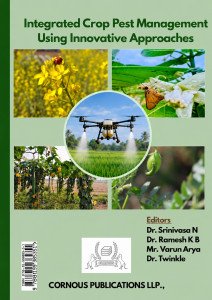
Editorial Book
Book Title: Integrated Crop Pest Management Using Innovative Approaches
OPEN ACCESS | Published on : 23-Jun-2026 | Pages: 100-111 | Doi : 10.37446/edibook252025/100-111
Pheromone-Mediated Mating Disruption for Area Wide Pest Management - Evidence from a Case Study of Cotton Pink Bollworm
- Kavadana Sankara Rao
- Assitant Professor, Department of Entomology, Bihar Agricultural College, Bihar Agricultural University, Sabour Bhagalpur, India.
- Ramana Narava
- Research Scientist, Crystal Crop Protection Limited, Guntur, Andhra Pradesh, India.
- Adarsha SK
- Assitant Professor, Department of Entomology, Bihar Agricultural College, Bihar Agricultural University, Sabour Bhagalpur, India.
- Sankarganesh E
- Assitant Professor, Department of Entomology, Bihar Agricultural College, Bihar Agricultural University, Sabour Bhagalpur, India.
- Hemanth K
- Research Scholar, Department of Entomology, Bihar Agricultural College, Bihar Agricultural University, Sabour Bhagalpur, India.
- Saurabh Tripathi
- Associate Vice President - Field Biology, Crystal Crop Protection Ltd, New Delhi, India.
Abstract
Insects utilize information-carrying molecules known as pheromones for intraspecific communication. These pheromones are essential for mate-finding and reproduction, oviposition, defence, and social organization. It has been found that interfering with pheromone-mediated sexual communication is one of the most benign and sustainable approaches to insect pest management. Consequently, pheromone-mediated mating disruption (MD) has emerged as one of the most innovative pest management strategies. By disrupting chemical communication between male and female insects, this technique suppresses mating and population growth without directly killing the target pest, thereby reducing dependence on conventional insecticides. The success of mating disruption is reflected in its adoption across more than one million hectares worldwide. Success stories have been widely reported in orchard and vineyard production systems, particularly in apple and grape crops, for the management of various lepidopteran moth pests. In annual crops, the area-wide management of cotton pink bollworm through MD technology represents one of the most notable examples of successful pest suppression. Recent advances in pheromone delivery systems, such as passive dispensers, microencapsulated formulations, SPLAT technologies, aerosol puffers, and next-generation biodegradable formulations, are expected to provide significant advancements in transforming area-wide pest management approaches in the near future. This chapter provides a comprehensive overview of pheromone-mediated mating disruption against insect pests. It comprehensively discusses the evolution and mechanisms of mating disruption, pheromone formulations and delivery systems used in MD programmes, successful examples of the technology's application against major insect pests, and a case study on the area-wide management of cotton pink bollworm are critically examined.
Keywords
Pheromones, Mating disruption, Dispensers, orchard pests, cotton pink bollworm, Area wide Pest management
References
Abd El-Ghany, N. M. (2020). Pheromones and chemical communication in insects. In D. Kontogiannatos, A. Kourti, & K. F. Mendes (Eds.), Pests, weeds and diseases in agricultural crop and animal husbandry production (pp. 16–30). Intech Open.
Asif, M. U., Muhammad, R., Awais, M., Sohail, M., & Khuhro, N. H. (2025). Management of pink bollworm (Pectinophora gossypiella) through mating disruption: An environment-friendly technique. Pakistan Journal of Zoology, Advance online publication.
Babar, M. H., Sarwar, G., Khan, A. M. J. E. D., Hameed, A., Mahmood, K., Tauseef, M., & Tabassum, M. I. (2022). Bio-efficacy of PB-Rope (L) as mating disruptant against pink bollworm, Pectinophora gossypiella (Saunders) in cotton. Plant Cell Biotechnology and Molecular Biology, 23(23–24), 33–42.
Benelli, G., Lucchi, A., Thomson, D., & Ioriatti, C. (2019). Sex pheromone aerosol devices for mating disruption: Challenges for a brighter future. Insects, 10(10), 308.
Butenandt, A., Beckmann, R., Stamm, D., & Hecker, E. (1959). The sex attractant of the silkworm moth Bombyx mori: Isolation, purification, and determination of structure. Zeitschrift für Naturforschung B, 14, 283–284.
Cardé, R. T. (2021). Mating disruption with pheromones for control of moth pests in area-wide management programmes. In J. Koul, A. Cuperus, & N. Elliott (Eds.), Area-wide integrated pest management (pp. 779–794). CRC Press.
Cardé, R. T., & Minks, A. K. (1995). Control of moth pests by mating disruption: Successes and constraints. Annual Review of Entomology, 40(1), 559–585.
Cocco, A., Deliperi, S., & Delrio, G. (2013). Control of Tuta absoluta (Meyrick) (Lepidoptera: Gelechiidae) in greenhouse tomato crops using the mating disruption technique. Journal of Applied Entomology, 137(1–2), 16–28.
Daane, K. M., Cooper, M. L., Mercer, N. H., Hogg, B. N., Yokota, G. Y., Haviland, D. R., Welter, S. C., Cave, F. E., Sial, A. A., & Boyd, E. A. (2021). Pheromone deployment strategies for mating disruption of a vineyard mealybug. Journal of Economic Entomology, 114(6), 2439–2451.
Doane, C. C., & Brooks, T. W. (1981). Research and development of pheromones for insect control with emphasis on the pink bollworm. In E. R. Mitchell (Ed.), Management of insect pests with semiochemicals: Concepts and practice (pp. 285–303). Springer.
Gaston, L. K., Kaae, R. S., Shorey, H. H., & Sellers, D. (1977). Controlling the pink bollworm by disrupting sex pheromone communication between adult moths. Science, 196(4292), 904–905.
Ghauri, Z. A. (2025). PB Rope dispenser technology for pink bollworm suppression in Punjab cotton. Ecofriendly, 2(1), 29–36.
Grefenstette, B., El-Lissy, O., & Staten, R. T. (2009). Pink bollworm eradication plan in the United States. United States Department of Agriculture, Animal and Plant Health Inspection Service.
Gut, L. J., Adams, C., Miller, J., McGhee, P., & Thomson, D. (2019). Biological control in integrated management of deciduous fruit insect pests: The use of semiochemicals. In X. Xu & M. Fountain (Eds.), Integrated management of diseases and insect pests of tree fruit (pp. 571–662). Burleigh Dodds Science Publishing.
Higbee, B. S., & Burks, C. S. (2021). Individual and additive effects of insecticide and mating disruption in integrated management of navel orangeworm in almonds. Insects, 12(2), 188.
Ioriatti, C., & Lucchi, A. (2016). Semiochemical strategies for tortricid moth control in apple orchards and vineyards in Italy. Journal of Chemical Ecology, 42(6), 571–583.
Kehat, M., Anshelevich, L., Gordon, D., Harel, M., & Dunkelblum, E. (1998). Evaluation of Shin-Etsu twist-tie rope dispensers by the mating table technique for disrupting mating of the cotton bollworm, Helicoverpa armigera (Lepidoptera: Noctuidae), and the pink bollworm, Pectinophora gossypiella (Lepidoptera: Gelechiidae). Bulletin of Entomological Research, 88(2), 141–148.
Knight, A. L., Larson, T. L., Ketner, K., Hilton, R., & Hawkins, L. (2008). Field evaluations of concentrated spray applications of microencapsulated sex pheromone for codling moth (Lepidoptera: Tortricidae). Environmental Entomology, 37(4), 980–989.
Knight, A. L., Preti, M., & Basoalto, E. (2025). What can we learn from dissecting tortricid females about the efficacy of mating disruption programs? Insects, 16(3), 248.
Mayee, C. D., Chaudhary, B., Panchbhai, R., Annepu, A. R., & Kapur, R. D. (2023). Mega-field demonstration of management of pink bollworm, Pectinophora gossypiella, in rain-fed cotton using mating disruption technology. Indian Journal of Plant Protection, 50(4), 115–119.
Miller, J. R., & Gut, L. J. (2015). Mating disruption for the 21st century: Matching technology with mechanism. Environmental Entomology, 44(3), 427–453.
Mohamed, H. O., El-Heneidy, A. H., Ali, A. G., & Awad, A. A. (2017). Non-chemical control of the pink and spiny bollworms in cotton fields at Assiut Governorate, Upper Egypt. II. Utilization of the egg parasitoid, Trichogrammatoidea bactrae. Egyptian Journal of Biological Pest Control, 26, 807–813.
Padimi, V., Manisha, B. L., Singh, S. K., & Mishra, V. K. (2023). Communication in insects: A review. Journal of Experimental Zoology India, 26(2), 1317–1327.
Patil, S. B. (2007). Mating disruption using PB Rope L: A promising option for pink bollworm (Pectinophora gossypiella Saunders) management in cotton.
Petkevicius, K., Löfstedt, C., & Borodina, I. (2020). Insect sex pheromone production in yeasts and plants. Current Opinion in Biotechnology, 65, 259–267.
Shangguan, W., Song, X., Chen, H., Xu, H., Huang, Q., & Cao, L. (2025). How to control the release behavior of insect sex pheromones using nanomicro fiber: Insights from experiment and molecular dynamics simulation. Journal of Agricultural and Food Chemistry, 73(22), 13366–13380.
Sreenivas, A. G., Markandeya, G., Harischandra Naik, R., Usha, R., Hanchinal, S. G., & Badariprasad, P. R. (2021). SPLAT-PBW: An eco-friendly, cost-effective mating disruption tool for the management of pink bollworm on cotton. Crop Protection, 149, 105784.
Staten, R. T., & Walters, M. L. (2021). Technology used by field managers for pink bollworm eradication with its successful outcome in the United States and Mexico. In J. Koul, A. Cuperus, & N. Elliott (Eds.), Area-wide integrated pest management (pp. 51–92). CRC Press.
Staten, R. T., Flint, H. M., Weddle, R. C., Quintero, E., Zariti, R. E., Finnell, C. M., Hernandez, M., & Yamamoto, A. (1987). Pink bollworm (Lepidoptera: Gelechiidae): Large-scale field tests with a high-rate gossyplure formulation. Journal of Economic Entomology, 80, 1267–1271.
Suckling, D. M. (2000). Issues affecting the use of pheromones and other semiochemicals in orchards. Crop Protection, 19(8–10), 677–683.
Unlu, L., & Mezreli, E. (2011). Control of the pink bollworm Pectinophora gossypiella by the mating disruption technique on cotton in a semi-arid region of Turkey. Phytoparasitica, 39(1), 19–25.
Witzgall, P., Kirsch, P., & Cork, A. (2010). Sex pheromones and their impact on pest management. Journal of Chemical Ecology, 36(1), 80–100.
Zada, A., Falach, L., & Byers, J. A. (2009). Development of sol–gel formulations for slow release of pheromones. Chemoecology, 19(1), 37–45.
Indexing In




Types of Books We Publish




Uniqueness of our Publication

DOI Assignment

ISBN Registration

Online Publication

High Visibility

Open & Closed Access
DOI Assignment
ISBN Registration
Online Publication
High Visibility