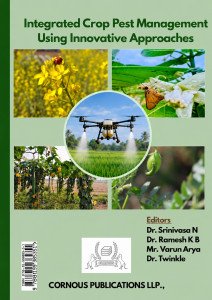
Editorial Book
Book Title: Integrated Crop Pest Management Using Innovative Approaches
OPEN ACCESS | Published on : 16-Apr-2026 | Pages: 63-73 | Doi : 10.37446/edibook252025/63-73
Pest management strategies in organic farming
- Ranjith. H. V
- ICAR-IIFSR, Modipuram, Uttar Pradesh, India.
- Divija S. D
- ICAR-DMAPR, Anand, Gujarat, India.
- Raghuteja P. V
- RySS-APCNF, Andra Pradesh, India.
- Arya P. S
- CCR(PG) College, Muzaffarnagar, Uttar Pradesh, India.
Abstract
Organic crop protection prioritizes ecological resilience and preventive measures over curative chemical control, aiming to maintain healthy soils, diverse agro-ecosystems and market-acceptable produce. This chapter describes the major strategies used in organic insect pest and disease management, including cultural and agronomic modifications (crop rotation, planting date, fertility and water management, tillage and mulches), conservation, and habitat manipulation to support natural enemies (nectar/pollen resources, refugia, hedgerows and cover crops), augmentative and classical biological control (predators, parasitoids, and entomopathogens), botanical and animal-derived formulations (neem products, Panchagavya, and cow urine derivatives), semiochemical tools (pheromone monitoring, mating disruption, and mass trapping), and organically acceptable materials (kaolin, insecticidal soaps, spinosad and microbial biopesticides). Organic farming practices do not encourage the application of synthetic chemicals or genetically modified organisms (GMOs), making pest control challenging. Constraints, including lower and variable efficacy, higher input costs, limited registered products, and market/infrastructure gaps, are discussed along with research priorities. The chapter concludes that organic pest management is not a single panacea but a suite of context-specific practices that require policy, research and market support for scaling.
Keywords
Botanicals, biodiversity, neem, organic farming, pest management, pesticides
References
Alvares, C. (1996). The organic farming sourcebook. The Other India Press, Mapusa, Goa, India.
Ambekar, J. S., Pawar, A. S., & Sakhare, M. V. (2000). Bio-efficacy of certain neem products against okra fruit borer.
Babu, P. B. S., Nair, M. S., & Sumitha, B. (1997). Antifeedant and insecticidal effects of some plant extracts against castor semilooper Achaea janata Linn. Journal of Insect Science, 10(2): 179-80
Baggen, L. R., Gurr, G. M., & Meats, A. (1999). Flowers in tri‐trophic systems: mechanisms allowing selective exploitation by insect natural enemies for conservation biological control. Entomologia experimentalis et applicata, 91(1), 155-161.
Baitha, A., Hameed, S. F., & Singh, R. (2000a). Effectiveness and economics of various treatments and their impact on spider populations in rice ecosystems. Annals of Plant Protection Sciences (India)., 8(1).
Baitha, A., Hameed, S. F., & Singh, R. (2000b). Relative toxicity of neem products against the larvae of rice leaf folder. Indian Journal of Entomology (India)., 62(1).
Bhattacharyya, P., & Chakraborty, G. (2005). Current status of organic farming in India and other countries.
Chavan, A. A., Shinde, B. D., Sanap, P. B., & Kengare, M. N. (2020). Efficacy of biopesticides against thrips (Scirtothrips dorsalis Hood) infesting chilli (Capsicum annuum L.). Journal of Entomology and Zoology Studies, 8(6), 370-373.
Daisy, B. H., Strobel, G. A., Castillo, U., Ezra, D., Sears, J., Weaver, D. K., & Runyon, J. B. (2002). Naphthalene, an insect repellent, is produced by Muscodor vitigenus, a novel endophytic fungus. Microbiology, 148(11), 3737-3741.
Gaur, R. B., & Sharma, R. N. Validation of some traditional wisdom of farming communities of semi-arid region of Rajasthan, India-Regional review. In Proceedings of the international conference on traditional practices in conservation agriculture (pp. 142-51).
Hagen, K. S., Sawall, E. J., & Tassan, R. L. (1971). The use of food sprays to increase effectiveness of entomophagous insects.
Haldhar, S. M., Jat, G. C., Deshwal, H. L., Gora, J. S., & Singh, D. (2017). Insect pest and disease management in organic farming. Book ‘Towards Organic Agriculture’ edited by B. Gangwar and NK Jat. Today & Tomorrow’s Publishers, New Delhi, Page, 359-390.
Hammerschmidt R. 2007. Introduction: definitions and some history. In: Walters D, Newton A, Lyon G, eds. Induced resistance for plant disease control: a sustainable approach to crop protection. Oxford, UK: Blackwell Publishing, 1-8.
Jackson, D. M., Canhilal, R., & Carner, G. R. (2005). Trap monitoring squash Vine Borers in cucurbits1, 2. Journal of Agricultural and Urban Entomology, 22(1), 27-39.
James, D. G. (2003). Field evaluation of herbivore-induced plant volatiles as attractants for beneficial insects: methyl salicylate and the green lacewing, Chrysopa nigricornis. Journal of chemical ecology, 29(7), 1601-1609.
Kaul, O. and Dhaliwal, S. (2000). Phytochemical Biopesticides. Hardwood Academic Publications Amsterdam, The Netherlands.
Landis, D. A., Wratten, S. D., & Gurr, G. M. (2000). Habitat management to conserve natural enemies of arthropod pests in agriculture. Annual review of entomology, 45(1), 175-201.
Mani, M. (2022). Organic pest management in horticultural crops. Trends in horticultural entomology, 211-241.
Mensah, R. K. (1997). Local density responses of predatory insects of Helicoverpa spp. to a newly developed food supplement 'Envirofeast' in commercial cotton in Australia. International Journal of Pest Management, 43(3), 221-225.
Orr, D. B., Landis, D. A., Mutch, D. R., Manley, G. V., Stuby, S. A., & King, R. L. (1997). Ground cover influence on microclimate and Trichogramma (Hymenoptera: Trichogrammatidae) augmentation in seed corn production. Environmental Entomology, 26(2), 433-438.
Palekar, S. (2016). Zero Budget Natural Farming. Amravati, Maharashtra, India: Zero Budget Natural Farming Research, Development & Extension Movement.
PAU. (2017). Package of Practices for Crops of Punjab, Kharif 2017. Punjab Agricultural University, Ludhiana, pp 203.
Pontin, D. R., Wade, M. R., Kehrli, P., & Wratten, S. D. (2006). Attractiveness of single and multiple species flower patches to beneficial insects in agroecosystems. Annals of Applied Biology, 148(1), 39-47.
Rosen, J. D., & Zang, X. (2007). “Photolysis of two pesticides used by organic farmers: sabadilla and ryania”. In Crop Protection Products for Organic Agriculture, ACS Symposium Series. Vol 947 Edited by: Felsot, A. S. and Racke, K. D. 222 – 229. Washington, D.C.: American Chemical Society.
Rythu Sadhikara Samstha (RySS) (2020). Andhra Pradesh Community Managed Natural Farming (APCNF): Technical Manual. Government of Andhra Pradesh, India.
Sharma, A. K., & Goyal, R. K. (2000). Addition in tradition: Agroforestry in the arid zone of India. LEISA India, 2(3), 19-20.
Srinivasan, K. (1992). The development and adoption of integrated pest management for major pests of cabbage using Indian mustard as a trap crop. In Diamondback Moth and Other Cruciferous Pests. Proc. 2nd Intl. Wkshp., Asian Veg. Res. and Dev. Ctr., Shunhua, Taiwan, 10-14.
Srinivasan, K., & Veeresh, G. K. (1986). The development and comparison of visual damage thresholds for the chemical control of Plutella xylostella and Crocidolomia binotalis on cabbage in India. International Journal of Tropical Insect Science, 7(4), 547-557.
Sticher, L., Mauch-Mani, B., & Métraux, A. J. (1997). Systemic acquired resistance. Annual review of phytopathology, 35(1), 235-270.
Surekha, J., & Rao, P. A. (2000). Management of fruit borer of bhendi with organic sources of NPK and certain insecticides and its effect on bhendi yield. Pestology, 24(8), 35-39.
Van Bruggen, A. H. (1995). Plant disease severity in high-input compared to reduced-input and organic farming systems. Plant disease, 79(10), 976-984.
Yue, Q., Wang, C., Gianfagna, T. J., & Meyer, W. A. (2001). Volatile compounds of endophyte-free and infected tall fescue (Festuca arundinacea Schreb.). Phytochemistry, 58(6), 935-941.
Zangger, A. (1994). The positive influence of strip-management on carabid beetles in a cereal field: accessibility of food and reproduction in Poecilus cupreus. In Carabid beetles: Ecology and evolution (pp. 469-472). Dordrecht: Springer Netherlands.
Indexing In




Types of Books We Publish




Uniqueness of our Publication

DOI Assignment

ISBN Registration

Online Publication

High Visibility

Open & Closed Access
DOI Assignment
ISBN Registration
Online Publication
High Visibility