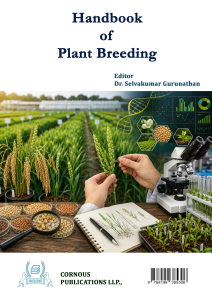
Handbook of Plant Breeding
- Selvakumar Gurunathan
- Assistant Professor (Genetics and Plant Breeding), SRM College of Agricultural Sciences, SRM Institute of Science and Technology, Vendhar Nagar, Baburayanpettai, Elapakkam (Post), Chengalpattu (Dt.), Tamil Nadu, India.
Plant breeding has played a pivotal role in the advancement of agriculture, ensuring food security, improving nutritional quality, and enhancing resilience to biotic and abiotic stresses. In the face of rapid population growth, climate change, shrinking natural resources, and evolving agricultural challenges, the development of improved crop varieties has become more critical than ever. The book Handbook of Plant Breeding has been conceived to address these challenges by providing a comprehensive and updated reference on the principles, methods, and modern advances in plant breeding.
This handbook presents an integrated overview of classical breeding approaches and contemporary molecular and genomic technologies. The chapters cover the fundamental principles of genetics and breeding, methods of crop improvement, selection strategies, and breeding for yield, quality, and resistance to pests, diseases, and environmental stresses. In addition, the book highlights emerging tools such as marker-assisted selection, genomic selection, mutation breeding, genome editing (including CRISPR/Cas systems), bioinformatics, and proteomics, which are transforming modern plant breeding practices.
Recognizing the importance of sustainability, the handbook of Plant Breeding emphasizes climate-resilient breeding, conservation of plant genetic resources, and the role of breeding in sustainable agricultural systems. Contributions also explore breeding of major field crops, horticultural crops, and vegetables, integrating real-world case studies and practical examples that link theory with application.
The Handbook of Plant Breeding is designed to serve as a valuable resource for undergraduate and postgraduate students, researchers, plant breeders, academicians, and agricultural professionals. By bringing together expertise from diverse domains, this volume aims to facilitate knowledge exchange, encourage innovation, and support the development of improved crop varieties that meet present and future global demands.
We hope that this handbook will contribute significantly to education, research, and practical breeding programs, and inspire continued advancements in plant breeding for sustainable agriculture and food security.
-
Breeding for Nutritional Traits
PAID ACCESS | Published on : 04-Feb-2026 | Doi :10.37446/ edibook152024 /1-7 | Pages : 1-7
-
Gene Editing and CRISPR - Cas9 Technology
PAID ACCESS | Published on : 04-Feb-2026 | Doi :10.37446/edibook152024/8-18 | Pages : 8-18
-
Molecular Techniques of Crop Breeding
OPEN ACCESS | Published on : 12-Feb-2026 | Pages : 19-29
-
Molecular Breeding - Pioneering Advances in Genetic Crop Improvement
PAID ACCESS | Published on : 24-Mar-2026 | Doi :10.37446/edibook152024/30-45 | Pages : 30-45
-
Genome-Wide Association Studies - Unveiling hidden traits in Modern Plant Breeding
PAID ACCESS | Published on : 20-May-2026 | Doi :10.37446/edibook152024/46-55 | Pages : 46-55
-
Utilizing Marker Assisted Selection (MAS) in Modern Plant Breeding
PAID ACCESS | Published on : 15-Jun-2026 | Doi :10.37446/edibook152024/56-75 | Pages : 56-75
-
Principles of Genetics and Plant Breeding
PAID ACCESS | Published on : 06-Jul-2026 | Doi :10.37446/edibook152024/76-90 | Pages : 76-90
-
Mungbean and Urdbean Breeding
OPEN ACCESS | Published on : 27-Jul-2026 | Doi :10.37446/edibook152024/91-137 | Pages : 91-137
Indexing In




Types of Books We Publish




Uniqueness of our Publication

DOI Assignment

ISBN Registration

Online Publication

High Visibility

Open & Closed Access
DOI Assignment
ISBN Registration
Online Publication
High Visibility
Open & Closed Access