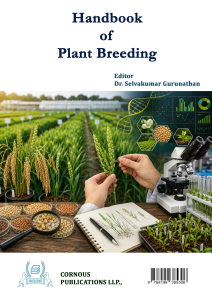
Editorial Book
Book Title: Handbook of Plant Breeding
OPEN ACCESS | Published on : 12-Feb-2026 | Pages: 19-29 |
Molecular Techniques of Crop Breeding
- Reena Kumari
- Assistant Professor, Department of Biotechnology, College of Horticulture and Forestry, Neri-Hamirpur, Himachal Pradesh, India.
- Minerva Ghani
- Assistant Professor, Department of Biotechnology, Government Degree College, Anantnag, Jammu and Kashmir, India.
- Himani Sharma
- Assistant Professor, Department of Biotechnology, College of Horticulture and Forestry, Neri-Hamirpur, Himachal Pradesh, India.
- Karuna Dhiman
- Assistant Professor, Department of Biotechnology, College of Horticulture and Forestry, Neri-Hamirpur, Himachal Pradesh, India.
- Aditi Thakur
- Scientist, Department of Biotechnology, College of Horticulture and Forestry, Neri-Hamirpur, Himachal Pradesh, India.
Abstract
Molecular approaches are considered as a versatile way to scan out diverse genomic resources which could facilitate to widen up the genetic pool of crop species and further adopted to develop superior cultivars with a wide range of economically demanding traits. In this chapter the tools like RNA interference, CRISPR, Marker assisted selection and genomic selection tools are discussed. The advanced molecular tools has accelerated the probability to manipulate and speed up the crop breeding programme.
Keywords
Crop breeding, RNA interference, CRISPR, Marker Assisted Selection, Genomic Selection
References
Ahmad, M., Fazeli, A., & Arminian, A. (2017). Identification of informative ISSR marker linked to resistance to powdery mildew in barley (Hordeum vulgare) at adult growth stage. Journal of Crop Breeding, 9(22), 31–40.
Ashkani, S., Rafii, M. Y., Meon, S., Abdullah, S. N. A., Ibrahim, R., Rahim, H. A., & Latif, A. (2011). Analysis of simple sequence repeat markers linked with blast disease resistance genes in a segregating population of rice (Oryza sativa). Genetics and Molecular Research, 10, 1345–1355.
Baite, M. S., Upadhyay, B. K., & Dubey, S. C. (2020). Development of a sequence-characterized amplified region marker for detection of Ascochyta rabiei causing Ascochyta blight in chickpea. Folia Microbiologica, 65, 103–108.
Balardin, R. S., & Kelly, J. D. (1997). Effect of common bean gene pools on Colletotrichum lindemuthianum variability. Phytopathology, 87.
Barrangou, R., Fremaux, C., Deveau, H., Richards, M., Boyaval, P., Moineau, S., & Horvath, P. (2007). CRISPR provides acquired resistance against viruses in prokaryotes. Science, 315, 1709–1712.
Bernardo, R., & Yu, J. (2007). Prospects for genome-wide selection for quantitative traits in maize. Crop Science, 47, 1082–1090.
Bindu, N., Vijay, K., Sheikh, R., Sadhna, M., Vivek, K., Joakim, P. E., Naresh, K., Akhilesh, K., Piyush, P., Arun, K. G., Javed, M. K., & Sarvesh, R. (2024). Biofortification as a solution for addressing nutrient deficiencies and malnutrition. Heliyon, 10(9), Article e30595.
Bonfim, K., Faria, J. C., Nogueira, E. O., Mendes, E. A., & Aragão, F. J. (2007). RNAi-mediated resistance to bean golden mosaic virus in genetically engineered common bean (Phaseolus vulgaris). Molecular Plant–Microbe Interactions, 20, 717–726.
Burgueño, J., de los Campos, G., Weigel, K., & Crossa, J. (2012). Genomic prediction of breeding values when modeling genotype x environment interaction using pedigree and dense molecular markers. Crop Science, 52, 707–719.
Dunoyer, P., Himber, C., & Voinnet, O. (2006). Induction, suppression, and requirement of RNA silencing pathways in virulent Agrobacterium tumefaciens infections. Nature Genetics, 38, 258–263.
Eltaher, S., Li, J., Freeman, B., Singh, S., & Ali, G. S. (2025). A genome-wide association study identified SNP markers and candidate genes associated with morphometric fruit quality traits in mangoes. BMC Genomics, 26, Article 120.
Eschen-Lippold, L., Landgraf, R., Smolka, U., Schulze, S., Heilmann, M., Heilmann, I., Hause, G., & Rosahl, S. (2012). Activation of defence against Phytophthora infestans in potato by down-regulation of syntaxin gene expression. New Phytologist.
Fire, A. Z., Xu, S., Montgomery, M. K., Kostas, S. A., Driver, S. E., & Mello, C. C. (1998). Potent and specific genetic interference by double-stranded RNA in Caenorhabditis elegans. Nature, 391, 806–811.
Flores, T., Karpova, O., Su, X., Zeng, P., Bilyeu, K., Sleper, D. A., Nguyen, H. T., & Zhang, Z. J. (2008). Silencing of GmFAD3 gene by siRNA leads to low α-linolenic acid levels in soybean. Transgenic Research, 17, 839–850.
Gao, J., Gao, L., Chen, W., Huang, J., Qing, D., Pan, Y., Ma, C., Wu, H., Zhou, W., Li, J., Yang, X., Dai, G., & Deng, G. (2024). Genetic effects of grain quality enhancement in indica hybrid rice: Insights for molecular design breeding. Rice, 17.
Gautam, P., Kumar, R., Feroz, Z., Vijayaraghavalu, S., & Kumar, M. (2022). RNA interference technology in plants: Mechanisms and applications in crop improvement. In Plant genomics for sustainable agriculture (pp. 265–290).
Gebremeskel, H., Muhammad, J. U., Zhu, H., Li, B., Zhao, S., Yang, P., Lu, X., He, N., & Liu, W. (2023). Genetic mapping and molecular characterization of the delayed green gene dg in watermelon (Citrullus lanatus). Frontiers in Plant Science, 14. https://doi.org/10.3389/fpls.2023.1152644
Ghildiyal, M., Seitz, H., Horwich, M. D., Li, C., Du, T., Lee, S., & Zamore, P. D. (2008). Endogenous siRNAs derived from transposons and mRNAs in Drosophila somatic cells. Science, 320(5879), 1077–1081.
Gustavo, H. F. K., Camila, F. O. J., Sarah, Z. A. T., Adriana, C. M. D., Carla, R. C. F., Adelar, M., Frederico, D., José, I. B., & Rubens, O. N. (2016). Genetic diversity and apple leaf spot disease resistance assessed by SSR markers. Crop Breeding and Applied Biotechnology, 16, 189–196.
Habier, D., Fernando, R. L., & Garrick, D. J. (2013). Genomic BLUP decoded: A look into the black box of genomic prediction. Genetics, 194, 597–607. https://doi.org/10.1534/genetics.113.152207
Habier, D., Fernando, R. L., Kizilkaya, K., & Garrick, D. J. (2011). Extension of the Bayesian alphabet for genomic selection. BMC Bioinformatics, 12, Article 186.
Hily, J. M., Ravelonandro, M., Damsteegt, V., Basset, C., Petri, C., Liu, Z., & Scorza, R. (2007). Plum pox virus coat protein gene intron–hairpin RNA constructs provide resistance in plants. Journal of the American Society for Horticultural Science, 132, 850–858.
Hu, Y., You, J., Li, C., Pan, F., & Wang, C. (2019). The Heterodera glycines effector Hg16B09 suppresses plant defence responses. Plant Science, 289, 110271.
Joshi, I., Kumar, A., Kohli, D., Singh, A. K., Sirohi, A., Subramaniam, K., Chaudhury, A., & Jain, P. K. (2020). Host-delivered RNAi-mediated silencing confers resistance to root-knot nematodes in Arabidopsis. Plant Science, 298, 110592.
Juliana, P., Singh, R. P., Braun, H. J., Huerta-Espino, J., Crespo-Herrera, L., & Govindan, V. (2020). Genomic selection for grain yield in CIMMYT wheat breeding. Frontiers in Plant Science, 11. https://doi.org/10.3389/fpls.2020.564183
Kaur, H., & Talekar, N. (2024). The role of RNA interference in crop enhancement: Mechanism and application. Journal of Experimental Agriculture International, 46(6), 351–370.
Kim, S. J., Park, J. S., Park, T., Lee, H. M., Choi, J. R., & Park, Y. D. (2021). Development of molecular markers associated with resistance to gray mold disease in onion (Allium cepa L.) through RAPD-PCR and transcriptome analysis. Horticulturae, 7(11), Article 436. https://doi.org/10.3390/horticulturae7110436
Kumar, B., Choudhary, M., Kumar, P., Kumar, K., Kumar, S., Singh, B. K., Lahkar, C., Meenakshi, Kumar, P., Dar, Z. A., Devlash, R., Hooda, K. S., Guleria, S. K., & Rakshit, S. (2022). Population structure analysis and association mapping for Turcicum leaf blight resistance in tropical maize using SSR markers. Genes, 13(4), Article 618. https://doi.org/10.3390/genes13040618
Kumari, R., Ghani, M., Sharma, H., Thakur, N., Dhiman, K., Thakur, A., Thakur, K., & Sharma, D. (2024). Genomic selection for quantitative disease resistance in plants. In Biotechnological advances for disease tolerance in plants (pp. 47–72). Springer.
Li, Y., Wang, K., Lu, Q., Du, J., Wang, Z., Wang, D., Sun, B., & Li, H. (2017). Transgenic Nicotiana benthamiana plants expressing a hairpin RNAi construct of a nematode Rs-cps gene exhibit enhanced resistance to Radopholus similis. Scientific Reports, 7(1), Article 13126. https://doi.org/10.1038/s41598-017-13459-3
Mathiazhagan, M., Chidambara, B., Hunashikatti, L. R., & Ravishankar, K. V. (2021). Genomic approaches for improvement of tropical fruits: Fruit quality, shelf life, and nutrient content. Genes, 12, Article 1881. https://doi.org/10.3390/genes12111881
Missiou, A., Kalantidis, K., Boutla, A., Tzortzakaki, S., Tabler, M., & Tsagris, M. (2004). Generation of transgenic potato plants highly resistant to potato virus Y through RNA silencing. Molecular Breeding, 14, 185–197.
Muhammad, T., Zhang, F., Zhang, Y., & Liang, Y. (2019). RNA interference: A natural immune system of plants to counteract biotic stressors. Cells, 8(1), Article 38. https://doi.org/10.3390/cells8010038
Mulepati, S., Heroux, A., & Bailey, S. (2014). Crystal structure of a CRISPR RNA-guided surveillance complex bound to single-stranded DNA target. Science, 345, 1479–1484. https://doi.org/10.1126/science.1256996
Nair, R. J., & Pandey, M. K. (2021). Role of molecular markers in crop breeding: A review. Agricultural Reviews, 45(1), 52–59.
Nakatsuka, T., Mishiba, K. I., Kubota, A., Abe, Y., Yamamura, S., Nakamura, N., Tanaka, Y., & Nishihara, M. (2010). Genetic engineering of novel flower color by suppression of anthocyanin modification genes in gentian. Journal of Plant Physiology, 167, 231–237.
Osei, M. K., Danquah, E., Danquah, A., Massoudi, M., Maxwell, D., Adu-Dapaah, H., & Blay, E. (2019). Validation of SNP markers linked to alc gene for long shelf life of tomato. Journal of Crop Improvement, 33(5), 669–682.
Pandey, A. K., Rubiales, D., Wang, Y., Fang, P., Sun, T., Liu, N., & Xu, P. (2021). Omics resources and omics-enabled approaches for achieving high productivity and improved quality in pea (Pisum sativum L.). Theoretical and Applied Genetics, 134(3), 755–776.
Perez, R. P., & Campos, D. L. G. (2014). Genome-wide regression and prediction with the BGLR statistical package. Genetics, 198, 483–495. https://doi.org/10.1534/genetics.114.164442
Perez, R. P., Crossa, J., Rutkoski, J., Poland, J., Singh, R., & Legarra, A. (2017). Single-step genomic and pedigree genotype × environment interaction models for predicting wheat lines. The Plant Genome, 10, Article 89.
Prodhomme, C., Vos, P. G., Paulo, M. J., Tammes, J. E., Visser, R. G. F., Vossen, J. H., & van Eck, H. J. (2020). Distribution of P1 (D1) wart disease resistance in potato germplasm and GWAS identification of haplotype-specific SNP markers. Theoretical and Applied Genetics, 133(6), 1859–1871.
Riechen, J. (2007). Establishment of broad-spectrum resistance against Blumeria graminis f. sp. tritici in Triticum aestivum by RNAi-mediated knock-down of MLO. Journal für Verbraucherschutz und Lebensmittelsicherheit, 2(1), 120.
Saurabh, S., Vidyarthi, A. S., & Prasad, D. (2014). RNA interference: Concept to reality in crop improvement. Planta, 239, 543–564.
Seitz, C., Vitten, M., Steinbach, P., Hartl, S., Hirsche, J., Rathje, W., Treutter, D., & Forkmann, G. (2007). Redirection of anthocyanin synthesis in Osteospermum hybrida by a two-enzyme manipulation strategy. Phytochemistry, 68, 824–833.
Singh, A. K., Rai, R., Singh, B. D., Chand, R., & Srivastava, C. P. (2015). Validation of SSR markers associated with rust (Uromyces fabae) resistance in pea (Pisum sativum L.). Physiology and Molecular Biology of Plants, 21(2), 243–247.
Song, R., Henning, G. W., Wu, Q., Jose, C., Zheng, H., Yan, W., & Lin, H. (2011). Male germ cells express abundant endogenous siRNAs. Proceedings of the National Academy of Sciences of the United States of America, 108(32), 13159–13164.
Tam, O. H., Aravin, A. A., Stein, P., Girard, A., Murchison, E. P., Cheloufi, S., & Hannon, G. J. (2008). Pseudogene-derived small interfering RNAs regulate gene expression in mouse oocytes. Nature, 453(7194), 534–538.
Thiruppathi, A., Salunkhe, S. R., Ramasamy, S. P., Palaniswamy, R., Rajagopalan, V. R., Rathnasamy, S. A., Alagarswamy, S., Swaminathan, M., Manickam, S., & Muthurajan, R. (2024). Unleashing the potential of CRISPR/Cas9 genome editing for yield-related traits in rice. Plants, 13(21), Article 2972.
Tian, B., Li, J., Vodkin, L. O., Todd, T. C., Finer, J. J., & Trick, H. N. (2019). Host-derived gene silencing of parasite fitness genes improves resistance to soybean cyst nematodes. Theoretical and Applied Genetics, 132, 2651–2662.
Tyagi, S., Kumar, R., Kumar, V., Won, S. Y., & Shukla, P. (2021). Engineering disease-resistant plants through CRISPR–Cas9 technology. GM Crops & Food, 12(1), 125–144.
Watanabe, T., Ochiai, H., Sakuma, T., Horch, H. W., Hamaguchi, N., Nakamura, T., & Mito, T. (2012). Non-transgenic genome modifications using zinc-finger and TAL effector nucleases. Nature Communications, 3, Article 1017.
Weise, S. E., Aung, K., Jarou, Z. J., Mehrshahi, P., Li, Z., Hardy, A. C., Carr, D. J., & Sharkey, T. D. (2012). Engineering starch accumulation by manipulation of phosphate metabolism of starch. Plant Biotechnology Journal, 10(5), 545–554.
Woo, J. W., Kim, J., Kwon, S. I., Corvalan, C., Cho, S. W., Kim, H., & Kim, J. S. (2015). DNA-free genome editing in plants with preassembled CRISPR–Cas9 ribonucleoproteins. Nature Biotechnology, 33, 1162–1164.
Zhang, L., Song, Y., Li, J., Liu, J., Zhang, Z., Xu, Y., Fan, D., Liu, M., Ren, Y., Xi, X., Chen, Q., He, J., Xu, W., Song, S., Liu, H., & Ma, C. (2023). Development, identification, and validation of a novel SSR molecular marker for heat resistance of grape based on miRNA. Horticulturae, 9(8), Article 931. https://doi.org/10.3390/horticulturae9080931.
Indexing In




Types of Books We Publish




Uniqueness of our Publication

DOI Assignment

ISBN Registration

Online Publication

High Visibility

Open & Closed Access
DOI Assignment
ISBN Registration
Online Publication
High Visibility