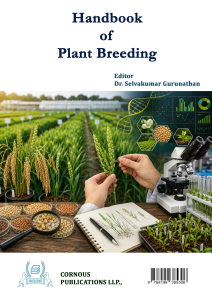
Editorial Book
Book Title: Handbook of Plant Breeding
PAID ACCESS | Published on : 04-Feb-2026 | Pages: 1-7 | Doi : 10.37446/ edibook152024 /1-7
Breeding for Nutritional Traits
- Lalitha R
- Assistant Professor, Genetics and Plant Breeding, Pushkaram College of Agriculture Sciences, Affiliated to TNAU, Accredited by ICAR, Thiruvarankulam, Pudukkottai, Tamil Nadu, India.
Abstract
Major commercially cultivated, consumed cereals, pulses and oilseed are deficient in nutrients, devoid of vitamins and minerals. Over two billion world population suffers due to inadequate amount of nutrient in diet. To overcome the problem of nutritional deficiency, application of classical breeding, biofortification and recent genomic techniques are used as a tool to fight against malnutrition.
Keywords
Consumed cereals, Population, Biofortification, Classical breeding
References
Adeyemo, S. M., & Onilude, A. A. (2013). Enzymatic reduction of anti-nutritional factors in fermenting soybeans by Lactobacillus plantarum isolates from fermenting cereals. Nigerian Food Journal, 31(2), 84-90.
Agarwal, S., Kumar, A., Bhati, K. K., Kaur, G., Shukla, V., Tiwari, S., & Pandey, A. K. (2018). RNAi-mediated downregulation of inositol pentakisphosphate kinase (IPK1) in wheat grains decreases phytic acid levels and increases Fe and Zn accumulation. Frontiers in Plant Science, 9, 259.
Ahmed, E. M. (1986). Lectin quantitation in peanut and soybean seeds. Peanut Science, 13(1), 47.
Amiri, R., Bahraminejad, S., Cheghamirza, K., & Arzani, A. (2020). Genetic analysis of iron and zinc concentrations in bread wheat grains. Journal of Cereal Science, 95, 103077.
Bhati, K. K., Alok, A., Kumar, A., Kaur, J., Tiwari, S., & Pandey, A. K. (2016). Silencing of ABCC13 transporter in wheat reveals its involvement in grain development, phytic acid accumulation and lateral root formation. Journal of Experimental Botany, 67(14), 4379-4389.
Campbell, A. R., & Frey, K. J. (1972). Inheritance of groat protein in interspecific oat crosses. Canadian Journal of Plant Science, 52(5), 735-742.
Endo, A., Saika, H., Takemura, M., Misawa, N., & Toki, S. (2019). A novel approach to carotenoid accumulation in rice callus by mimicking the cauliflower Orange mutation via genome editing. Rice, 12, 1-5.
Gaikwad, K. B., Rani, S., Kumar, M., Gupta, V., Babu, P. H., Bainsla, N. K., & Yadav, R. (2020). Enhancing the nutritional quality of major food crops through conventional and genomics-assisted breeding. Frontiers in Nutrition, 7, 533453.
Goldberg, G. (2003). FLAIR‐FLOW 4: Synthesis report on obesity for health professionals. Nutrition Bulletin, 28(4), 343-354.
Holthaus, J. F., Holland, J. B., White, P. J., & Frey, K. J. (1996). Inheritance of β‐glucan content of oat grain. Crop Science, 36(3), 567-572.
Jia-Ling, Y. & Tzer-Kuan, H. (2011). Generation mean analysis of the mineral element contents in rice. Journal of the Science of Food and Agriculture, 113: 59-68.
Kaushal, P., Kumar, V., & Sharma, H. K. (2012). Comparative study of physicochemical, functional, antinutritional and pasting properties of taro (Colocasia esculenta), rice (Oryza sativa) flour, pigeonpea (Cajanus cajan) flour and their blends. LWT-Food Science and Technology, 48(1), 59-68.
Kulp, K., & Ponte, J. G. (2000). Breads and yeast-leavened bakery foods. In Handbook of Cereal Science and Technology, Revised and Expanded (pp. 539-573). CRC Press.
Margier, M., Georgé, S., Hafnaoui, N., Remond, D., Nowicki, M., Du Chaffaut, L., & Reboul, E. (2018). Nutritional composition and bioactive content of legumes: Characterization of pulses frequently consumed in France and effect of the cooking method. Nutrients, 10(11), 1668.
Pfeiffer, W. H., & McClafferty, B. (2007). HarvestPlus: breeding crops for better nutrition. Crop Science, 47, S-88.
Sarwar, M. H., Sarwar, M. F., Sarwar, M., Qadri, N. A., &Moghal, S. (2013). The importance of cereals (Poaceae: Gramineae) nutrition in human health: A review. Journal of cereals and oilseeds, 4(3), 32-35.
Saxena, K. B., Faris, D. G., Singh, U., & Kumar, R. V. (1987). Relationship between seed size and protein content in newly developed high protein lines of pigeonpea. Plant Foods for Human Nutrition, 36, 335-340.
Singh, S., Gupta, A. K., & Kaur, N. (2012). Influence Of drought and sowing time on protein composition, antinutrients, and mineral contents of wheat. Sci World J 2012: 485751.
Sokrab, A. M., Mohamed Ahmed, I. A., & Babiker, E. E. (2011). Effect of genotype on chemical composition, total energy, antinutrients, and total and extractable minerals of corn. Int. J. Agric. Res. Rev, 1(1), 38-43.
Soldatov, K. I. (1976, June). Chemical mutagenesis in sunflower breeding. In Proc. 7th Int. Sunflower Conf., Krasnodar, USSR (Vol. 27, pp. 352-357). Vlaardingen, the Netherlands: Int. Sunflower Assoc.
Song, J. H., Shin, G., Kim, H. J., Lee, S. B., Moon, J. Y., Jeong, J. C., & Chung, Y. S. (2022). Mutation of GmIPK1 gene using CRISPR/Cas9 reduced phytic acid content in soybean seeds. International Journal of Molecular Sciences, 23(18), 10583.
Indexing In




Types of Books We Publish




Uniqueness of our Publication

DOI Assignment

ISBN Registration

Online Publication

High Visibility

Open & Closed Access
DOI Assignment
ISBN Registration
Online Publication
High Visibility