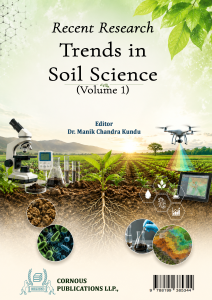
Recent Research Trends in Soil Science (Volume 1)
- Manik Chandra Kundu
- Assistant Professor of Soil Science, Department of Soil Science and Agricultural Chemistry, Institute of Agriculture (Palli Siksha Bhavana), Visva-Bharati, Sriniketan, West Bengal, India.
Soil is the foundation of terrestrial life and one of the most valuable natural resources sustaining agriculture, ecosystems, biodiversity, and human civilization. In recent decades, rapid population growth, climate change, land degradation, pollution, and unsustainable agricultural practices have intensified pressure on soil resources worldwide. These emerging challenges have transformed soil science from a traditional discipline focused primarily on soil fertility and classification into an interdisciplinary science addressing global issues such as food security, environmental sustainability, carbon sequestration, ecosystem resilience, and climate adaptation.
The book Recent Research Trends in Soil Science (Volume 1) has been prepared with the objective of presenting contemporary advances, innovative methodologies, and emerging perspectives in the field of soil science. This volume highlights the latest developments in soil physical, chemical, and biological processes, along with modern technologies that are revolutionizing soil research and management. Particular emphasis has been given to digital soil mapping, remote sensing, GIS and GPS applications, soil microbiology, precision agriculture, sustainable soil management, soil health assessment, and climate-smart agricultural practices.
Recent scientific progress has revealed the immense complexity of soil ecosystems and their critical role in maintaining environmental balance. Advanced analytical tools, molecular techniques, artificial intelligence, sensor technologies, and data-driven approaches are opening new frontiers in understanding soil functions and interactions. Research on soil microorganisms, carbon dynamics, nutrient cycling, and soil restoration strategies has gained remarkable momentum due to their relevance in addressing global environmental concerns.
This volume brings together contributions from researchers, academicians, and experts who have shared their valuable knowledge and findings across diverse domains of soil science. The chapters are designed to provide both fundamental understanding and recent innovations, making the book useful for students, researchers, teachers, policymakers, extension workers, and professionals engaged in agriculture and environmental sciences.
We sincerely hope that this book will serve as a meaningful resource for advancing scientific understanding, encouraging sustainable soil management practices, and inspiring future research in soil science. The editors express their heartfelt gratitude to all contributors, reviewers, and publishers whose support and dedication made this volume possible.
We believe that protecting and understanding soils is essential for ensuring sustainable development and securing the future of humanity. As global attention increasingly turns toward soil health and ecosystem sustainability, this volume aims to contribute to the collective scientific effort toward conserving one of Earth’s most precious resources.
-
Introduction to Recent Research Trends in Soil Science
PAID ACCESS | Published on : 25-May-2026 | Pages : 1-4
-
Soil Pollution - causes, impacts and management strategies
PAID ACCESS | Published on : 25-May-2026 | Pages : 5-20
-
Nanotechnology - Sustainable nutrient management for modern agriculture
PAID ACCESS | Published on : 25-May-2026 | Pages : 21-36
-
Soils of India - their problems and potentials
PAID ACCESS | Published on : 25-May-2026 | Pages : 37-50
-
Soil Erosion - Types, Causes, Impacts, Monitoring Approaches and Management Practices
PAID ACCESS | Published on : 11-Jun-2026 | Doi :10.37446/volbook122026/51-69 | Pages : 51-69
-
Impact of NICRA-Based Climate-Resilient Technologies on Livelihoods in Tribal Villages of Khowai District, Tripura
PAID ACCESS | Published on : 23-Jun-2026 | Pages : 70-82
-
Soil Compaction and Its Effect on Crops
PAID ACCESS | Published on : 25-Aug-2026 | Pages : 83-87
-
Climate-Smart Soil Management
PAID ACCESS | Published on : 26-Aug-2026 | Doi :10.37446/volbook122026/88-102 | Pages : 88-102
Indexing In




Types of Books We Publish




Uniqueness of our Publication

DOI Assignment

ISBN Registration

Online Publication

High Visibility

Open & Closed Access
DOI Assignment
ISBN Registration
Online Publication
High Visibility
Open & Closed Access