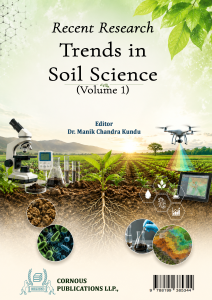
Editorial Book
Book Title: Recent Research Trends in Soil Science (Volume 1)
PAID ACCESS | Published on : 11-Jun-2026 | Pages: 51-69 | Doi : 10.37446/volbook122026/51-69
Soil Erosion - Types, Causes, Impacts, Monitoring Approaches and Management Practices
- Krisanu Golui
- Department of Soil Science, Chaudhary Charan Singh Haryana Agricultural University, Hisar, Haryana, India.
- Ankit Singh
- Department of Soil Science, Chaudhary Charan Singh Haryana Agricultural University, Hisar, Haryana, India.
- Naina Sharma
- Department of Soil Science, Punjab Agricultural University, Ludhiana, Punjab, India.
- Dikshant Sheoran
- Department of Soil Science, Chaudhary Charan Singh Haryana Agricultural University, Hisar, Haryana, India.
- Atul Sharma
- Department of Agronomy, Chaudhary Charan Singh University, Meerut, Uttar Pradesh, India.
- Arpit Sharma
- Department of Soil Science & Agricultural Chemistry, Banaras Hindu University, Varanasi, Uttar Pradesh, India.
- Shobhit Singh
- Department of Soil Science & Agricultural Chemistry, Banaras Hindu University, Varanasi, Uttar Pradesh, India.
- Priyanshi Nautiyal
- Department of Soil Science, G. B. Pant University of Agriculture and Technology, Pantnagar, Uttarakhand, India.
Abstract
Soil erosion is a primary driver of land degradation, leading to loss of fertile topsoil, reducing soil productivity and ecosystem stability. Natural factors like rainfall, strong wind, steep slope, along with human activities like deforestation and improper land-use, accelerate this process. Climate change further amplify erosion risks via extreme weather events. Comprehensive monitoring with field methods, empirical models, and modern tools like remote sensing, geographic information system (GIS), and machine learning is necessary for large-scale evaluation. Adoption of climate-resilient approaches, including agroforestry, conservation agriculture, and watershed management, is need of the hour. These measures support sustainable development goals (SDGs) by promoting food security, climate adaptation, and long-term environmental sustainability. This chapter provides scientific understanding of erosion processes, monitoring tools and management strategies, allowing informed decision-making for land degradation control and climate-smart adaptations. Overall, it aims to bridge theory and practice by presenting soil erosion science in a clear, concise, and modern framework aligned with sustainable land management goals.
Keywords
Soil erosion, land degradation, climate change, climate-resilient approaches, sustainable development goals, environmental sustainability
References
Adhikary, P.P., Hombegowda, H.C., Barman, D., & Madhu, M. (2018). Soil and onsite nutrient conservation potential of aromatic grasses at field scale under a shifting cultivated, degraded catchment in Eastern Ghats, India. International Journal of Sediment Research, 33(3), 340-350. https://doi.org/10.1016/j.ijsrc.2018.01.002
Adimassu, Z., Mekonnen, K., Yirga, C., & Kessler, A. (2014). Effect of soil bunds on runoff, soil and nutrient losses, and crop yield in the central highlands of Ethiopia. Land Degradation & Development, 25(6), 554-564. https://doi.org/10.1002/ldr.2182
Arabameri, A., Chen, W., Blaschke, T., Tiefenbacher, J.P., Pradhan, B., & Tien Bui, D. (2020). Gully head-cut distribution modeling using machine learning methods–A case study of N.W. Iran. Water, 12(1), 16. https://doi.org/10.3390/w12010016
Blanco-Canqui, H., Gantzer, C.J., Anderson, S.H., Alberts, E.E., & Thompson, A.L. (2004). Grass barrier and vegetative filter strip effectiveness in reducing runoff, sediment, nitrogen, and phosphorus loss. Soil Science Society of America Journal, 68(5), 1670-1678. https://doi.org/10.2136/sssaj2004.1670
Borrelli, P., Robinson, D.A., Fleischer, L.R., Lugato, E., Ballabio, C., Alewell, C., Meusburger, K., Modugno, S., Schütt, B., Ferro, V., & Panagos, P. (2017). An assessment of the global impact of 21st century land use change on soil erosion. Nature Communications, 8(1), 2013. https://doi.org/10.1038/s41467-017-02142-7
Dangiso, Y., & Wolka, K. (2024). Fanya Juu terraces improve soil properties of cultivated land in erosion-prone semi-arid area of Ethiopia. Scientific Reports, 14, 25485. https://doi.org/10.1038/s41598-024-77229-5
Doetterl, S., Van Oost, K., & Six, J. (2012). Towards constraining the magnitude of global agricultural sediment and soil organic carbon fluxes. Earth Surface Processes and Landforms, 37(6), 642-655. https://doi.org/10.1002/esp.3198
Douville, H., Allan, R.P., Arias, P.A., Betts, R.A., Caretta, M.A., Cherchi, A., Mukherji, A., Raghavan, K., & Renwick, J. (2022). Water remains a blind spot in climate change policies. PLoS Water, 1(12), e0000058. https://doi.org/10.1371/journal.pwat.0000058
El Mazi, M., Hmamouchi, M., Saber, E.R., Bouchantouf, S., & Houari, A. (2022). Deforestation effects on soil properties and erosion: a case study in the central Rif, Morocco. Eurasian Journal of Soil Science, 11(4), 275-283. https://doi.org/10.18393/ejss.1098600
Freebairn, D.M., Ward, L.D., Clarke, A.L., & Smith, G.D. (1986). Research and development of reduced tillage systems for Vertisols in Queensland, Australia. Soil and Tillage Research, 8, 211-229. https://doi.org/10.1016/0167-1987(86)90335-1
GSP (2017). Global Soil Partnership Endorses Guidelines on Sustainable Soil Management. Available online: http://www.fao.org/global-soil-partnership/resources/highlights/detail/en/c/416516/
Gudino‐Elizondo, N., Biggs, T.W., Castillo, C., Bingner, R.L., Langendoen, E.J., Taniguchi, K.T., Kretzschmar, T., Yuan, Y., & Liden, D. (2018). Measuring ephemeral gully erosion rates and topographical thresholds in an urban watershed using unmanned aerial systems and structure from motion photogrammetric techniques. Land Degradation & Development, 29(6), 1896-1905. https://doi.org/10.1002/ldr.2976
Gyawali, C., De, N., Koley, S., Golui, K., Khanna, C., & Mahinda, A.J. (2024). Defining Framework for Soil Health Assessment for Regenerative Agriculture under Different Land Uses. In A.K. Mishra, S. Sharma & A. Mishra, (Ed.), Key Drivers and Indicators of Soil Health Management: Transitioning from Conventional to Regenerative Agriculture (pp. 73-84). Singapore: Springer Nature Singapore. https://doi.org/10.1007/978-981-97-7564-4_4
He, J., Jiang, X., Lei, Y., Cai, W., & Zhang, J. (2022). Temporal and spatial variation and driving forces of soil erosion on the Loess Plateau before and after the implementation of the Grain-for-Green Project: A case study in the Yanhe River Basin, China. International Journal of Environmental Research and Public Health, 19(14), 8446. https://doi.org/10.3390/ijerph19148446
Kirurhika, A.M., Arunachalam, S., Reddy, A.K., & Suresh, S.B. (2011). Silt sediment analysis for Devarabelekere reservoir using remote sensing and GIS. International Journal of Earth Sciences and Engineering, 4(1), 24-30.
Majoro, F., Wali, U.G., Munyaneza, O., & Naramabuye, F.X. (2023). Sustainability Analysis of Soil Erosion Control in Rwanda: Case Study of the Sebeya Watershed. Sustainability, 15(3), 1969. https://doi.org/10.3390/su15031969
Mentaschi, L., Vousdoukas, M.I., Pekel, J.F., Voukouvalas, E., & Feyen, L. (2018). Global long-term observations of coastal erosion and accretion. Scientific Reports, 8(1), 12876. https://doi.org/10.1038/s41598-018-30904-w
Merten, G.H., Araújo, A.G., Biscaia, R.C.M., Barbosa, G.M.C., & Conte, O. (2015). No-till surface runoff and soil losses in southern Brazil. Soil and Tillage Research, 152, 85-93. https://doi.org/10.1016/j.still.2015.03.014
Napitupulu, R.E., Andawayanti, U., Bisri, M., & Putra, R.A.W. (2025). Land use change impact on erosion and sedimentation in Kreo sub-watershed, Central Java. Jurnal Presipitasi: Media Komunikasi dan Pengembangan Teknik Lingkungan, 22(3), 820-836. https://doi.org/10.14710/presipitasi.v22i3.820-836
Oktan, E., Kezik, U., Hacisalihoglu, S., & Yucesan, Z. (2022). Effects of deforestation on soil erosion and carbon sequestration in the soil. Fresenius Environmental Bulletin, 31, 2239-2249.
Panagos, P., Borrelli, P., Poesen, J., Ballabio, C., Lugato, E., Meusburger, K., Montanarella, L., & Alewell, C. (2015). The new assessment of soil loss by water erosion in Europe. Environmental Science & Policy, 54, 438–447. https://doi.org/10.1016/j.envsci.2015.08.012
Porto, P., Walling, D.E., Cogliandro, V., & Callegari, G. (2016). Exploring the potential for using 210Pbex measurements within a re-sampling approach to document recent changes in soil redistribution rates within a small catchment in southern Italy. Journal of Environmental Radioactivity, 164, 158-168. https://doi.org/10.1016/j.jenvrad.2016.06.026
Raj, R., Saharia, M., & Chakma, S. (2024). Geospatial modeling and mapping of soil erosion in India. Catena, 240, 107996. https://doi.org/10.1016/j.catena.2024.107996
Rao, B.K., Singh, G., Kumar, G., Pande, V.C., Lenka, N.K., Dinesh, D., Mishra, P.K., & Singh, A.K. (2022). Effect of selected bioengineering measures on runoff, soil loss, and cotton (Gossypium hirsutum L.) productivity in the semi-arid region of western India. Industrial Crops and Products, 184, 115029. https://doi.org/10.1016/j.indcrop.2022.115029
Shao, Y., Wyrwoll, K.H., Chappell, A., Huang, J., Lin, Z., McTainsh, G.H., Mikami, M., Tanaka, T.Y., Wang, X., & Yoon, S. (2011). Dust cycle: An emerging core theme in Earth system science. Aeolian Research, 2(4), 181-204. https://doi.org/10.1016/j.aeolia.2011.02.001
Sharma, N., Golui, K., Appasaheb, M.A., & Behera, S.R. (2026). Effects of Climate Change and Land Degradation on Water Availability and Quality. In U. Chatterjee & A. Ghosh, (Ed.), Climate Change, Land Degradation, and Sustainability: Insight towards Innovative Solutions (pp. 123-156). Cham: Springer Nature Switzerland. https://doi.org/10.1007/978-3-032-00704-9_6
Shi, Y., Li, T., Zheng, L., Jing, X., Li, M., Hussain, H.A., & Zhang, Q. (2025). Soil erosion accelerates carbon cycling as a response to carbon limitation in erosion-prone sloping cropland. International Soil and Water Conservation Research, 13(4), 971-978. https://doi.org/10.1016/j.iswcr.2025.05.004
Singh, M., & Kukal, S.S. (2019). Measurement of soil erosion by water. In A. Yousuf & M. Singh, (Ed.), Watershed Hydrology, Management and Modeling (pp. 62-76). Boca Raton: CRC Press. https://doi-org.pbidi.unam.mx:2443/10.1201/978042
Solomon, N., Birhane, E., Tilahun, M., Schauer, M., Gebremedhin, M.A., Gebremariam, F.T., Gidey, T., & Newete, S.W. (2024). Revitalizing Ethiopia’s highland soil degradation: a comprehensive review on land degradation and effective management interventions. Discover Sustainability, 5(1), 106. https://doi.org/10.1007/s43621-024-00282-7
Thodsen, H., Hasholt, B., & Kjærsgaard, J.H. (2008). The influence of climate change on suspended sediment transport in Danish rivers. Hydrological Processes: An International Journal, 22(6), 764-774. https://doi.org/10.1002/hyp.6652
Tundu, C., Tumbare, M.J., & Kileshye Onema, J.M. (2018). Sedimentation and its impacts/effects on river system and reservoir water quality: case study of Mazowe catchment, Zimbabwe. Proceedings of the International Association of Hydrological Sciences, 377, 57-66. https://doi.org/10.5194/piahs-377-57-2018
Yang, A., Wang, C., Pang, G., Long, Y., Wang, L., Cruse, R.M., & Yang, Q. (2021). Gully erosion susceptibility mapping in highly complex terrain using machine learning models. ISPRS International Journal of Geo-Information, 10(10), 680. https://doi.org/10.3390/ijgi10100680
Ziadat, F.M., & Taimeh, A.Y. (2013). Effect of rainfall intensity, slope, land use and antecedent soil moisture on soil erosion in an arid environment. Land Degradation & Development, 24(6), 582-590. https://doi.org/10.1002/ldr.2239.
Indexing In




Types of Books We Publish




Uniqueness of our Publication

DOI Assignment

ISBN Registration

Online Publication

High Visibility

Open & Closed Access
DOI Assignment
ISBN Registration
Online Publication
High Visibility