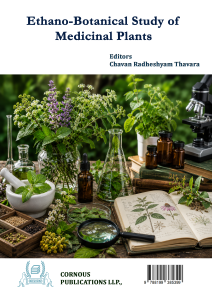
Ethano-Botanical Study of Medicinal Plants
- Chavan Radheshyam Thavara
- Assistant Professor, Department of Botany & Biotechnology, Toshniwal Arts, Commerce & Science College Sengaon District, Hingoli, Maharashtra, India - 431513.
From ancient times, human societies have always relied on plants and their products for curing ailments. Indigenous groups developed knowledge of ethnomedicinal plants and plant-based products through their skills to solve various problems they faced during their routine activities and through practical experience. In certain areas of the world, the plant-based prescription is endemic, especially in developing nations. In recent years, the World Health Organization (WHO) has focused on the traditional knowledge associated with plant-based herbal medicine as a large mainstream of rural and folk groups in various developing countries are still using herbal medicine as first safety for curing various diseases. WHO observed that approximately 80% of the world population depends on plant-based medicine for curing primary health. Sometimes, the commercialization of these plants and excessive dependency on the products from plants led to the rapid extinction of medicinal plants. The global market for herbal medi-cine and medicinal plants is estimated to be worth US$800 billion annually. Traditional medicines are continuously increasing due to features like safety and efficacy against diseases. In the past few years, special attention has been paid to alternative medicine for curing ailments because of their fast reaction, but at the same time, alternative medicine or allopathic medicine have caused side effects. So, WHO has encouraged people through various programs to interact with West-ern and indigenous people with a view on developing new bioactive compounds that could address non-microbial origins and microbial infections and offer better, safer remedies. At the same time, the documentation of ethnomedicinal knowledge and herbal preparation is an essential approach for the use of various medicinal plant species to treat different ailments and also for conservation of ethnic sources. The documentation of traditional knowledge through ethnobotanical surveys and studies is essential for the conservation of cultural and biological diversity.
The research of natural products is based on ethnobotanical knowledge as various drugs today are developed from plants and the repository source of medicinal plants. All the primary information in drug discovery comes from the traditional source which is generally gathered from the indigenous com-munities. Even more essential, traditional communities, which have a lot of information to contribute to better human health, are now studied, as a central task of modern ethnobotanical surveys and research. A major portion of ethnobotanical research in recent years has been focused on a better understanding of the pharmacological effects of each of the plants separately which systematically have explored the human health effects of the ethnopharmacopoeia. Current studies examine the status of ethnomedicinal plants in phytochemical and pharmacological terms, but less frequent are studies that combine cultural and traditional approaches. Ethnobotanical knowledge has two important aspects, (a) indigenous ethnobotanical knowledge and (b) sources of useful economically important plants.
The first category will help in spreading traditional knowledge associated with plants from one to another generation whereas the second category can help in the documentation of plants through bioprospecting. The present edited book of ethnobotany in dif- ferent regions of world tries to bring together all of the knowledge of ethnobotany in one place. For this purpose, competent authors have been selected to summarize the information regarding the different aspects of ethnobotany, such as ethnoecology, ethnopharamacology, ethnoconservation, bioprospectiong of ethnobotanical knowledge and its protection. Further this book provided the details information on ethnomedicinal plants used in different ways along with their essentials properties which will be helpful to the people interested in traditional ethnobotany.
-
A Review on Ethnoveterinary Medicinal Plants - Traditional Healing Practices for Animal Health
PAID ACCESS | Published on : 23-Jan-2026 | Doi :10.37446/edibook182024/1-10 | Pages : 1-10
-
Phytochemical Analysis of Medicinal Plants
OPEN ACCESS | Published on : 23-Jan-2026 | Doi :10.37446/edibook182024/11-30 | Pages : 11-30
-
Medicinal Plants in Tropical Evergreen Forest
PAID ACCESS | Published on : 23-Jan-2026 | Doi :10.37446/edibook182024/31-48 | Pages : 31-48
-
Uses of various Bio-fencing plants in the control of human diseases
PAID ACCESS | Published on : 23-Jan-2026 | Pages : 49-64
-
An Ethno-Medico - botanical study of native plant remedies against Gynaecological diseases
PAID ACCESS | Published on : 23-Jan-2026 | Doi :10.37446/edibook182024/65-75 | Pages : 65-75
-
Domesticating wild plants - Challenges and Chances
OPEN ACCESS | Published on : 30-Jan-2026 | Doi :10.37446/edibook182024/76-88 | Pages : 76-88
-
Ethno - medicinal plant species for respiration and bronchial diseases
PAID ACCESS | Published on : 24-Mar-2026 | Doi :10.37446/edibook182024/89-94 | Pages : 89-94
-
The Contribution of Wild Edible Plants in Human Nutrition (Wild Vegetables of India- Diversity, Nutritional Significance, Medicinal Value and Economic Potential)
OPEN ACCESS | Published on : 18-Jul-2026 | Doi :10.37446/edibook182024/95-103 | Pages : 95-103
Indexing In




Types of Books We Publish




Uniqueness of our Publication

DOI Assignment

ISBN Registration

Online Publication

High Visibility

Open & Closed Access
DOI Assignment
ISBN Registration
Online Publication
High Visibility
Open & Closed Access