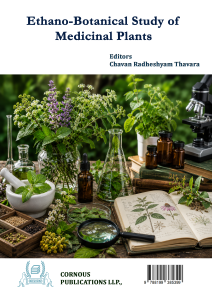
Editorial Book
Book Title: Ethano-Botanical Study of Medicinal Plants
PAID ACCESS | Published on : 23-Jan-2026 | Pages: 1-10 | Doi : 10.37446/edibook182024/1-10
A Review on Ethnoveterinary Medicinal Plants - Traditional Healing Practices for Animal Health
- Saroj Kumari
- Department of Botany, University of Rajasthan, Jaipur, Rajasthan, India.
- Aparna Pareek
- Assistant Professor, Department of Botany, University of Rajasthan, Jaipur, Rajasthan, India.
Abstract
Ethnoveterinary medicine encompasses the traditional knowledge, practices, and beliefs used by indigenous communities for maintaining animal health using plant-based remedies. This review highlights the importance of ethnoveterinary medicinal plants in providing cost-effective, eco-friendly, and culturally acceptable healthcare solutions for livestock. The study consolidates information from various ethnobotanical surveys, focusing on commonly used plant species, their therapeutic applications and the ailments treated across diverse regions. Furthermore, it addresses the urgent need for scientific validation, conservation strategies, and integration of traditional knowledge into modern veterinary practices. The review advocates for a multidisciplinary approach to preserve indigenous wisdom while advancing sustainable animal healthcare. The review highlights obstacles in preserving ethnoveterinary knowledge, such as threats from modernization, habitat loss, and lack of recording.
Keywords
Ethno veterinary medicine, Medicinal plants, Indigenous knowledge, Animal healthcare, Phytochemical studies, Herbal remedies
References
Bjerge, K., Mann, H. M., & Høye, T. T. (2022). Real‐time insect tracking and monitoring with computer vision and deep learning. Remote Sensing in Ecology and Conservation, 8: 315-327.
Boho, D., Rzanny, M., Wäldchen, J., Nitsche, F., Deggelmann, A., Wittich, H. C., Seeland, M., & Mäder, P. (2020). Flora Capture: a citizen science application for collecting structured plant observations. BMC Bioinformatics, 21: 1-11.
Brydegaard, M., & Jansson, S. (2019). Advances in entomological laser radar. Journal of Engineering, 7542–7545.
Carranza-Rojas, J., Goeau, H., Bonnet, P., Mata-Montero, E., & Joly, A. (2017). Going deeper in the automated identification of Herbarium specimens. BMC Evolutionary Biology, 17:1-14.
Drake, V. A., Wang, H. K., & Harman, I. T. (2002). Insect monitoring radar: remote and network operation. Computers and Electronics in Agriculture, 35: 77–94.
Gerovichev, A., Sadeh, A., Winter, V., Bar-Massada, A., Keasar, T., & Keasar, C. (2021). High throughput data acquisition and deep learning for insect ecoinformatics. Frontiers in Ecology and Evolution, 9: 600931.
Hirao, T. M., Murakami, M., & Kashizaki, A. (2008). Effects of mobility on daily attraction to light traps: comparison between lepidopteran and coleopteran communities. Insect Conservation and Diversity, 1: 32–39.
Jeliazkov, A., Bas, Y., Kerbiriou, C., Julien, J. F., Penone, C., & Le Viol, I. (2016). Large-scale semi-automated acoustic monitoring allows to detect temporal decline of bush-crickets. Global Ecology and Conservation, 6: 208-218.
Klink, R., August, T., Bas, Y., Bodesheim, P., Bonn, A., Fossøy, F., Høye, T. T., Jongejans, E., Menz, M. H., Miraldo, A., & Roslin, T. (2022). Emerging technologies revolutionise insect ecology and monitoring. Trends in Ecology & Evolution, 37(10), 872-885.
Merril, S. C., Gebre-Amlak, A., Armstrong, J. S., & and Pearirs, F. B. (2010). Nonlinear degree-day models of the sunflower weevil (Curculionidae: Coleoptera). Journal of Economic Entomology, 103, 303–307.
Wäldchen, J., & Mäder, P. (2018). Machine learning for image-based species identification. Methods in Ecology and Evolution, 9(11), 2216-2225.
Zalucki, M. P., & Furlong, M. J. (2005). Forecasting Helicoverpa populations in Australia: a comparison of regression-based models and a bioclimatic based modeling approach. Insect Science, 12, 45–46.
Indexing In




Types of Books We Publish




Uniqueness of our Publication

DOI Assignment

ISBN Registration

Online Publication

High Visibility

Open & Closed Access
DOI Assignment
ISBN Registration
Online Publication
High Visibility