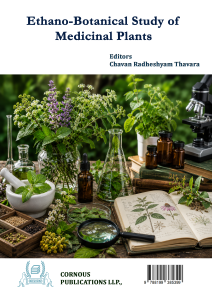
Editorial Book
Book Title: Ethano-Botanical Study of Medicinal Plants
PAID ACCESS | Published on : 23-Jan-2026 | Pages: 31-48 | Doi : 10.37446/edibook182024/31-48
Medicinal Plants in Tropical Evergreen Forest
- Seema Talwar
- Department of Botany, Shivaji College, University of Delhi, India.
- Gunjan Sirohi
- Department of Botany, Shivaji College, University of Delhi, India.
- Priyanka Ojha
- Department of Botany, Shivaji College, University of Delhi, India.
Abstract
Forests are one of the most treasured natural resources on the Earth. There are different types of forests such as dry deciduous forests, coniferous forests, tropical evergreen forests and mangrove forests, which supports a wide variety of plants, animals and other microorganisms. Tropical evergreen forests are found near the equator, characterized by heavy rainfall, dense vegetation, and rich biodiversity. These forests are important from an ecological, economic, and cultural standpoint for concerns related to biodiversity, climate change, global food security, and human health. Forests play a significant role in providing natural medicines; therefore, they are frequently referred to as nature's pharmacy.
Keywords
Tropical wet evergreen forest, Medicinal plants, Western ghats
References
Anandjiwala, S., Bagul, M. S., Parabia, M., & Rajani, M. (2008). Evaluation of free radical scavenging activity of an ayurvedic formulation, Panchvalkala. Indian Journal of Pharmaceutical Sciences, 70(1), 31.
Aragão, L. (2012). The rainforest's water pump. Nature, 489, 217–218. https://doi.org/10.1038/nature11485
Balasubramanian, A. (2017). The Andaman and Nicobar Islands-At a Glance. 10.13140/RG.2.2.34474.93129.
Borah, N. (2012). Community structure, tree regeneration and utilization of forest resources in Cachar and Hailakandi Districts of Assam, India [Unpublished doctoral dissertation]. Assam University, Silchar.
Borah, N., & Garkoti, S. C. (2011). Tree species composition, diversity, and regeneration patterns in undisturbed and disturbed forests of Barak Valley, South Assam, India. International Journal of Ecology and Environmental Sciences, 37(3), 131–141.
Borah, N., Rabha, D., & Athokpam, F. D. (2016). Tree species diversity in tropical forests of Barak valley in Assam, India. Tropical Plant Research, 3(1), 1–9.
Champion, H. G., & Seth, S. K. (1968). A revised survey of the forest types of India. The Manager of Publications.
Cleveland, C. C., Townsend, A. R., Taylor, P., Alvarez‐Clare, S., Bustamante, M., Chuyong, G., Dobrowski, S. Z., Grierson, P., Harms, K. E., Houlton, B. Z., Marklein, A., Parton, W., Porder, S., Reed, S. C., Sierra, C. A., Silver, W. L., Tanner, E. V. J., & Wieder, W. R. (2011). Relationships among net primary productivity, nutrients and climate in tropical rain forest: A pan‐tropical analysis. Ecology Letters, 14(9), 939–947.
Ekhuemelo, D. O., Amonum, J. I., & Usman, I. A. (2016). Importance of forest and trees in sustaining water supply and rainfall. Nigeria Journal of Education, Health and Technology Research (NJEHETR), 8.
Erb, M., & Kliebenstein, D. J. (2020). Plant secondary metabolites as defenses, regulators, and primary metabolites: The blurred functional trichotomy. Plant Physiology, 184(1), 39–52. https://doi.org/10.1104/pp.20.00433
Forest Survey of India. (2011). Atlas Forest Types of India. Ministry of Environment of Forests.
Islam, N., & Hossain, T. (2022). Evaluating the effectiveness of reforestation programs in tropical rainforests. International Journal of Geography, Geology and Environment, 4(2), 239–241.
Jegan, G., Kamalraj, P., & Muthuchelian, K. (2008). Medicinal plants in tropical evergreen forest of Pachakumachi Hill, Cumbum Valley, Western Ghats, India. Ethnobotanical Leaflets, 2008(1), 30.
Khalifa, S. A., Elshafiey, E. H., Shetaia, A. A., El-Wahed, A. A. A., Algethami, A. F., Musharraf, S. G., & El-Seedi, H. R. (2021). Overview of bee pollination and its economic value for crop production. Insects, 12(8), 688.
Khound, P., Deb, P. K., Bhattacharjee, S., Medina, K. D., Sarma, P. P., Sarkar, B., & Devi, R. (2024). Phenolic enriched fraction of Clerodendrum glandulosum Lindl. leaf extract ameliorates hyperglycemia and oxidative stress in streptozotocin-nicotinamide induced diabetic rats. Journal of Ayurveda and Integrative Medicine, 15(3), 100906.
Kumar, A., Shukla, A., & Kailkhura, S. (2024). Biodiversity loss and its economic costs: A global perspective. Research Journal of Recent Sciences, 13(1), 31–37.
Kumar, S., & Kumar, N. (2018). Tropical Rainforests of India and World. Journal of Emerging Technologies and Innovative Research, 5(3), 1380–1386.
Malavika, J. (2023). Important Medicinal Plants of Western Ghats: A Review. International Journal of New Media Studies (IJNMS), ISSN, 2394-4331.
Myers, N., Mittermeier, R. A., Mittermeier, C. G., DaFonseca, G. A. B., & Kent, J. (2000). Biodiversity hotspots from conservation priorities. Nature, 403, 853–858.
Rachel, G. E. (2014). Ecology of tropical rain forests. In Ecology and the Environment (pp. 247–272). https://doi.org/10.1007/978-1-4614-7501-9_4
Nair, G. M. (2005). Plant wealth of the Western Ghats: Conservation and sustainable utilization-The Tropical Botanic Garden and Research Institute scenario. In P. Tandon, M. Sharma, & R. Swarup (Eds.), Biodiversity: Status and Prospects (pp. 66–78). Narosa Publishing House.
Nayar, M. P. (1996). Hot Spots of Endemic Plants of India, Nepal and Bhutan. TBGRI Publications.
Nigel, D., & Sue, S. (2003). Running Pure: The Importance of Forest protected Areas to Drinking Water. World Bank/WWF Alliance for Forest Conservation and Sustainable Use.
Pascal, J. P., Ramesh, B. R., & Franceschi, D. D. (2004). Wet evergreen forest types of the southern Western Ghats, India. Tropical Ecology, 45(2), 281–292.
Poojary, M. M., Vishnumurthy, K. A., & Adhikari, A. V. (2015). Extraction, characterization and biological studies of phytochemicals from Mammea suriga. Journal of Pharmaceutical Analysis, 5(3), 182–189.
Rajshekharan, P. E., & Ganeshan, S. (2002). Conservation of medicinal plant biodiversity: An Indian perspective. Journal of Medicinal and Aromatic Plant Sciences, 24, 132–147.
Ramesh, B. R., Menon, S., & Bawa, K. S. (1997). A vegetation-based approach to biodiversity gap analysis in the Agasthyamalai Region, Western Ghats, India. Ambio, 226, 529–536.
Samadd, M. A., Sikder, M. A. A., Asrafi, S., Hasan, C. M., Al Mansur, M. A., & Rashid, M. A. (2024). Unveiling the Phytopharmacological Potentials of Mesua nagassarium (Burm. f.): In vitro and In silico Approaches. Dhaka University Journal of Pharmaceutical Sciences, 23(2), 181–193.
Sarmah, D. (2025). Diversity of Forests in India, A few basic facts about forest classification. Indira Gandhi National Forest Academy. (IGNFA Research Cell Document No: 2025/02/IGNFARF)
Shah, A. S., & Alagawadi, K. R. (2011). Anti-inflammatory, analgesic and antipyretic properties of Thespesia populnea Soland ex. Correa seed extracts and its fractions in animal models. Journal of Ethnopharmacology, 137(3), 1504–1509.
Singh, J. S., & Chaturvedi, R. K. (2017). Diversity of Ecosystem Types in India: A Review. Proceedings of the Indian National Science Academy, 83, 569–594.
Sinha, B. N., Bansal, S. K., & Pattnaik, A. K. (2009). Phytochemical and antimicrobial activity of extracts, fractions and betulin, 7-methyl juglone obtained from Diospyros paniculata. Journal of Natural Remedies, 99-102.
Somkuwar, S. R., Chaudhary, R. R., Patil, V. N., & Deokule, S. S. (2012). A study of important medicinal plants of Savantwadi region, Western Ghats, (MS), India. International Journal of Current Research, 4(12), 154–159.
Teoh, E. S. (2016). Secondary metabolites of plants. In Medicinal Orchids of Asia (pp. 59–73). Springer. https://doi.org/10.1007/978-3-319-24274-3_5
Tijjani, H., Egbuna, C., & Carrol, L. D. (2019). Biosynthesis of phytochemicals. Apple Academic Press, Taylor and Francis. https://doi.org/10.1201/9780429426223
Yudharaj, P., Shankar, M., Sowjanya, R., Sireesha, B., Naik, E. A., & Priyadarshini, R. J. (2016). Importance and uses of medicinal plants – An overview. International Journal of Preclinical and Pharmaceutical Research, 7(2), 67–73.
Zhang, X. R., Kaunda, J. S., Zhu, H. T., Wang, D., Yang, C. R., & Zhang, Y. J. (2019). The genus Terminalia (Combretaceae): An ethnopharmacological, phytochemical and pharmacological review. Natural Products and Bioprospecting, 9, 357–392.
Indexing In




Types of Books We Publish




Uniqueness of our Publication

DOI Assignment

ISBN Registration

Online Publication

High Visibility

Open & Closed Access
DOI Assignment
ISBN Registration
Online Publication
High Visibility