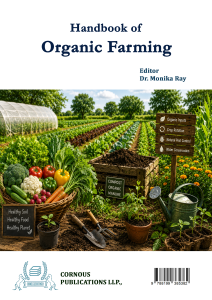
Handbook of Organic Farming
- Monika Ray
- Regional Research and Technology Transfer Station, Odisha University of Agriculture and Technology, Keonjhar-758002, Odisha, India.
Organic farming has emerged as a cornerstone of sustainable agricultural development, addressing the growing global concerns about soil degradation, environmental pollution, loss of biodiversity, and declining nutritional quality of food. The Handbook of Organic Farming has been conceived as a comprehensive and practical guide to the principles, practices, and innovations that define the organic agriculture movement today. This book brings together diverse perspectives from agronomy, ecology, economics, and social sciences to provide an integrated understanding of how organic farming contributes to food security, environmental conservation, and rural development. It traces the historical evolution of organic agriculture, explores the international standards and certification systems, and elaborates on core farming principles such as soil health, nutrient management, pest control, and crop diversification.
Each chapter has been thoughtfully designed to address specific dimensions of organic farming—from water and weed management, seed production, and livestock integration to market trends, consumer behaviour, and policy frameworks. The volume also delves into emerging and cross-cutting issues, including climate resilience, carbon sequestration, urban and peri-urban organic farming, and the integration of indigenous and gender knowledge systems. In an era of rapid technological advancement and environmental uncertainty, this handbook serves as both a reference resource and a field guide for students, researchers, extension professionals, and policymakers committed to advancing sustainable agriculture. It emphasises the interconnectedness of ecological balance, economic viability, and social equity—pillars upon which the philosophy of organic farming firmly stands.
I hope that this volume not only enhances scientific understanding but also inspires collective action toward a greener, more resilient, and ethically grounded agricultural future.
-
Soil Health Management in Organic Agriculture - Importance of Soil Health and Organic Management
OPEN ACCESS | Published on : 23-Jan-2026 | Doi :10.37446/edibook142024/1-19 | Pages : 1-19
-
Organic Farming and Gender Equality- Promoting gender equality and women's empowerment in organic agriculture
PAID ACCESS | Published on : 23-Jan-2026 | Doi :10.37446/edibook142024/20-29 | Pages : 20-29
-
Organic Farming and Translational Research - Bridging the gap between research and practical applications in organic agriculture
OPEN ACCESS | Published on : 23-Jan-2026 | Doi :10.37446/edibook142024/30-44 | Pages : 30-44
-
Benefits of Crop Rotation and Diversification in Organic Agriculture
PAID ACCESS | Published on : 23-Jan-2026 | Doi :10.37446/edibook142024/45-56 | Pages : 45-56
-
Rejuvenating Ancient Farming of India to the Modern World
PAID ACCESS | Published on : 23-Jan-2026 | Doi :10.37446/edibook142024/57-75 | Pages : 57-75
-
Biological Pests and Disease Management
PAID ACCESS | Published on : 23-May-2026 | Pages : 76-90
-
Cover Crops and Green Manures- Role of Cover Crops in Soil Fertility and Weed Suppression
PAID ACCESS | Published on : 11-Aug-2026 | Pages : 91-102
Indexing In




Types of Books We Publish




Uniqueness of our Publication

DOI Assignment

ISBN Registration

Online Publication

High Visibility

Open & Closed Access
DOI Assignment
ISBN Registration
Online Publication
High Visibility
Open & Closed Access