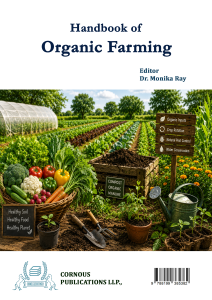
Editorial Book
Book Title: Handbook of Organic Farming
PAID ACCESS | Published on : 23-Jan-2026 | Pages: 57-75 | Doi : 10.37446/edibook142024/57-75
Rejuvenating Ancient Farming of India to the Modern World
- Amit Kesarwani
- Assistant Professor, Department of Agronomy, College of Agriculture, G.B. Pant University of Agriculture & Technology, Pant Nagar, India.
- Sweta Shikta Mahapatra
- Assistant Professor, CV Raman Global University, Bhubaneshwar, Odisha, India.
- Vineeta Rathore
- Assistant Professor, Department of Agronomy, College of Agriculture, G.B. Pant University of Agriculture & Technology, Pant Nagar, India.
- Sunita T. Pandey
- Professor, Department of Agronomy, College of Agriculture, G.B. Pant University of Agriculture & Technology, Pant Nagar, India.
Abstract
The farmers of ancient India are known to have evolved nature friendly farming systems and practices such as mixed farming, mixed cropping and crop rotation. Since time immemorial, it has been described in holy scripts of Atharva and Rig veda dating back to 1500-1200 BC. The essence is to live in partnership with, rather than exploit, nature has been discussed in the “Vrikshayurveda” (Science of plants), the “Krishisastra” (Science of agriculture) and the “Mrugayurveda” (Animal Science). The Vedic farming technology was completely focused on farm organic inputs, natural bio-mechanical pest disease management making limited usage of non-renewable resources and also making the effort to replenish the amount used for future generations. They further indicate the crop production in India during vedic period were grown organically with holistic amalgamation of Sanskrit hymn & syllable chants, conducting yanjnas and wide use of Panchgavyas, products obtained from cow who was considered as holy gomata in Indian culture, i.e. Cow milk & ghee, curd, gomutra & gobar (cow urine and dung). Cow is the backbone of Indian culture and rural economy, and sustains our life; represent cattle wealth and bio-diversity. It is known as “Kamdhenu” and “Gaumata” because of its nourishing nature like mother, the giver of all providing riches to humanity and is a store of medicines in the past five decades, however, the traditional knowledge and practices of organic farming have almost eroded from many parts of India due to influx of modern “green revolution” technologies. Recently, sustaining of soil productivity has become a major issue as lands are being intensively tilled under multiple and intensive cropping systems.
Keywords
Weed management, Organic farming, Cultural practices, Crop rotation, Cover crops, Intercropping, Mulching
References
Aryal, S., Lamichhane, J., Kumar, P., Naresh, R., Banmala, A., Dhaka, A., Kumar, V., & Ahirwar, G. (2025). Panchagavya: Our ancestral magic potion—An input to organic farming. International Journal of Advanced Biochemistry Research, 9, 436–448.
Battu, S., & Rai, P. K. (2022). Standardization of different pre-sowing seed treatments with Jeevamrutha, Panchagavya, Neem oil and Vermiwash on plant growth yield and yield attributing traits of cowpea (Vigna unguiculata L.) var. SSC-06. International Journal of Plant & Soil Science, 34(23), 458–465.
Bhadu, K., Sharma, S. K., Choudhary, R., Yadav, S. K., Sharvan, Jain, R. K., Jat, G., & Ravishanker, N. (2021). Effect of jeevamrut on productivity and profitability of wheat under organic farming. Indian Journal of Agricultural Sciences, 91(6), 924–928.
Devakumar, N., Shuba, S., Gouder, S. B., & Rao, G. G. E. (2014). Microbial analytical studies of traditional organic preparations beejamrutha and jeevamrutha. In G. Rahmann & U. Aksoy (Eds.), Proceedings of 4th ISOFAR Scientific Conference, Organic World Congress (pp. 639–642). Istanbul, Turkey.
Ganesh, B., & Upadhyay, H. (2020). Influence of organic liquid formulation on crop growth and yield: An overview. International Journal of Agriculture Sciences, 8, 2455–6211.
Jnanesha, A. C., Venugopal, S., Kumar, S. R., Kumar, A., Bisht, D., Chanotiya, C. S., & Lal, R. K. (2024). Optimization of a new organic approach to natural biostimulant (Jeevamrutha) for yield and quality management in Senna (Cassia angustifolia Vahl.): An agriculturally highly export-oriented crop. Technology in Horticulture, 4, e009.
Kesarwani, A. (2007). Effect of organic nutrient management practices on the stalk yield and juice quality of sweet sorghum (Sorghum bicolor L. Moench) for ethanol production (M.Sc. thesis). University of Agricultural Sciences, Bengaluru, Karnataka.
Kesarwani, A., & Sharanappa, S. S. C. (2010). Organic agriculture: Modern tool to mitigate climate change. In Proceedings of the International Conference on Organic Agriculture in Scope of Environmental Problems (pp. 22–27). Northern Cyprus.
Kesarwani, A., & Sharanappa. (2009). Milliable stalk yield, nutrient uptake and soil health in sweet sorghum (Sorghum bicolor L. Moench) production as influenced by different organic sources of nutrients. Mysore Journal of Agricultural Sciences, 43(1), 18–23.
Khanal, A., Shakya, S. M., Shah, S. C., & Sharma, M. D. (2010). Utilization of urine waste to produce quality cauliflower. Journal of Agriculture and Environment, 12, 84–90.
Kumar, A., Avasthe, R., Babu, S., Singh, R., Verma, G., Gudade, B., Ingudam, B., & Devi, E. (2021). Jeevamrut: A low-cost organic liquid manure in organic farming for sustainable crop production. Journal of Pharmacognosy and Phytochemistry, 9, 32–34.
Kumar, R. D., Rai, P. K., Bara, B. M., & Raju, G. V. (2022). Pre-sowing seed treatments with Panchagavya, Jeevamrutha and Beejamrutha on growth, yield and yield attributing traits in chickpea (Cicer arietinum L.) variety RVG202. International Journal of Plant & Soil Science, 34(22), 1183–1187
Mahapatra, S. S. (2017). Nutrient management through organics for sustained productivity of finger millet (Eleusine coracana L. Gaertn) (M.Sc. thesis). Acharya N. G. Ranga Agricultural University, Tirupati, Andhra Pradesh.
Mahapatra, S. S., Sunitha, N., Reddy Ramu, Y., & Prasanthi, A. (2017). Efficacy of different organic nutrient management practices on growth and yield of finger millet. Andhra Pradesh Journal of Agricultural Sciences, 3(3), 165–170.
Minocheherhomji, F. P., & Vyas, B. M. (2014). Study of the antimicrobial activity of cow urine and medicinal plant extracts on pathogenic human microbial strains. International Journal of Advances in Pharmacy, Biology and Chemistry, 3, 836–840.
Ouyang, Y., Reeve, J. R., & Norton, J. M. (2022). The quality of organic amendments affects soil microbiome and nitrogen-cycling bacteria in an organic farming system. Frontiers in Soil Science, 2, 869136.
Palekar, S. (2006). Text book on Shoonya Bandovalada Naisargika Krushi. Swamy Anand Agri Prakashana.
Patil, S. M., Khairnar, A. V., Patil, H. M., & Gaikwad, C. B. (2008). Response of potash and foliar spray of cow urine on growth and yield of summer greengram (Vigna radiata L.). International Journal of Agricultural Sciences, 4(2), 446–449.
Prabhu, M. J. (2008, September 18). Muttai rasam: An excellent plant growth promoter. The Hindu. http://www.thehindu.com/todays-paper/tp-features/tp-sci-tech-and-agri/Muttai-rasam-An-excellent-plant-growth-promoter/article15411409.ece
Rahmann, G., & Aksoy, U. (Eds.). (2014). Proceedings of the 4th ISOFAR Scientific Conference: “Building organic bridges” at the Organic World Congress 2014, October 13–15, Istanbul, Turkey.
Rakesh, K. N., Dileep, N., Junaid, S., Prashith, K. T. R., Vinayaka, K. S., & Noor, N. A. S. (2013). Inhibitory effect of cow urine extracts of selected plants against pathogens causing rhizome rot of ginger. Science, Technology and Arts Research Journal, 2(2), 92–96.
Saharan, B. S., Tyagi, S., Kumar, R., Vijay, O. H., Mandal, B. S., & Duhan, J. S. (2023). Application of Jeevamrit improves soil properties in Zero Budget Natural Farming fields. Agriculture, 13(1), 196.
Sharma, A., Sharma, S. K., Vyas, L., Yadav, S. K., Pramanick, B., Naik, B., Obročník, O., Barek, V., Brestic, M., Gaber, A., Alshehri, M., & Hossain, A. (2024). Innovative organic nutrient management and land arrangements improve soil health and productivity of wheat (Triticum aestivum L.) in an organic farming system. Frontiers in Sustainable Food Systems, 8, 1455433. https://doi.org/10.3389/fsufs.2024.1455433
Sugumaran, M. P., Akila, S., Porkodi, G., & Kalaichelvi, K. (2024). Potential of Panchagavya and Jeevamruth for sustainable organic farming in India. Journal of Eco-Friendly Agriculture, 19(2), 240–246.
Yadav, R., Aravindakshan, K., Singh, B., Sharma, R. K., Kumawat, V. K., & Ujjwal, R. (2023). Influence of soil physio-chemical properties and available nutrient status by organic growth promoters under pea (Pisum sativum L.) cultivation. International Journal of Plant & Soil Science, 35(21), 613–619.
Indexing In




Types of Books We Publish




Uniqueness of our Publication

DOI Assignment

ISBN Registration

Online Publication

High Visibility

Open & Closed Access
DOI Assignment
ISBN Registration
Online Publication
High Visibility