Editorial Book
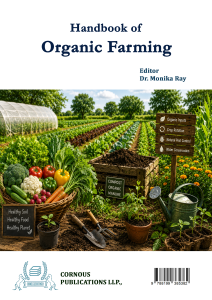
Book Title: Handbook of Organic Farming
OPEN ACCESS | Published on : 23-Jan-2026 | Pages: 30-44 | Doi : 10.37446/edibook142024/30-44
Organic Farming and Translational Research - Bridging the gap between research and practical applications in organic agriculture
- Hem Chandra Chaudhary
- Assistant Professor-cum-Scientist, Plant Pathology, RPCAU, Pusa, Samastipur, Bihar, India.
- Dhirendra Kumar Roy
- Director Seed and Professor-cum-Chief Scientist, Directorate of Seed, RPCAU, Pusa, Samastipur, Bihar, India.
- V.K. Choudhary
- Assistant Professor-cum-Scientist, Genetics and Plant Breeding, RPCAU, Pusa, Samastipur, Bihar, India.
- Amrendra Kumar
- Assistant professor, Department of Agronomy, TCA, Dholi, RPCAU, Pusa, Samastipur, Bihar, India.
Abstract
Greenhouse technology is vital to modern horticulture, enabling controlled-environment agriculture to enhance productivity, quality, and sustainability. This chapter explores greenhouse cultivation's evolution, principles, and applications, emphasizing its role in the horticultural sector. It examines the historical development of greenhouses, from ancient Roman practices to modern high-tech structures, along with advancements in materials and environmental control mechanisms. The economic aspects of greenhouse farming, including construction costs, operational expenses, and profitability, are analyzed to highlight its feasibility for high-value crop production. The chapter also reviews the present status of greenhouse farming in India, focusing on technological advancements, market trends, and government initiatives that support farmers through subsidies for polyhouse construction. Despite its benefits, greenhouse farming faces challenges such as high initial investments, the need for technical expertise, and climate-specific design considerations. However, emerging innovations, including automation and AI-driven precision agriculture, offer promising solutions for enhancing efficiency and affordability. By examining the principles, economic viability, and future prospects of greenhouse cultivation, this chapter underscores its transformative potential in ensuring food security, resource efficiency, and sustainability in modern agriculture.
Keywords
Organic farming, Green revolution, Organic manures
References
Agriculture Census (2010–11). All India Report on Number and Area of Operational Holdings, Agriculture Census Division, Department of Agriculture & Co-operation, Ministry of Agriculture, Government of India.
Aktar, W., Sengupta, D., & Chowdhury, A. (2009). Impact of pesticides use in agriculture: their benefits and hazards. Interdisciplinary Toxicology, 2(1): 1–12.
APEDA (2014). Agricultural and Processed Food Product Export Development Authority, Ministry of Commerce and Industries, GOI. Retrieved from www.apeda.gov.in.
Balachandran, V. (2004). Future in the Past: A study on the status of organic farming in Kerala. Discussion Paper No. 82.
Bhattacharyya, P., & Chakraborty, G. (2005). Current status of organic farming in India and other countries. Indian Journal of Fertilizers, 1(9): 111–123.
Brook, B., & Bhagat, G. (2004). Organic by default: The irony of organic farming in India. Retrieved from http://www.ecoworld.org/Home/Articles2.cfm?TID=349.
Chandrashekar, H. M. (2010). Changing scenario of organic farming in India: An overview. International NGO Journal, 5: 34–39.
Charyulu, K., & Biswas, S. (2010). Organic input production and marketing in India – Efficiency, issues, and policies. CMA Publication No. 239.
Dadhwal, K. S., Sharma, N. K., & Ghosh, B. N. (2011). Organic farming for resource conservation and soil health improvement in the Himalayan region, India. Indian Journal of Soil Conservation, 39(3): 243–250.
Das, K. (2004). Transitioning to organic. Retrieved from http://www.indiatogether.org/2004/jun/agr-transorg.html
Fertilizer Statistics (2011–12). The Fertilizer Association of India, New Delhi.
GOI (2014). Ministry of Commerce and Industries, Lok Sabha Question No. 2393, answered on 25th July 2014.
Government of India (2001b). Report of the Working Group on Organic and Biodynamic Farming for the Tenth Five-Year Plan, TFYP Working Group Sr. No. 46/2001, Planning Commission, New Delhi.
Gupta, A., & Verma, J. et al. (1997). Vanishing breeds. Down to Earth, 11(15): 27–37.
Guruswamy, K., & Gurunathan, K. B. (2010). A need for organic farming in India. Journal of Contemporary Research in Management, January–March.
IFOAM (2005). Principles of Organic Agriculture. Bonn: International Federation of Organic Agriculture Movements.
IFOAM (2010). Organic food and farming: A system approach to meet the sustainability challenge. Kölling, A. (Ed.): Belgium, pp. 05.
Indian Express (2016). Sikkim became India’s first fully organic state in 2016. December 31, 2016, 10:26 am. Retrieved from http://indianexpress.com/article/india/sikkim-became-indias-first-fully-organic-state-in-2016-4452765/.
Makadia, J. J., & Patel, K. S. (2015). Prospects, status and marketing of organic products in India – A review. Agricultural Review, 36(1): 73–76.
Ministry of Agriculture and Farmer Welfare (2016). Mission Organic Value Chain Development for North-eastern Region. A Sub-Mission under National Mission for Sustainable Agriculture (NMSA). Operational Guidelines. Retrieved from http://agricoop.nic.in/sites/default/files/OPG1922016.pdf.
Musa, M., Bokhtiar, S. M., & Gurung, T. R. (Eds.) (2015). Status and future prospect of organic agriculture for safe food security in SAARC countries.
NAAS (2005). Organic farming: Approaches and possibilities in the context of Indian agriculture. Policy Paper 30, National Academy of Agricultural Sciences.
Narayanan, S. (2005). Organic farming in India: Relevance, problems and constraints. Department of Economic Analysis and Research, National Bank for Agriculture and Rural Development, Mumbai.
Pandey, J., & Singh, A. (2012). Opportunities and constraints in organic farming: An Indian perspective. Journal of Scientific Research, 56, 47–72.
Press Information Bureau, Ministry of Agriculture, Government of India. (09-May-2017, 16:49 IST). Retrieved on 13 September 2017, from http://pib.nic.in/newsite/PrintRelease.aspx?relid=161670.
Ramesh, P., Panwar, N. R., Singh, A. B., Ramana, S., Yadav, S. K., Shirvastava, R., & Rao, A. S. (2010). Status of organic farming in India. Current Science, 98(6): 1190–1194.
Ramesh, P., Singh, M., & Rao, S. A. (2005). Organic farming: Its relevance to the Indian context. Current Science, 88(4): 561–568.
Roychowdhury, R., Banerjee, U., Sofkova, S., & Tah, J. (2013). Organic farming for crop improvement and sustainable agriculture in the era of climate change. Online Journal of Biological Sciences, 13(2): 50–65.
Roychowdhury, R., Gawwad, M. R. A., Banerjee, U., Bishnu, S., & Tah, J. (2013). Status, trends and prospects of organic farming in India: A review. Journal of Plant Biology Research, 2(2): 38–48.
Sahu, R. P., Singh, R. J., & Singh, K. (2010). Knowledge gap about organic farming practices of farmers of Bageshwar District of Uttarakhand. Indian Journal of Extension Education, 45(1&2): 135–136.
Salvador, V. G., & Katke, J. (2003). Market opportunities and challenges for Indian organic products. Research Institute of Organic Agriculture (FIBL) and ACNielsen ORGMARG. Swiss State Secretariat of Economic Affairs (SECO). Retrieved from http://orgprints.org/000026841.
Shetty, P. K., Alvares, C., & Yadav, A. K. (Eds.). (2014). Organic Farming and Sustainability (ISBN: 978–93–83566–03–7). National Institute of Advanced Studies, Bangalore.
Shetty, P. K., Hiremath, M. B., & Murugan, M. (2013). Status of organic farming in agro-ecosystems in India. Indian Journal of Science and Technology, 6(8): 5083–5088.
Singh, J. (2013). Punjab, cancer capital of India. Down to Earth, Feb 2, 2013. Retrieved from http://www.downtoearth.org.in/content/punjab-cancer-capital-india.
Singh, R., Ravisankar, N., & Prasad, K. (2017). Improvement in productivity and economics of major food production systems of India through balanced dose of nutrients. Current Science, 112(12): 2470–2474.
The Hindu (2016). Sikkim becomes India’s first organic state. September 23, 2016. Retrieved on 14 September 2017, from http://www.thehindu.com/news/national/Sikkim-becomes-India%E2%80%99s-first-organic-state/article13999445.ece.
Venkateswarlu, B., Balloli, S. S., & Ramakrishna, Y. S. (2008). Organic farming in rainfed agriculture: Opportunities and constraints. Central Research Institute for Dryland Agriculture, Hyderabad. pp. 185.
Indexing In




Types of Books We Publish



Uniqueness of our Publication

DOI Assignment

ISBN Registration

Online Publication

High Visibility

Open & Closed Access
DOI Assignment
ISBN Registration
Online Publication
High Visibility