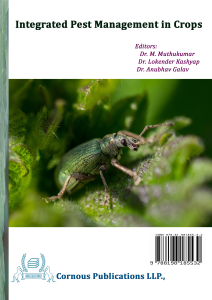
Integrated Pest Management in Crops
- M Muthukumar
- Assistant Professor (Senior Grade) and Head, Department of Entomology, SRM College of Agricultural Sciences, SRM Institute of Science and Technology, Vendhar Nagar, Baburayanpettai, Elapakkam (Post), Chengalpattu (Dt.), Tamil Nadu, India.
- Lokender Kashyap
- Professor, MMDU, Mullana, Ambala, India.
- Anubhav Galav
- Yotta Agro Ventures Pvt. Ltd., Jaipur, Rajasthan, India.
The world's agricultural landscape is a dynamic and challenging arena, constantly grappling with the imperative to produce sufficient food for a growing population while minimizing the environmental footprint of agricultural practices. At the heart of this challenge lies the complex issue of pest management. Traditional reliance on broad-spectrum chemical pesticides, while often effective in the short term, has led to a cascade of unintended consequences, including pesticide resistance, ecological disruption, and potential risks to human health.
This book, "Integrated Pest Management in Crops," is born from the recognition that a more holistic and sustainable approach to pest control is not only desirable, but essential. It aims to provide a comprehensive guide to Integrated Pest Management (IPM), a strategy that prioritizes ecological balance, economic viability, and human safety.
We embark on this journey with the understanding that IPM is not a singular, prescriptive solution, but rather a flexible and adaptive framework. It emphasizes a deep understanding of pest biology, ecology, and the agroecosystem as a whole. This understanding forms the foundation for developing tailored management strategies that integrate multiple tactics, including:
Cultural practices: Optimizing crop rotations, sanitation, and other agronomic techniques to minimize pest pressure.
Biological control: Harnessing the power of natural enemies, such as predators, parasitoids, and pathogens, to suppress pest populations.
Host plant resistance: Utilizing crop varieties with inherent resistance to specific pests.
Chemical control: Employing pesticides judiciously, only when necessary, and prioritizing the use of selective and environmentally sound products.
Monitoring and forecasting: Regularly assessing pest populations and using predictive models to guide management decisions.
This book is designed to serve as a valuable resource for a diverse audience, including:
Students and researchers in agricultural sciences, entomology, and plant pathology.
Extension agents and agricultural consultants.
Farmers and growers seeking to implement sustainable pest management practices.
Policymakers and regulators involved in shaping agricultural policies.
-
Integrated Pest Management in Maize
PAID ACCESS | Published on : 22-Feb-2025 | Doi :10.37446/edibook112025/1-11 | Pages : 1-11
-
Integrated Pest Management in Sorghum
OPEN ACCESS | Published on : 22-Feb-2025 | Doi :10.37446/edibook112025/12-33 | Pages : 12-33
-
Integrated Pest Management in Mustards
PAID ACCESS | Published on : 22-Feb-2025 | Doi :10.37446/edibook112025/34-46 | Pages : 34-46
-
Horticultural Mineral Oil in Pest Management
PAID ACCESS | Published on : 17-Oct-2025 | Doi :10.37446/edibook112025/47-55 | Pages : 47-55
-
Integrated Pest Management in Sunflower
PAID ACCESS | Published on : 18-Nov-2025 | Doi :10.37446/edibook112025/56-64 | Pages : 56-64
-
Integrated Pest Management in Black Gram (Vigna mungo L.)
PAID ACCESS | Published on : 18-Nov-2025 | Doi :10.37446/edibook112025/65-79 | Pages : 65-79
-
Integrated Pest Management in Cassava
PAID ACCESS | Published on : 24-Nov-2025 | Doi :10.37446/edibook112025/80-93 | Pages : 80-93
Indexing In




Types of Books We Publish




Uniqueness of our Publication

DOI Assignment

ISBN Registration

Online Publication

High Visibility

Open & Closed Access
DOI Assignment
ISBN Registration
Online Publication
High Visibility
Open & Closed Access