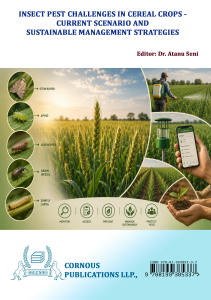
Editorial Book
Book Title: Insect Pest Challenges in Cereal Crops - Current Scenario and Sustainable Management Strategies
OPEN ACCESS | Published on : 03-Feb-2026 | Pages: 12-27 | Doi : 10.37446/edibook212025/12-27
Ecological Role of Entomopathogenic Nematodes in Suppressing Insect Pests in Maize (Zea mays L.)
- Gitanjali Devi
- Department of Nematology, SCS College of Agriculture, Assam Agricultural University, Dhubri, Assam, India.
Abstract
Maize (Zea mays L.) is an annual crop mainly grown for food in tropical and subtropical regions of the world. Among various abiotic and biotic factors, infestation of pest is one of the factors in low production of maize. Although chemical insecticides are the main means of pest suppression, various agro-ecological approaches have been suggested for pest management through the actions of natural enemies. Among the natural enemies of insect pests of maize, entomopathogenic nematodes (EPNs) are one of the important natural enemies that have several positive attributes as biocontrol agent. EPNs, Steinernema spp. and Heterorhabditis spp. are obligate parasites of insect pests attacking agricultural crops including maize. They carry pathogenic bacterial symbionts which are responsible for killing the insect host within 24 - 48 hrs. However, the efficacy of EPNs to control insect pests is adversely affected by various ecological factors. Differences in virulence, application techniques, resource competitors as well as environmental conditions have been cited as possible reasons for variable field performance. Technological advances in EPN mass production and application methods with changing agricultural practices will provide further opportunities to include the use of EPNs in pest management programs in maize crop. Therefore, knowledge about the EPN population dynamics and their behavioral ecology is essential for optimizing their use as sustainable pest management approaches. By combining traditional insights with new innovative methods, with better formulation and application practices we can expand EPN applications in agroecosystems, fostering eco-friendly maize cultivation.
Keywords
Maize, Insect pests, Entomopathogenic nematodes (EPNs), Natural enemies, Ecology
References
Acharya, R., Hwang, H. S., Mostafiz, M. M., Yu, Y. S., & Lee, K. Y. (2020). Susceptibility of various developmental stages of the fall armyworm, Spodoptera frugiperda, to entomopathogenic nematodes. Insects, 11(12), 868. https://doi.org/10.3390/insects11120868
Alonso, V., Nasrolahi, S., & Dillman, A. R. (2018). Host-specific activation of entomopathogenic nematode infective juveniles. Insects, 9(2), 59. https://doi.org/10.3390/insects9020059
Andaló, V., de Faria, L. S., Carvalho, F. J., de Assis, G. A., Santos, V., et al. (2021). Entomopathogenic nematodes for the control of Helicoverpa armigera (Hübner) (Lepidoptera: Noctuidae) pupae. Arquivos do Instituto Biológico, 88(4), e00742019. https://doi.org/10.1590/1808-1657000742019
Andaló, V., Santos, V., Moreira, G. F., Moreira, C. C., & Junior, A. M. (2010). Evaluation of entomopathogenic nematodes under laboratory and greenhouse conditions for the control of Spodoptera frugiperda. Ciência Rural, 40(9), 1860–1866. https://doi.org/10.1590/S0103-84782010005000151
Azazy, A., Adly, A., El-Sappagh, I., Khalil, A., & El-Saadany, H. (2025). Field application of entomopathogenic agents against the fall armyworm (Spodoptera frugiperda) in maize. Egyptian Journal of Biological Pest Control, 35, 19. https://doi.org/10.1186/s41938-025-00854-3
Babendreier, D., Koku Agboyi, L., Beseh, P., Osae, M., Nboyine, J., Ofori, S. E. K., et al. (2020). The efficacy of environmentally friendly plant protection measures for control of fall armyworm, Spodoptera frugiperda, in maize. Insects, 11(4), 240. https://doi.org/10.3390/insects11040240
Baker, A., & Zahniser, S. (2006). Ethanol reshapes the corn market. Amber Waves, 4(2), 30–35.
Barbercheck, M. (2024). Conservation of entomopathogenic nematodes in agro-ecosystems. In D. I. Shapiro-Ilan & E. E. Lewis (Eds.), Entomopathogenic nematodes as biological control agents (pp. 519 - 537). CABI. https://doi.org/10.1079/9781800620322.0028
Ben-Yakir, D., Efron, D., Chen, M., & Glazer, I. (1998). Evaluation of entomopathogenic nematodes for biocontrol of the European corn borer on sweet corn in Israel. Phytoparasitica, 26, 101–108. https://doi.org/10.1007/BF02980676
Bhagat, R. M., Khajuria, M. K., Shankar, U., Monobrullah, M., & Kaul, V. (2008). Efficacy of biopesticides and insecticides for controlling maize cutworm in Jammu. Journal of Biological Control, 22(1), 99–106. https://doi.org/10.18641/JBC/22/1/40218
Blanco-Pérez, R., Bueno-Pallero, F. Á., Vicente-Díez, I., Marco-Mancebón, V. S., Pérez-Moreno, I., & Campos-Herrera, R. (2019). Scavenging behavior and competition affect fitness of Steinernema feltiae. Journal of Invertebrate Pathology, 164, 5–15. https://doi.org/10.1016/j.jip.2019.04.002
Blanco-Pérez, R., Stevens, G., & Campos-Herrera, R. (2024). Population biology of entomopathogenic nematodes: An ecological and agronomical model. In D. I. Shapiro-Ilan & E. E. Lewis (Eds.), Entomopathogenic nematodes as biological control agents (pp. 126–148). CABI. https://doi.org/10.1079/9781800620322.0007
Bong, C. F. J. (1986). Field control of Heliothis zea using a parasitic nematode. International Journal of Tropical Insect Science, 7, 23–25. https://doi.org/10.1017/S1742758400003052
Bong, C. F. J., & Sikorowski, P. P. (1983). Use of the DD-136 strain of Neoaplectana carpocapsae for control of corn earworm. Journal of Economic Entomology, 76(3), 590–593. https://doi.org/10.1093/jee/76.3.590
Bruno, P., Machado, R. A. R., Glauser, G., Köhler, A., Campos-Herrera, R., Bernal, J., et al. (2020). Entomopathogenic nematodes from Mexico overcoming resistance of western corn rootworm. Scientific Reports, 10, 8257. https://doi.org/10.1038/s41598-020-64945-x
Cabanillas, H. E., & Raulston, J. R. (1995). Impact of Steinernema riobravis on control of Helicoverpa zea in corn. Journal of Economic Entomology, 88(1), 58–64. https://doi.org/10.1093/jee/88.1.58
Caccia, M. G., Del Valle, E., Doucet, M. E., & Lax, P. (2014). Susceptibility of Spodoptera frugiperda and Helicoverpa gelotopoeon to Steinernema diaprepesi. Chilean Journal of Agricultural Research, 74(1), 123–126. https://doi.org/10.4067/S0718-58392014000100019
Campbell, F. J., & Gaugler, R. (1993). Nictation behaviour and ecological implications in nematode host search. Behaviour, 126(3–4), 155–169. http://www.jstor.org/stable/4535132
Campbell, J. F., & Lewis, E. E. (2002). Entomopathogenic nematode host-search strategies. In E. E. Lewis, J. F. Campbell, & M. V. K. Sukhdeo (Eds.), The behavioral ecology of parasites (pp. 13–38). CABI. https://doi.org/10.1079/9780851996158.0013
Capinera, J. L., Pelissier, D., Menout, G. S., & Epsky, N. D. (1988). Control of black cutworm using entomopathogenic nematodes. Journal of Invertebrate Pathology, 52(3), 427–435. https://doi.org/10.1016/0022-2011(88)90055-9
Chao, W. H., Chen, R., Ali, J., Abbas, S., Alam, A., Ge, C., et al. (2025). Efficacy of Steinernema carpocapsae against Ostrinia furnacalis pupae. Bulletin of Entomological Research, 115(4), 463–471. https://doi.org/10.1017/S0007485325000264
Chen, Y., Long, H., Jin, T., Peng, Z., Sun, Y., & Feng, T. (2023). Potential of EPN HbSD as a biocontrol agent against fall armyworm. Insects, 14(1), 2. https://doi.org/10.3390/insects14010002
Cheng, C. C., Tang, L. C., Hou, R. F., & colleagues. (1999). Characteristics and application of Steinernema carpocapsae paste formulation for Asian corn borer control. Chinese Journal of Entomology, 19, 265–277.
Claudius-Cole, A. O. (2018). Potential of entomopathogenic nematodes for managing Sesamia calamistis in Nigeria. IOSR Journal of Agriculture and Veterinary Science, 11(6), 48–53. https://doi.org/10.9790/2380-1106024853
Depuydt, E., Ogier, J. C., Ali, N., Villenave, C., Jimenez, A., Mahieu, P., et al. (2024). Detection of EPN distribution using baiting cycles and ddPCR. Soil Biology and Biochemistry, 189, 109275. https://doi.org/10.1016/j.soilbio.2023.109275
Ebssa, L., & Koppenhöfer, A. M. (2012). EPN management of Agrotis ipsilon: Effect of instar and species. Pest Management Science, 68(6), 947–957. https://doi.org/10.1002/ps.3259
Ellsbury, M. M., Jackson, J. J., Woodson, W. D., Beck, D. L., & Stange, K. A. (1996). Application and distribution of Steinernema carpocapsae in maize. Journal of Economic Entomology, 89(1), 74–81. https://doi.org/10.1093/jee/89.1.74
El-Wakeil, N. E., & Hussein, M. A. (2009). Field performance of EPNs and parasitoids in controlling corn borers. Archives of Phytopathology and Plant Protection, 42, 228–237.
Fallet, P., Bazagwira, D., Guenat, J. M., Bustos-Segura, C., Karangwa, P., Mukundwa, I. P., et al. (2022). Gel formulation of EPNs for FAW control. Biological Control, 176, 105086. https://doi.org/10.1016/j.biocontrol.2022.105086
Fallet, P., Bazagwira, D., Ruzzante, L., Ingabire, G., Levivier, S., Bustos-Segura, C., et al. (2024). EPNs as sustainable control of fall armyworm in Africa. PNAS Nexus, 3(4), pgae122. https://doi.org/10.1093/pnasnexus/pgae122
Fallet, P., Gianni, L. D., Machado, R. A. R., Bruno, P., Bernal, J. S., Karangwa, P., et al. (2022). Screening of EPNs from multiple regions against FAW. Insects, 13(2), 205. https://doi.org/10.3390/insects13020205
Feaster, M. A., & Steinkraus, D. C. (1996). Inundative control of Helicoverpa zea using Steinernema riobravis. Biological Control, 7(1), 38–43. https://doi.org/10.1006/bcon.1996.0061
Fuxa, J. R., Richter, A. R., & Acudelo-Silva, F. (1988). Host age and nematode strain effects on susceptibility of Spodoptera frugiperda. Journal of Nematology, 20(1), 91–95.
Geisert, R. W., Cheruiyot, D. J., Hibbard, B. E., Shapiro-Ilan, D. I., Shelby, K. S., & Coudron, T. A. (2018). Infectivity comparison among EPN species for Diabrotica virgifera virgifera. Journal of Economic Entomology, 111(2), 542–548. https://doi.org/10.1093/jee/tox372
Glazer, I. (2002). Survival biology. In R. Gaugler (Ed.), Entomopathogenic nematology (pp. 169–187). CABI. https://doi.org/10.1079/9780851995670.016
Glazer, I., & Salame, L. (2000). Osmotic survival of Steinernema carpocapsae. Biological Control, 18(3), 251–257. https://doi.org/10.1006/bcon.2000.0814
Glazer, I., Simões, N., Eleftherianos, I., Ramakrishnan, J., Ment, D., Toubarro, D., et al. (2025). Survival, virulence, and immunity of EPNs. Journal of Invertebrate Pathology, 212, 108363. https://doi.org/10.1016/j.jip.2025.108363
Glover, J. P., Spaulding, N., George, J., Portilla, M., Reddy, G. V. P., & Dillman, A. (2025). Efficacy of Steinernema adamsi against Helicoverpa zea. Journal of Nematology, 57(1), 20250012. https://doi.org/10.2478/jofnem-2025-0012
Gözel, U., & Güneş, Ç. (2013). Virulence of EPN species on corn stalk borer at different temperatures. African Journal of Agricultural Research, 8(19), 2178–2182. https://doi.org/10.5897/AJAR11.499
Halawa, S. M., El-Kholy, M. Y., & El-Zaher, T. R. A. (2007). Evaluation of EPNs, bioinsecticide, and peppermint oil for control of Sesamia cretica. Egyptian Journal of Biological Pest Control, 17(1–2), 1–11.
Hazir, S., Shapiro-Ilan, D. I., Hazir, C., Leite, L. G., Cakmak, I., & Olson, D. (2016). Multifaceted effects of host plants on entomopathogenic nematodes. Journal of Invertebrate Pathology, 135, 53–59. https://doi.org/10.1016/j.jip.2016.02.004
He, K. L., Zhou, D. R., & Yang, H. W. (1991). Biological control of Asian corn borer with the entomopathogenic nematode, Steinernema feltiae Agriotos. Chinese Journal of Biological Control, 7, 1–6. http://www.zgswfz.com.cn/EN/Y1991/V7/I1/1
Hiltpold, I., Hibbard, B. E., French, B. W., & Turlings, T. C. J. (2012). Capsules containing entomopathogenic nematodes as a Trojan horse approach to control the western corn rootworm. Plant and Soil, 358, 11–25. https://doi.org/10.1007/s11104-012-1253-0
Hiltpold, I., Toepfer, S., Kuhlmann, U., & Turlings, T. C. J. (2009). How maize root volatiles affect the efficacy of entomopathogenic nematodes in controlling the western corn rootworm. Chemoecology, 20, 155–162. https://doi.org/10.1007/s00049-009-0034-6
Ishibashi, N., & Kondo, E. (1990). Behavior of infective juveniles. In R. Gaugler & H. K. Kaya (Eds.), Entomopathogenic nematodes in biological control (pp. 139–150). CRC Press.
Jackson, J. J. (1996). Field performance of entomopathogenic nematodes for suppression of western corn rootworm. Journal of Economic Entomology, 89(2), 366–372. https://doi.org/10.1093/jee/89.2.366
Jackson, J. J., & Brooks, M. A. (1989). Susceptibility and immune response of western corn rootworm larvae to the entomogenous nematode Steinernema feltiae. Journal of Economic Entomology, 82(4), 1073–1077. https://doi.org/10.1093/jee/82.4.1073
Jackson, J. J., & Brooks, M. A. (1995). Parasitism of western corn rootworm larvae and pupae by Steinernema carpocapsae. Journal of Nematology, 27(1), 15–20.
Jackson, J. J., & Hesler, L. S. (1995). Placement and application rate of the nematode Steinernema carpocapsae for suppression of the western corn rootworm. Journal of the Kansas Entomological Society, 68(4), 461–467.
Jaffuel, G., Sbaiti, I., & Turlings, T. C. J. (2020). Encapsulated entomopathogenic nematodes can protect maize plants from Diabrotica balteata larvae. Insects, 11(27). https://doi.org/10.3390/insects11010027
Journey, A. M., & Ostlie, K. R. (2000). Biological control of the western corn rootworm using Steinernema carpocapsae. Environmental Entomology, 29(4), 822–831. https://doi.org/10.1603/0046-225X-29.4.822
Kim, J., Hiltpold, I., Jaffuel, G., Sbaiti, I., Hibbard, B. E., & Turlings, T. C. J. (2021). Calcium–alginate beads as a formulation for entomopathogenic nematodes. Journal of Pest Science, 94, 1–12. https://doi.org/10.1007/s10340-021-01349-4
Koppenhöfer, A. M., Shapiro-Ilan, D. I., & Hiltpold, I. (2020). Entomopathogenic nematodes in sustainable food production. Frontiers in Sustainable Food Systems, 4, 125. https://doi.org/10.3389/fsufs.2020.00125
Kurtz, B., et al. (2009). Comparative susceptibility of western corn rootworm stages to nematodes. BioControl, 54, 255–262. https://doi.org/10.1007/s10526-008-9156-y
Lewis, E. E., Hazir, S., Hodson, A., & Gulcu, B. (2015). Trophic relationships of entomopathogenic nematodes. In R. Campos-Herrera (Ed.), Nematode Pathogenesis (pp. 139–163). Springer.
Modic, Š., et al. (2020). Field efficacy of Heterorhabditis bacteriophora and insecticides. Insects, 11(3), 202. https://doi.org/10.3390/insects11030202
Mohamed, H. O., & Shairra, S. A. (2023). Pathogenicity of EPNs against fall armyworm. Egyptian Journal of Biological Pest Control, 33, 24. https://doi.org/10.1186/s41938-023-00669-0
Patel, S., & Rajput, S. K. S. (2024). Major pests of maize and their management. In Pests of Field Crops & Stored Grains (pp. 28–38). National Press Associates.
Patil, J., et al. (2022). Biocontrol potential of entomopathogenic nematodes for fall armyworm. Pest Management Science, 54(7), 2883–2895. https://doi.org/10.1002/ps.6912
Pilz, C., et al. (2012). Persistence of Heterorhabditis bacteriophora in maize fields. Journal of Applied Entomology, 138(3), 202–212.
Pilz, C., Heimbach, U., & Grabenweger, G. (2011). EPNs for control of western corn rootworm. IOBC-WPRS Bulletin, 66, 275–279.
Pilz, C., Keller, S., Kuhlmann, U., & Toepfer, S. (2009). Comparative efficacy of fungi, nematodes, and insecticides. BioControl, 54(5), 671–684.
Purcell, M., et al. (1992). Biological control of Helicoverpa zea with S. carpocapsae. Environmental Entomology, 21(6), 1441–1447.
Rakubu, I. L., Katumanyane, A., & Hurley, B. P. (2024). Host-foraging strategies of five local entomopathogenic nematode species in South Africa. Crop Protection, 176, 106525. https://doi.org/10.1016/j.cropro.2023.106525
Rashed, H. A. S., Elbath, M. A., Abd-Elhameid, N. F., & Khalil, M. S. (2024). Virulence of entomopathogenic nematodes on Spodoptera frugiperda (J. E. Smith) (Lepidoptera: Noctuidae) under laboratory conditions. Egyptian Academic Journal of Biological Sciences. F. Toxicology & Pest Control, 16(2), 45–55. https://doi.org/10.21608/eajbsf.2024.377909
Rasmann, S., Kollner, T. G., Degenhardt, J., Hiltpold, I., Toepfer, S., Kuhlmann, U., et al. (2005). Recruitment of entomopathogenic nematodes by insect-damaged maize roots. Nature, 434(7034), 732–737. https://doi.org/10.1038/nature03451
Ratnakala, B., Kalleshwaraswamy, C. M., Rajkumar, M., Deshmukh, S. S., Mallikarjuna, H. B., & Narasimhaiah, L. (2023). Field evaluation of whorl application of sand mixed entomopathogenic nematodes for the management of invasive fall armyworm, Spodoptera frugiperda (J. E. Smith) (Lepidoptera: Noctuidae) in sweet corn. Egyptian Journal of Biological Pest Control, 33, 58. https://doi.org/10.1186/s41938-023-00706-y
Raulston, J. R., Pair, S. D., Loera, J., & Cabanillas, H. E. (1992). Prepupal and pupal parasitism of Helicoverpa zea and Spodoptera frugiperda (Lepidoptera: Noctuidae) by Steinernema sp. in cornfields in the Lower Rio Grande Valley. Journal of Economic Entomology, 85(5), 1666–1670. https://doi.org/10.1093/jee/85.5.1666
Reddy, G. R. (2024). ANGRAU Maize Outlook Report: June to May 2023–24. ANGRAU.
Richter, A. R., & Fuxa, J. R. (1990). Effect of Steinernema feltiae on Spodoptera frugiperda and Heliothis zea (Lepidoptera: Noctuidae) in corn. Journal of Economic Entomology, 83(4), 1286–1291. https://doi.org/10.1093/jee/83.4.1286
Riga, E., Whistlecraft, J., & Potter, J. (2001). Potential of controlling insect pests of corn using entomopathogenic nematodes. Canadian Journal of Plant Science, 81(4), 783–787. https://doi.org/10.4141/P00-116
Ruiz-Nájera, R. E., Ruiz-Estudillo, R. A., Sánchez-Yáñez, J. M., Molina-Ochoa, J., Skoda, S. R., Coutino-Ruiz, R., et al. (2013). Occurrence of entomopathogenic fungi and parasitic nematodes on Spodoptera frugiperda (Lepidoptera: Noctuidae) larvae collected in central Chiapas, México. Florida Entomologist, 96(2), 498–503. https://doi.org/10.1653/024.096.0215
Saleh, M. M. E., Matter, M. M., & Hussein, M. A. (2000). Efficiency of entomopathogenic nematodes in controlling Sesamia cretica (Lepidoptera: Noctuidae) in Egypt. Bulletin of the National Research Centre (Cairo), 25, 181–188.
Sayed, R. M., Ibrahim, S. S., & El-Gepaly, H. M. (2022). Susceptibility of the fall armyworm, Spodoptera frugiperda (J. E. Smith) (Lepidoptera: Noctuidae), larvae to un-irradiated and gamma-irradiated entomopathogenic nematodes. Egyptian Journal of Biological Pest Control, 32, 119. https://doi.org/10.1186/s41938-022-00619-2
Shapiro-Ilan, D. I., Gouge, D. H., Piggott, S. J., & Fife, J. P. (2006). Application technology and environmental considerations for use of entomopathogenic nematodes in biological control. Biological Control, 38(1), 124–133. https://doi.org/10.1016/j.biocontrol.2005.09.005
Shapiro-Ilan, D. I., Han, R., & Dolinski, C. (2012). Entomopathogenic nematode production and application technology. Journal of Nematology, 44(2), 206–217. https://pubmed.ncbi.nlm.nih.gov/23482883/
Shinde, S. P., Ingole, D. B., Biradar, V. K., Gokte-Narkhedkar, N., Lavhe, N. V., Thube, S. H., et al. (2022). Efficacy of native strains of entomopathogenic nematode, Heterorhabditis indica against the fall armyworm, Spodoptera frugiperda (J. E. Smith) (Lepidoptera: Noctuidae) from India. Egyptian Journal of Biological Pest Control, 32, 141. https://doi.org/10.1186/s41938-022-00638-z
Singh, G., & Jaglan, M. S. (2018). Seasonal incidence of different insect-pests in kharif maize. Journal of Pharmacognosy and Phytochemistry, 7(3), 3666–3669.
Stuart, R. J., Barbercheck, M. E., & Grewal, P. S. (2015). Entomopathogenic nematodes in the soil environment: Distributions, interactions and the influence of biotic and abiotic factors. In R. Campos-Herrera (Ed.), Nematode pathogenesis of insects and other pests: Ecology and applied technologies for sustainable plant and crop protection (pp. 97–136). Springer.
Tarasco, E., Fanelli, E., Salvemini, C., El-Khoury, Y., Troccoli, A., Vovlas, A., et al. (2023). Entomopathogenic nematodes and their symbiotic bacteria: From genes to field uses. Frontiers in Insect Science, 3, 1195254. https://doi.org/10.3389/finsc.2023.1195254
Thurston, G. S., & Yule, W. N. (1990). Control of larval northern corn rootworm (Diabrotica barberi) with two steinernematid nematode species. Journal of Nematology, 22(1), 127–131.
Toepfer, S., & Zellner, M. (2017). Entomopathogenic nematodes can replace soil insecticides in western corn rootworm control. IOBC-WPRS Bulletin, 129, 144–156.
Toepfer, S., Gueldenzoph, C., Ehlers, R. U., & Kuhlmann, U. (2005). Screening of entomopathogenic nematodes for virulence against the invasive western corn rootworm, Diabrotica virgifera virgifera (Coleoptera: Chrysomelidae) in Europe. Bulletin of Entomological Research, 95(5), 473–482. https://doi.org/10.1079/ber2005379
Toepfer, S., Peters, A., Ehlers, R. U., & Kuhlmann, U. (2008). Comparative assessment of the efficacy of entomopathogenic nematode species at reducing western corn rootworm larvae and root damage in maize. Journal of Applied Entomology, 132(5), 337–348. https://doi.org/10.1111/j.1439-0418.2008.01274.x.
Toshova, T. B., Velchev, D. I., Pilarska, D. K., Todorov, I. A., Esteves, I., Barth, M., et al. (2024). Biocontrol potential of entomopathogenic nematodes against the grey maize weevil Tanymecus dilaticollis (Coleoptera: Curculionidae) adults. Biologia Futura, 75(2), 219–233. https://doi.org/10.1007/s42977-024-00206-6.
Toth, S., Toepfer, S., Szalai, M., & Kiss, J. (2022). Limited influence of abiotic and biotic factors on the efficacy of soil insecticides and entomopathogenic nematodes when managing the maize pest Diabrotica v. virgifera (Coleoptera:Chrysomelidae). Agronomy, 12(11), 2697. https://doi.org/10.3390/agronomy12112697
Viteri, D. M., Linares, A. M., & Flores, L. (2018). Use of the entomopathogenic nematode Steinernema carpocapsae in combination with low-toxicity insecticides to control fall armyworm (Lepidoptera: Noctuidae) larvae. Florida Entomologist, 101(2), 327–329. https://doi.org/10.1653/024.101.0228.
Wattanachaiyingcharoen, W., Lepcha, O., Vitta, A., & Wattanachaiyingcharoen, D. (2021). Efficacy of Thai indigenous entomopathogenic nematodes for controlling fall armyworm (Spodoptera frugiperda). Egyptian Journal of Biological Pest Control, 31(1), 1–7. https://doi.org/10.1186/s41938-021-00497-0.
Wright, R. J., Witkowski, J. F., Echtenkamp, G., & Georgis, R. (1993). Efficacy and persistence of Steinernema carpocapsae applied through a center-pivot irrigation system against larval corn rootworms (Coleoptera: Chrysomelidae). Journal of Economic Entomology, 86(5), 1348–1354. https://doi.org/10.1093/jee/86.5.1348.
Zhang, M., Spaulding, N., Reddy, G. V. P., & Shapiro-Ilan, D. I. (2024). The efficacy of entomopathogenic nematodes plus an adjuvant against Helicoverpa zea and Chrysodeixis includens in aboveground applications. Journal of Nematology, 56(1), 20240018. https://doi.org/10.2478/jofnem-2024-0018.
Zhang, X., Machado, R. A., Doan, C. V., Arce, C. C., Hu, L., & Robert, C. A. (2019). Entomopathogenic nematodes increase predation success by inducing cadaver volatiles that attract healthy herbivores. eLife, 8, e46668. https://doi.org/10.7554/eLife.46668.
Zhou, W., Arcot, Y., Medina, R. F., Bernal, J., Cisneros-Zevallos, L., & Akbulut, M. E. S. (2024). Integrated pest management: An update on the sustainability approach to crop protection. ACS Omega, 9(40), 41130–41147. https://doi.org/10.1021/acsomega.4c06628.
Indexing In




Types of Books We Publish




Uniqueness of our Publication

DOI Assignment

ISBN Registration

Online Publication

High Visibility

Open & Closed Access
DOI Assignment
ISBN Registration
Online Publication
High Visibility