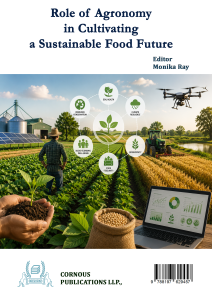
Role of Agronomy in Cultivating a Sustainable Food Future
- Monika Ray
- Regional Research and Technology Transfer Station, Odisha University of Agriculture and Technology, Keonjhar-758002, Odisha, India.
In an era defined by environmental challenges and a rapidly growing global population, the need for a sustainable food system has never been more urgent. Agriculture, the bedrock of human civilization, stands at the crossroads of this pressing need. As we seek to meet the demands of billions, the role of agronomy the science and practice of crop production and soil management—has emerged as a pivotal factor in shaping a sustainable food future.
This book, Role of Agronomy in Cultivating a Sustainable Food Future, delves into the multifaceted aspects of agronomy that are critical to addressing these challenges. It explores the innovative practices, technologies, and research that are transforming agriculture into a more resilient, efficient, and environmentally conscious endeavor. From the intricacies of soil health to the adoption of climate-smart agricultural techniques, this work aims to provide a comprehensive understanding of how agronomy can contribute to a more sustainable world.
Throughout the chapters, we highlight the importance of integrating ecological principles with agronomic practices, ensuring that food production not only meets current demands but also preserves and enhances the natural resources on which it depends. We also examine the role of agronomists, researchers, policymakers, and farmers in driving this transformation, acknowledging that the path to sustainability is a collective journey.
This book is intended for a wide audience, including students, researchers, practitioners, and policymakers in the field of agriculture and environmental science. It serves as both an introduction to key concepts and a detailed exploration of cutting-edge developments in agronomy. Our goal is to inspire and inform the next generation of agricultural professionals who will be tasked with the vital role of feeding the world sustainably.
As we embark on this journey through the pages of this book, we are reminded that the future of our food system depends not just on what we grow, but on how we grow it. Through the lens of agronomy, we can envision a future where agriculture thrives in harmony with the environment, ensuring food security, economic prosperity, and ecological balance for generations to come.
-
Sustainable Farming Practices: A Global Perspective
PAID ACCESS | Published on : 31-Oct-2024 | Doi :10.37446/edibook092024/1-18 | Pages : 1-18
-
Soil Health and Plant Nutrition for Sustainable Agriculture
PAID ACCESS | Published on : 31-Oct-2024 | Doi :10.37446/edibook092024/19-28 | Pages : 19-28
-
Crop-Livestock Interactions: A Step Towards Sustainable Production
PAID ACCESS | Published on : 31-Oct-2024 | Doi :10.37446/edibook092024/29-43 | Pages : 29-43
-
Green Technologies for Sustainable Agriculture
PAID ACCESS | Published on : 31-Oct-2024 | Doi :10.37446/edibook092024/44-55 | Pages : 44-55
-
Agricultural Waste Management Using Bio-decomposers
PAID ACCESS | Published on : 31-Oct-2024 | Doi :10.37446/edibook092024/56-78 | Pages : 56-78
-
Pest Management: Combating Crop Pests Sustainably
PAID ACCESS | Published on : 31-Oct-2024 | Doi :10.37446/edibook092024/79-91 | Pages : 79-91
-
Agroecology: Balancing Ecology and Agriculture
PAID ACCESS | Published on : 31-Oct-2024 | Doi :10.37446/edibook092024/92-104 | Pages : 92-104
-
Sustainable Water Management for Agriculture: Emerging Trends and Technologies
PAID ACCESS | Published on : 31-Oct-2024 | Doi :10.37446/edibook092024/107-115 | Pages : 107-115
-
Precision Agriculture: Harnessing Technology for Sustainable and Efficient Farming
PAID ACCESS | Published on : 31-Oct-2024 | Doi :10.37446/edibook092024/116-122 | Pages : 116-122
-
Role of IoT in Modern Agriculture: Driving Efficiency and Innovation
PAID ACCESS | Published on : 31-Oct-2024 | Doi :10.37446/edibook092024/123-130 | Pages : 123-130
-
Elevating Crop Yields Through Microclimate Management in Agriculture
PAID ACCESS | Published on : 31-Oct-2024 | Doi :10.37446/ edibook092024 /131-138 | Pages : 131-138
-
Smart Farming With AI: Revolutionizing Crop Management and Monitoring
PAID ACCESS | Published on : 31-Oct-2024 | Doi :10.37446/ edibook092024/139-147 | Pages : 139-147
-
Integrated Nutrient Management: A Pathway to Sustainable Agriculture
PAID ACCESS | Published on : 31-Oct-2024 | Doi :10.37446/edibook092024/148-155 | Pages : 148-155
-
Enhancing Nutrient Management Strategies Through Technological Innovations
PAID ACCESS | Published on : 31-Oct-2024 | Doi :10.37446/ edibook092024/156-164 | Pages : 156-164
-
Harnessing Biodiversity: A Blueprint for Resilient and Sustainable Agricultural Systems
PAID ACCESS | Published on : 31-Oct-2024 | Doi :10.37446/edibook092024/165-171 | Pages : 165-171
-
Nanotechnology in Agriculture - Current Trends and Future Prospects
PAID ACCESS | Published on : 31-Oct-2024 | Doi :10.37446/edibook092024/172-179 | Pages : 172-179
Indexing In




Types of Books We Publish




Uniqueness of our Publication

DOI Assignment

ISBN Registration

Online Publication

High Visibility

Open & Closed Access
DOI Assignment
ISBN Registration
Online Publication
High Visibility
Open & Closed Access