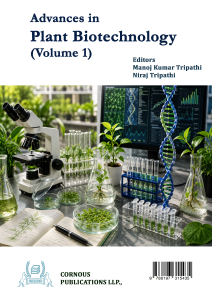
Advances in Plant Biotechnology (Volume 1)
- Manoj Kumar Tripathi
- Professor, Rajmata Vijayaraje Scindia Agricultural University, Gwalior, M.P., India.
- Niraj Tripathi
- Research Associate, Jawaharlal Nehru Krishi Vishwa Vidyalaya, Jabalpur, 482004, MP, India.
Plant Modern crop enhancement relies heavily on plant biotechnology, which provides instruments to improve nutritional quality, resilience, and yield. Compared to conventional methods, it uses methods like genetic engineering and molecular breeding to more quickly and accurately introduce desired features into crops. This book, Advances in Plant Biotechnology Volume I, presents a comprehensive overview of the latest breakthroughs in the applications of biotechnological tools in the improvement of crops. Cutting-edge techniques like molecular breeding, genomic and marker-assisted selection, gene editing tools like CRISPR/Cas, twofold haploidy, and speed breeding are all combined with bioinformatics and omics tools. Plant breeding is changing as a result of these developments, which are making it possible to create high-yielding, nutritionally superior, and climate-resilient crop types at a never-before-seen rate. Every chapter examines a different facet of contemporary plant breeding, fusing theoretical foundations with real-world applications. The book also features case studies and breeding initiatives from the real world that show how these cutting-edge methods may be successfully applied to a range of crop species. This book bridges the gap between science and sustainable agricultural development by relating basic research to field-level results. Plant breeders, geneticists, agronomists and students who are dedicated to promoting innovation in crop improvement might find this book to be a useful resource. The findings presented in this volume are intended to stimulate new research, support breeding initiatives, and eventually lead to a more resilient and sustainable agricultural future as we traverse an era characterized by ecological instability and food system transition. We would like to express our profound gratitude to all of the researchers, contributors, and publishing team whose knowledge and dedication have been crucial to the creation of this work. I hope that this book will be a source of inspiration for future developments in plant biotechnology.
-
Genetic Diversity in Crop Improvement - A Cornerstone for Sustainable Agriculture and Global Food Security
PAID ACCESS | Published on : 03-Jul-2024 | Doi :10.37446/volbook032024/1-21 | Pages : 1-21
-
Breeding for Major Genes against Drought Stress in Soybean
PAID ACCESS | Published on : 04-Aug-2024 | Doi :10.37446/volbook032024/22-68 | Pages : 22-68
-
Next-generation Sequencing and its Application in Crop Improvement
PAID ACCESS | Published on : 02-Oct-2024 | Doi :10.37446/volbook032024/69-82 | Pages : 69-82
-
Molecular Markers: A First Step Towards Molecular Breeding for Crop Improvement
PAID ACCESS | Published on : 02-Oct-2024 | Doi :10.37446/volbook032024/83-92 | Pages : 83-92
-
Application of Plant Tissue Culture in Crop Improvement
PAID ACCESS | Published on : 17-Nov-2024 | Doi :10.37446/volbook032024/93-114 | Pages : 93-114
-
Integrated Approaches for Climate Resilient Agriculture
PAID ACCESS | Published on : 17-Nov-2024 | Doi :10.37446/volbook032024/115-128 | Pages : 115-128
-
Metagenomics: An Unveiling the Microbial World
PAID ACCESS | Published on : 01-Dec-2024 | Doi :10.37446/volbook032024/129-158 | Pages : 129-158
-
Prospectives of Metabolic Engineering for Sustainable Bioenergy Production
PAID ACCESS | Published on : 06-Dec-2024 | Doi :10.37446/volbook032024/159-187 | Pages : 159-187
-
Marker Assisted Selection - a Crucial Technique to Facilitate Modern Plant Breeding
PAID ACCESS | Published on : 24-Feb-2025 | Doi :10.37446/volbook032024/188-207 | Pages : 188-207
-
Significance of Somatic Hybridization in Crop Improvement
PAID ACCESS | Published on : 23-Mar-2025 | Doi :10.37446/volbook032024/208-226 | Pages : 208-226
Indexing In




Types of Books We Publish




Uniqueness of our Publication

DOI Assignment

ISBN Registration

Online Publication

High Visibility

Open & Closed Access
DOI Assignment
ISBN Registration
Online Publication
High Visibility
Open & Closed Access