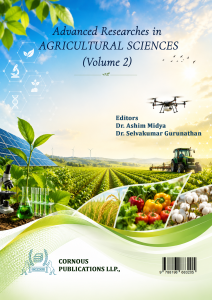
Editorial Book
Book Title: Advanced Researches in Agricultural Sciences (Volume 2)
OPEN ACCESS | Published on : 19-Mar-2026 | Pages: 41-53 | Doi : 10.37446/vol2book092025/41-53
Water Scarcity and Judicious Management for Agricultural Sustainability under the backdrop of a shrinking resource base
- Amruta Sawant
- Academy of Scientific and Innovative Research (AcSIR), Ghaziabad, India; CSIR-National Environmental Engineering Research Institute (CSIR-NEERI), Nehru Marg, Nagpur, India.
- Chandani Lakhani
- Academy of Scientific and Innovative Research (AcSIR), Ghaziabad, India; CSIR-National Environmental Engineering Research Institute (CSIR-NEERI), Nehru Marg, Nagpur, India.
- Sandeep Bodkhe
- Academy of Scientific and Innovative Research (AcSIR), Ghaziabad, India; CSIR-National Environmental Engineering Research Institute (CSIR-NEERI), Nehru Marg, Nagpur, India.
Abstract
Water scarcity, climate change, uncontrolled resource exploitation, and governance challenges are the key drivers largely impacting agricultural sustainability. The chapter briefly reviews the water agriculture dependency with a focus on the key drivers, impacts, and strategies associated with water scarcity in agriculture. It also reviews the present declining water resource related issue and its effects on crop production, yield stability, soil degradation, salinity, and farmer livelihoods as possible emerging risks to food security and rural sustainability. Further, the chapter discusses water-smart agriculture practices, including the latest water-efficient irrigation technologies, advanced cropping patterns, and soil-water conservation measures as sustainable water management strategies. This section explains the role of traditional water management practices, policies, institutional measures, and emerging technologies in addressing challenges related to water scarcity in agriculture. It also explains how these efforts help to make efficient and judicious use of water in agriculture. Overall, the chapter has highlighted that efficient water management in agriculture is essential for achieving long-term water security and agricultural sustainability.
Keywords
Water scarcity, Agricultural sustainability, Climate change, Water-smart agriculture, Sustainable water governance
References
Baraj, B., Mishra, M., Sudarsan, D., Marques, R., & Augusto, C. (2024). Climate change and resilience, adaptation, and sustainability of agriculture in India: A bibliometric review. Heliyon, 10, e29586. https://doi.org/10.1016/j.heliyon.2024.e29586
Biswas, A., Sarkar, S., Das, S., Dutta, S., Banerjee, K., Gupta, D., & Paul, D. (2025). Water scarcity: A global hindrance to sustainable development and agricultural production - A critical review of the impacts and adaptation strategies. Cambridge Prisms: Water, 3, e4. https://doi.org/10.1017/wat.2024.16
Central Water Commission. (2024). National register of major and medium irrigation projects in India. Ministry of Jal Shakti, Government of India.
Chouhan, S., Kumari, S., Kumar, R., & Chaudhary, P. L. (2023). Climate resilient water management for sustainable agriculture. International Journal of Environment and Climate Change, 13(7), 411–426. https://doi.org/10.9734/ijecc/2023/v13i71894
Deng, Q., Sharretts, T., Ali, T., Ao, Y. Z., Chiarelli, D. D., Demeke, B., Marston, L., Mehta, P., Mekonnen, M., Rulli, M. C., Tuninetti, M., Xie, W., & Davis, K. F. (2025). Deepening water scarcity in breadbasket nations. Nature Communications, 16(1), 1–14. https://doi.org/10.1038/s41467-025-56022-6
Deshmukh, P., Amolic, U. V., & Mutkule, U. S. (2025). Impact of industrialization on accumulation of heavy metals in irrigation water, soil and vegetables. International Journal of Advanced Biochemistry Research, 9(3), 472–476. https://doi.org/10.33545/26174693.2025.v9.i3f.3985
Food and Agriculture Organization of the United Nations. (2007). Water for food, water for life: A comprehensive assessment of water management in agriculture. Earthscan.
Food and Agriculture Organization of the United Nations. (2024). AQUASTAT database. https://www.fao.org/aquastat
Government of India. (2025). Economic Survey 2024–25. Department of Economic Affairs.
He, L., & Rosa, L. (2023). Solutions to agricultural green water scarcity under climate change. PNAS Nexus, 2(4), pgad117. https://doi.org/10.1093/pnasnexus/pgad117
Jatav, S. S., & Naik, K. (2023). Measuring the agricultural sustainability of India: An application of pressure–state–response model. Regional Sustainability, 4(3), 218–234. https://doi.org/10.1016/j.regsus.2023.05.006
Leijnse, M., Bierkens, M. F. P., Gommans, K. H. M., Lin, D., & Tait, A. (2024). Key drivers and pressures of global water scarcity hotspots. Environmental Research Letters, 19(5), 054035. https://doi.org/10.1088/1748-9326/ad3c54
Mehla, M. K., Kothari, M., Singh, P. K., Bhakar, S. R., & Yadav, K. K. (2023). Water footprint assessment and its importance in Indian context: A meta-review. Water Supply, 23(8), 3113–3127. https://doi.org/10.2166/ws.2023.174
Midya, A. (2025). Present research priority on aerobic rice culture for sustainable rice production under the backdrop of shrinking resource base: A review. Indian Journal of Agricultural Research, 59(3), 339–350.
Midya, A., Saren, B. K., Dey, J. K., Maitra, S., Praharaj, S., Gaikwad, D. J., Gaber, A., Alsanie, W. F., & Hossain, A. (2021). Crop establishment methods and integrated nutrient management improve: Part I. Crop performance, water productivity and profitability of rice (Oryza sativa L.) in the lower Indo-Gangetic Plain, India. Agronomy, 11(9), 1860. https://doi.org/10.3390/agronomy11091860
Morchid, A., El Raezah, A. A., & Sabbar, Y. (2024). Applications of internet of things (IoT) and sensor technology to increase food security and agricultural sustainability: Benefits and challenges. Ain Shams Engineering Journal, 15(3), 102509. https://doi.org/10.1016/j.asej.2023.102509
Nasim, I., Ahmad, B., Atif, M., Rab, I., Alam, R., & Ghani, N. (2026). Impact of industrial wastewater on heavy metal contamination in agricultural soils and associated health risks. Applied Water Science, 16(2), 41. https://doi.org/10.1007/s13201-025-02559-2
NITI Aayog. (2023). Strategy paper on reuse of treated wastewater in peri-urban agriculture in India. Government of India.
Paschaline, A., & Kabari, O. (2024). The blue revolution: Sustainable water management for a thirsty world. Discover Sustainability. https://doi.org/10.1007/s43621-024-00631-6
Patel, D. P., Das, A., Munda, G. C., Ghosh, P. K., Bordoloi, J. S., & Kumar, M. (2010). Evaluation of yields and physiological attributes of high yielding rice varieties under aerobic and flood irrigated management practices in mid hill eco-system. Agricultural Water Management, 97, 1269–1276.
Rastogi, M., Kolur, S. M., Burud, A., Sadineni, T., Sekhar, M., Kumar, R., & Rajput, A. (2024). Advancing water conservation techniques in agriculture for sustainable resource management: A review. Journal of Geography, Environment and Earth Science International, 28(3), 41–53. https://doi.org/10.9734/jgeesi/2024/v28i3755
Sahoo, S., Singha, C., Govind, A., & Moghimi, A. (2025). Review of climate-resilient agriculture for ensuring food security: Sustainability opportunities and challenges of India. Environmental and Sustainability Indicators, 25, 100544. https://doi.org/10.1016/j.indic.2024.100544
Saikanth, D. R. K., Kumar, S., Rani, M., Sharma, A., Srivastava, S., Vyas, D., Singh, G. A., & Kumar, S. (2023). A comprehensive review on climate change adaptation strategies and challenges in agriculture. International Journal of Environment and Climate Change, 13(11), 10–19. https://doi.org/10.9734/ijecc/2023/v13i113138
Schreefel, L., Creamer, R. E., van Zanten, H. H. E., de Olde, E. M., Koppelmäki, K., Debernardini, M., de Boer, I. J. M., & Schulte, R. P. O. (2024). How to monitor the ‘success’ of agricultural sustainability: A perspective. Global Food Security, 43, 100810. https://doi.org/10.1016/j.gfs.2024.100810
Seckler, D., Barker, R., & Amarasinghe, U. (1999). Water scarcity in the twenty-first century. International Journal of Water Resources Development, 15(1–2), 29–42. https://doi.org/10.1080/07900629948916
Tandle, V. H., Dubey, L. R., & Kumari, K. (2025). Water scarcity in India related to agriculture. International Journal of Research Publication and Reviews, 6(1), 535–540.
Verma, K. K., Peng, X., Aradhna, S., Jagadesh, K. M., Kumar, S., Rajan, S., Munna, B., Chandra, S., & Seth, S. (2025). Climate change adaptation: Challenges for agricultural sustainability. Plant, Cell & Environment. https://doi.org/10.1111/pce.15078.
Indexing In




Types of Books We Publish



Uniqueness of our Publication

DOI Assignment

ISBN Registration

Online Publication

High Visibility

Open & Closed Access
DOI Assignment
ISBN Registration
Online Publication
High Visibility