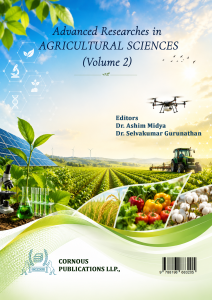
Editorial Book
Book Title: Advanced Researches in Agricultural Sciences (Volume 2)
PAID ACCESS | Published on : 30-Sep-2026 | Pages: 144-157 | Doi : 10.37446/vol2book092025/144-157
Value Addition in Sesame for Enhancing Farmers' Income
- ABM Sirisha
- Scientist, Genetics and Plant Breeding Research (GPBR), Agricultural Research Station, Yelamanchili, Anakapalli District, Andhra Pradesh–531055, India.
- MBGS Kumari
- Principal Scientist and Head (Agronomy), Agricultural Research Station, Yelamanchili, Anakapalli District, Andhra Pradesh–531055, India.
- A Chandini
- Research Associate (Plant Pathology), Agricultural Research Station, Yelamanchili, Anakapalli District, Andhra Pradesh–531055, India.
- Rohit Kumar
- Research Associate (Genetics and Plant Breeding), Agricultural Research Station, Yelamanchili, Anakapalli District, Andhra Pradesh–531055, India.
Abstract
Sesame (Sesamum indicum L.) is an ancient and nutritionally important oilseed crop with considerable potential for value-added food, nutraceutical, cosmetic and industrial applications. Its seeds are rich in edible oil and protein and also contain lignans, tocopherols, phytosterols, phenolic compounds, minerals and other biologically active constituents. Nevertheless, a large proportion of sesame is still marketed as raw seed, limiting the proportion of the final consumer value received by producers. Value addition provides an opportunity to overcome this limitation by converting sesame into higher-value products and by efficiently utilizing processing residues. This chapter discusses the economic importance of sesame, the need for value addition, traditional sesame products, modern processing technologies, nutraceutical and functional-food applications, utilization of oil cake, meal and hulls, rural entrepreneurship, market and export prospects, major constraints and future research priorities.
Keywords
Sesamum indicum, sesame oil, value addition, functional foods, nutraceuticals, sesame meal, sesame hulls, processing, entrepreneurship, farmer income, value chain
References
Angamuthu, M., Govindasamy, S., Kasirajan, S., Langyan, S., Rangan, P., & Pradheep, K. (2025). Origin and history of sesame and its uses. In S. Langyan, P. Yadava, R. Yadav, & R. Bhardwaj (Eds.), Sesame: Sustainable production and applications (pp. 1–19). Springer Nature Singapore.
Das, R., & Bhattacharjee, C. (2015). Processing sesame seeds and bioactive fractions. In V. Preedy (Ed.), Processing and impact on active components in food (pp. 385–394). Academic Press/Elsevier. https://doi.org/10.1016/B978-0-12-404699-3.00046-9
Elleuch, M., Besbes, S., Roiseux, O., Blecker, C., & Attia, H. (2007). Quality characteristics of sesame seeds and by-products. Food Chemistry, 103(2), 641–650. https://doi.org/10.1016/j.foodchem.2006.09.008
Haque, M., Umadevi, M., & Langyan, S. (2025). Challenges and strategies for global sustainable production, market dynamics, and trade in sesame. In S. Langyan, P. Yadava, R. Yadav, & R. Bhardwaj (Eds.), Sesame: Sustainable production and applications (pp. 21–36). Springer Nature Singapore.
Haque, M., Yadav, S., Lal, M., Yadav, R., & Langyan, S. (2025). Nutritional quality of sesame and its health applications. In S. Langyan, P. Yadava, R. Yadav, & R. Bhardwaj (Eds.), Sesame: Sustainable production and applications (pp. 163–184). Springer Nature Singapore.
Hegde, D. M. (2012). Sesame. In M. Peter (Ed.), Handbook of herbs and spices (2nd ed., Vol. 2, pp. 449–486). Woodhead Publishing. https://doi.org/10.1533/9780857095688.449
Joshi, A. B. (1961). Sesamum. Indian Central Oilseeds Committee.
Khan, F. N., Yadava, P., Yadav, R., & Langyan, S. (2025). Indigenous sesame products for food and health. In S. Langyan, P. Yadava, R. Yadav, & R. Bhardwaj (Eds.), Sesame: Sustainable production and applications (pp. 135–161). Springer Nature Singapore.
Langyan, S., Yadava, P., Yadav, R., & Bhardwaj, R. (Eds.). (2025). Sesame: Sustainable production and applications. Springer Nature Singapore. https://doi.org/10.1007/978-981-96-0656-6
Mahajan, M., & Sadana, R. (2025). Food applications of sesame and new product development. In S. Langyan, P. Yadava, R. Yadav, & R. Bhardwaj (Eds.), Sesame: Sustainable production and applications (pp. 185–208). Springer Nature Singapore.
Nakano, D., Ogura, K., Miyakoshi, M., Ishii, F., Kawanishi, H., Kurumazuka, D., Kwak, C.-J., Ikemura, K., Takaoka, M., Moriguchi, S., Iino, T., Kusumoto, A., Asami, S., Shibata, H., Kiso, Y., & Matsumura, Y. (2006). Antihypertensive effect of angiotensin I-converting enzyme inhibitory peptides from a sesame protein hydrolysate in spontaneously hypertensive rats. Bioscience, Biotechnology, and Biochemistry, 70(5), 1118–1126. https://doi.org/10.1271/bbb.70.1118
Namiki, M. (2007). Nutraceutical functions of sesame: A review. Critical Reviews in Food Science and Nutrition, 47(7), 651–673. https://doi.org/10.1080/10408390600919114
Pathak, N., Rai, A. K., Kumari, R., & Bhat, K. V. (2014). Value addition in sesame: A perspective on bioactive components for enhancing utility and profitability. Pharmacognosy Reviews, 8(16), 147–155. https://doi.org/10.4103/0973-7847.134249
Peddobilesu, N., & Padmavathi, A. (2019). Productivity analysis of oilseeds in Andhra Pradesh. Journal of Emerging Technologies and Innovative Research, 6(5), Article JETIR1905386.
Sarita, Sharma, M., & Samota, M. K. (2025). Sesame waste to valuable products, applications, and future perspectives of value-added products. In S. Langyan, P. Yadava, R. Yadav, & R. Bhardwaj (Eds.), Sesame: Sustainable production and applications (pp. 243–288). Springer Nature Singapore.
Sharma, S., Kashyap, L., Goyal, A., Bala, M., & Singh, M. (2025). Techniques for sesame oil extraction and its quality analysis and comparison with other oilseed crops. In S. Langyan, P. Yadava, R. Yadav, & R. Bhardwaj (Eds.), Sesame: Sustainable production and applications (pp. 107–134). Springer Nature Singapore.
Visavadiya, N. P., & Narasimhacharya, A. V. R. L. (2008). Sesame as a hypocholesterolaemic and antioxidant dietary component. Food and Chemical Toxicology, 46(6), 1889–1895. https://doi.org/10.1016/j.fct.2008.01.012
Weiss, E. A. (1983). Oilseed crops. Longman.
Yadav, S., & Langyan, S. (2025). Toward sustainable agriculture of sesame crop: Challenges and recommendations. In S. Langyan, P. Yadava, R. Yadav, & R. Bhardwaj (Eds.), Sesame: Sustainable production and applications (pp. 289–301). Springer Nature Singapore.
Indexing In




Types of Books We Publish



Uniqueness of our Publication

DOI Assignment

ISBN Registration

Online Publication

High Visibility

Open & Closed Access
DOI Assignment
ISBN Registration
Online Publication
High Visibility