Editorial Book
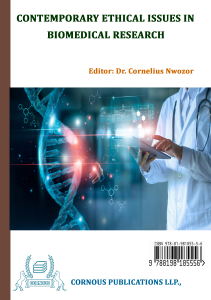
Book Title: Contemporary Ethical Issues in Biomedical Research
PAID ACCESS | Published on : 01-Dec-2025 | Pages: 1-9 | Doi : 10.37446/edibook062025/1-9
Use of Animals in Biomedical Research
- Shabnam Kumari Thakur
- Assistant professor, Gokaraju Rangaraju college of pharmacy, Hyderabad, India.
Abstract
In both fundamental and applied science, models of both vertebrates and invertebrates have played a significant role for many years. They have contributed to our understanding of the morphology of cells and organs, the aetiology and prevention of disease, behavioural research, and the creation and evaluation of foods, medications, cosmetics, and other items. They also aid in providing answers for inquiries that cannot be resolved by using only human participants. For the study of complicated multigenic disorders and drug testing, in vivo models are still indispensable, even though alternate non-animal models are being developed. Animal studies frequently yield the most accurate estimations and forecasts of human reactions when human data is lacking.
Keywords
Biomedical research, Laboratory models, Ethical justification, Disease models, Drug testing
References
Alston, T. A. (2007). Nitrous or nitric? Same difference. Molecular formulas in the 1840s. Journal of clinical anesthesia, 19(2), 159-161.
Bateson, P. (1991). Assessment of pain in animals. Animal behaviour, 42(5), 827-839.
Breivik, J. (2005, February). The evolutionary origin of genetic instability in cancer development. In Seminars in cancer biology (Vol. 15, No. 1, pp. 51-60). Academic Press.
Cespedes, M. V., Casanova, I., Parreño, M., & Mangues, R. (2006). Mouse models in oncogenesis and cancer therapy. Clinical and Translational Oncology, 8, 318-329.
Congress, U. S. (1986). Office of Technology Assessment. Alternatives to animal use in research, testing, and education. Washington DC: US Government Printing Office. OTA-BA-273. 1986. http://govinfo. library. unt. edu/ota/Ota_3/DATA/1986/8601. PDF (accessed 3 Jul 2014).
Festing, M. F., & Altman, D. G. (2002). Guidelines for the design and statistical analysis of experiments using laboratory animals. ILAR journal, 43(4), 244-258.
Freudenreich, C. H. (2007). Chromosome fragility: molecular mechanisms and cellular consequences. Front Biosci, 12(12), 4911.
Greiner, D. L., Hesselton, R. A., & Shultz, L. D. (1998). SCID mouse models of human stem cell engraftment. Stem cells, 16(3), 166-177.
Hafen, E. (2004). Cancer, type 2 diabetes, and ageing: news from flies and worms. Swiss medical weekly, 134(49-50), 711-719.
Hudler, P. (2007). The use of animals in biomedical research. Volume 3 Slov Vet Res• Ljubljana• 2007• Volume 44• Number 3• 55-96, 55.
Jin, P., Zhao, Y., Ngalame, Y., Panelli, M. C., Nagorsen, D., Monsurró, V., ... & Wang, E. (2004). Selection and validation of endogenous reference genes using a high throughput approach. BMC genomics, 5, 1-17.
Kostomitsopoulos, N. G., Paronis, E., Alexakos, P., Balafas, E., van Loo, P., & Baumans, V. (2007). The influence of the location of a nest box in an individually ventilated cage on the preference of mice to use it. Journal of Applied Animal Welfare Science, 10(2), 111-121.
LaFollette, H., & Shanks, N. (1994). Animal experimentation: the legacy of Claude Bernard. International Studies in the philosophy of Science, 8(3), 195-210.
Lehner, B., Crombie, C., Tischler, J., Fortunato, A., & Fraser, A. G. (2006). Systematic mapping of genetic interactions in Caenorhabditis elegans identifies common modifiers of diverse signaling pathways. Nature genetics, 38(8), 896-903.
Lloyd, M. H., Foden, B. W., & Wolfensohn, S. E. (2008). Refinement: promoting the three Rs in practice. Laboratory Animals, 42(3), 284-293.
McConway, K. (1992). The number of subjects in animal behaviour experiments: is Still, right? Animal Behaviour, 35-38.
Morton, D. B., & Griffiths, P. H. (1985). Guidelines on the recognition of pain, distress and discomfort in experimental animals and a hypothesis for assessment. Vet Rec, 116(16), 431-6.
Ohnishi, Y., Nakamura, H., Yoshimura, M., Tokuda, Y., Iwasawa, M., Ueyama, Y., ... & Shimamura, K. (1995). Prolonged survival of mice with human gastric cancer treated with an anti-c-ErbB-2 monoclonal antibody. British journal of cancer, 71(5), 969-973.
Örink, K. J., & Rehbinder, C. (2000). Animal definition: a necessity for the validity of animal experiments? Laboratory Animals, 34(2), 121-130.
Rand, M. S. (2004). Selection of animal models. Research animal methods. University of Arizona, Tucson.
Rehbinder, C., Alenius, S., Bures, J., De las Heras, M., Greko, C., Kroon, P. S., & Gutzwille, A. (2000). FELASA recommendations for the health monitoring of experimental units of calves, sheep and goats: Report of the Federation of European Laboratory Animal Science Associations (FELASA) Working Group on Animal Health. Laboratory animals, 34(4), 329-350.
Russell Wms, B. (1992). The principles of humane experimental technique. London: UFAW.
Russell Wms, B. (1992). The principles of humane experimental technique. London: UFAW.
Schein, P. S., & Scheffler, B. (2006). Barriers to efficient development of cancer therapeutics. Clinical Cancer Research, 12(11), 3243-3248.
Shultz, L. D., Ishikawa, F., & Greiner, D. L. (2007). Humanized mice in translational biomedical research. Nature Reviews Immunology, 7(2), 118-130.
Talmadge, J. E., Singh, R. K., Fidler, I. J., & Raz, A. (2007). Murine models to evaluate novel and conventional therapeutic strategies for cancer. The American journal of pathology, 170(3), 793-804.
van der Meer, M., Rolls, A., Baumans, V., Olivier, B., & Van Zutphen, L. F. M. (2001). Use of score sheets for welfare assessment of transgenic mice. Laboratory Animals, 35(4), 379-389.
Vogelstein, B., & Kinzler, K. W. (2004). Cancer genes and the pathways they control. Nature medicine, 10(8), 789-799.
Wakefield, I. D., Pollard, C., Redfern, W. S., Hammond, T. G., & Valentin, J. P. (2002). The application of in vitro methods to safety pharmacology. Fundamental & Clinical Pharmacology, 16(3), 209-218.
Wallace, J. (2000). Humane endpoints and cancer research. ILAR journal, 41(2), 87-93.
Wells, D. J., Playle, L. C., Enser, W. E. J., Flecknell, P. A., Gardiner, M. A., Holland, J., ... & Watt, N. (2006). Assessing the welfare of genetically altered mice. Laboratory animals, 40(2), 111-114..
Zhao, J. J., Roberts, T. M., & Hahn, W. C. (2004). Functional genetics and experimental models of human cancer. Trends in molecular medicine, 10(7), 344-350.
Indexing In




Types of Books We Publish




Uniqueness of our Publication

DOI Assignment

ISBN Registration

Online Publication

High Visibility

Open & Closed Access
DOI Assignment
ISBN Registration
Online Publication
High Visibility