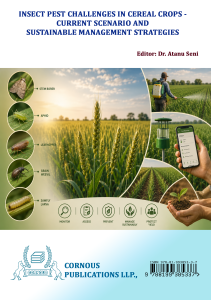
Editorial Book
Book Title: Insect Pest Challenges in Cereal Crops - Current Scenario and Sustainable Management Strategies
PAID ACCESS | Published on : 25-Nov-2026 | Pages: 142-151 | Doi : https://doi.org/10.37446/edibook212025/142-151
The Economics of Insect Pest Damage and Integrated Management in Rice
- Bhuvaneshwari . N
- Ph.D. Research Scholar, Department of Economics, Avinashilingam Institute for Home Science and Higher Education for Women, Coimbatore, Tamil Nadu, India
- Malarvizhi . V
- Professor and Head, Department of Economics, Avinashilingam Institute for Home Science and Higher Education for Women, Coimbatore, Tamil Nadu, India.
Abstract
Insect pests remain one of the most persistent economic constraints on rice production, the crop that anchors food security and rural livelihoods across Asia. This chapter examines insect pest management in rice through an economic lens rather than a purely entomological one, treating the problem as one of resource allocation under risk. It reviews the scale of economic loss attributable to insect pests, frames the economic threshold level (ETL) as an applied marginal cost-marginal benefit decision rule, and compares the cost-benefit performance of integrated pest management (IPM) against conventional, calendar-based chemical control using published farm-level evidence. The chapter also considers the externalities of pesticide-intensive rice cultivation–health costs, ecological costs, and pesticide-residue-related trade losses–and the institutional and policy factors that shape farmers' adoption of IPM. The evidence reviewed suggests that IPM consistently outperforms conventional practice on cost-benefit ratio and net farm income, even though pesticide-intensive practices persist because of information gaps, risk aversion, and short-run liquidity constraints among farmers rather than genuine economic superiority of chemical control.
Keywords
Rice, Insect pests, Economic threshold level, Cost-benefit analysis, Integrated pest management, Externalities, Farm economics
References
Abbott, P. C. (2011). Export restrictions as stabilization responses to food crisis. American Journal of Agricultural Economics, 94(2), 428–434.
Anderson, K., & Nelgen, S. (2012). Trade barrier volatility and agricultural price stabilization. World Development, 40(1), 36–48.
Antle, J. A. (1994). Pesticide, productivity and farmer health: A Philippine case study. American Journal of Agricultural Economics, 76, 418–430.
APEDA. (2017). Basmati and non-basmati rice export statistics. Agricultural and Processed Food Products Export Development Authority, Government of India.
Birthal, P. S., Hazrana, J., & Negi, D. S. (2015). Diversification in Indian agriculture towards high-value crops: An empirical study. National Centre for Agricultural Economics and Policy Research.
Bishwajit, G., Sarker, S., Kpoghomou, M.-A., Gao, H., Jun, L., Yin, D., & Ghosh, S. (2013). Self-sufficiency in rice and food security: A South Asian perspective. Agriculture & Food Security, 2(1), 1–6.
Cost-benefit ratio of IPM modules against major insect pests of rice during Kharif 2018–2019. (n.d.). Agricultural Science Digest. https://arccjournals.com/journal/agricultural-science-digest/D-5823
Council on Energy, Environment and Water. (2023). What is integrated pest management in India? https://ceew.in/publications/sustainable-agriculture-india/integrated-pest-management
Crop losses due to insect pests in Indian agriculture: An update. (2025). ResearchGate. https://www.researchgate.net/publication/281304642
Crop losses due to insect pests: Global and Indian scenario. (n.d.). ResearchGate. https://www.researchgate.net/publication/282390119
Dhaliwal, G. S., & Koul, O. (2010). Quantification of losses and assessment methodology. In G. S. Dhaliwal & O. Koul (Eds.), Reprint – Vol. I.
Economic and ecological perspectives of farmers on rice insect pest management. (2019). ResearchGate. https://www.researchgate.net/publication/330181166
Evaluation of integrated pest and diseases management (IPDM) package on basmati/aromatic rice. (2024). Academia.edu. https://www.academia.edu/91649821
Food and Agriculture Organization of the United Nations. (2017). FAO rice market monitor (RMM).
Goel, A. (2024). The effect of export of rice on the economy of India. International Journal of Social Science and Economic Research, 9(4), 1236–1246.
Headey, D. (2011). Rethinking the global food crisis: The role of trade shocks. Food Policy, 36(2), 136–146.
Heong, K. L., Escalada, M. M., & Vo, M. (2008). An analysis of insecticide use in rice: Case studies in the Philippines and Vietnam. International Journal of Pest Management, 40, 173–178.
Input-based assessment on integrated pest management for transplanted rice (Oryza sativa) in India. (2020). ScienceDirect. https://www.sciencedirect.com/science/article/abs/pii/S026121942030377X
Integrated pest management in Indian agriculture: A developing economy perspective. (n.d.). Radcliffe's IPM World Textbook. https://ipmworld.umn.edu/krishna-indian-ag
Integrated pest management: Economic threshold and win-win framing. (2026). Frontiers in Insect Science. https://doi.org/10.3389/finsc.2026.1795406
Jayaprapakaran, P. (2026). An econometric assessment of rice production and export performance in India (2000–01 to 2024–25). International Journal of Special Education, 41(16s), 1294–1302.
Lazaro, A. A., & Heong, K. L. (1995). Analysis of factors influencing farmers' insecticide sprays. International Rice Research Notes, 20, 20.
Martin, W., & Anderson, K. (2012). Export restrictions and price insulation during commodity price booms. American Journal of Agricultural Economics, 94(2), 422–427.
Mitra, S., & Josling, T. (2009). Agricultural export restrictions: Welfare implications and trade disciplines. International Food & Agricultural Trade Policy Council.
National Institute of Plant Health Management. (n.d.). Integrated pest management package for rice. https://niphm.gov.in/IPMPackages/Rice.pdf
Parsons, K. C., Mineau, P., & Renfrew, R. B. (2010). Effects of pesticide use in rice fields on birds. Waterbirds, 33, 193–218.
Pasalu, I. C., Mishra, B., Krishnaiah, N. V., & Katti, G. (2004). Integrated pest management in rice in India: Status and prospects. Indian Agriculture, 25.
Pimentel, D. (1995). Amounts of pesticides reaching target pests: Environmental impacts and ethics. Journal of Agricultural and Environmental Ethics, 8, 17–29.
Pradhan Mantri Fasal Bima Yojana & Restructured Weather Based Crop Insurance Scheme. (2021). State-wise business statistics, FY 2016–17 to 2019–20 (as on 31.08.2021). Department of Agriculture, Cooperation and Farmers Welfare, Government of India.
Pretty, J., & Bharucha, Z. P. (2015). Integrated pest management for sustainable intensification of agriculture in Asia and Africa. Insects, 6, 152–182.
Savary, S., Willocquet, L., Elazegui, F. A., Castilla, N. P., & Teng, P. S. (2000). Rice pest constraints in tropical Asia: Quantification of yield losses due to rice pests in a range of production situations. Plant Disease, 84(3), 357–369.
Shashikiran, L., & Umesh, K. B. (2015). Determinants of crop insurance participation and its impact on income and consumption smoothing. [Journal details not provided].
Singh, A. (2010). Crop insurance in India: A study. Economic and Political Weekly / related policy publication.
Indexing In




Types of Books We Publish




Uniqueness of our Publication

DOI Assignment

ISBN Registration

Online Publication

High Visibility

Open & Closed Access
DOI Assignment
ISBN Registration
Online Publication
High Visibility