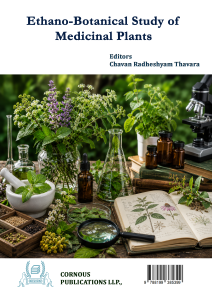
Editorial Book
Book Title: Ethano-Botanical Study of Medicinal Plants
OPEN ACCESS | Published on : 18-Jul-2026 | Pages: 95-103 | Doi : 10.37446/edibook182024/95-103
The Contribution of Wild Edible Plants in Human Nutrition (Wild Vegetables of India- Diversity, Nutritional Significance, Medicinal Value and Economic Potential)
- Ravindra Y. Thakur
- Department of Botany, S. R. M. Mahavidyalaya, Kudal, Sindhudurg, Maharashtra, India.
Abstract
Wild vegetables have formed an integral component of human diets since prehistoric times. In India, a vast diversity of wild edible plants has traditionally been utilized by tribal, rural, and forest-dependent communities for food, medicine, and livelihood. These plants represent an important source of nutrients, vitamins, minerals, antioxidants, and bioactive compounds. Besides contributing to household food security, wild vegetables play a significant role in traditional healthcare systems and local economies. India’s diverse agro-climatic regions, ranging from the Himalayas to the Western Ghats and from arid deserts to coastal ecosystems, harbour a rich diversity of wild edible species. However, modernization, habitat degradation, and changing food preferences are leading to a gradual decline in their utilization. This chapter reviews the importance of vegetables in human nutrition, the diversity and distribution of wild vegetables in India, their classification based on edible plant parts, medicinal properties, economic significance, and conservation needs.
Keywords
Wild vegetables, edible plants, traditional knowledge, nutrition, medicinal plants, biodiversity, food security, India
References
Arora, R. K. (1981). Native food plants of the Himalayas.
Bhattacharjee, A., et al. (2009). Wild edible plants of North-East India.
Food and Agriculture Organization. (n.d.). Wild food plants and food security reports.
Government of Maharashtra, Agriculture Department. (2021). Booklet on wild vegetables (2020–21).
Jain, S. K. (1991). Dictionary of Indian folk medicine and ethnobotany.
Kirtikar, K. R., & Basu, B. D. (1999). Indian medicinal plants (2nd ed., Vols. 1–4). International Book Distributors. (Original work published 1935)
Mahapatra, A. K., et al. (2012). Nutrient analysis of some selected wild edible fruits of deciduous forests of India: An explorative study towards non-conventional bio-nutrition. Advance Journal of Food Science and Technology, 4(1), 15–21.
Ministry of Environment, Forest and Climate Change, Government of India. (n.d.). Publications and reports.
Rashid, A., Anand, V. K., & Serwar, J. (2008). Less known wild edible plants used by tribal communities.
Sinha, R., & Lakra, V. (2005). Wild tribal food plants of India.
Indexing In




Types of Books We Publish




Uniqueness of our Publication

DOI Assignment

ISBN Registration

Online Publication

High Visibility

Open & Closed Access
DOI Assignment
ISBN Registration
Online Publication
High Visibility