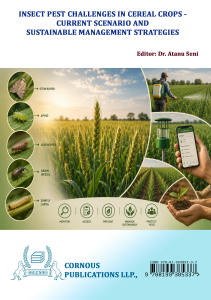
Editorial Book
Book Title: Insect Pest Challenges in Cereal Crops - Current Scenario and Sustainable Management Strategies
PAID ACCESS | Published on : 03-Feb-2026 | Pages: 83-91 | Doi : 10.37446/edibook212025/83-91
Sustainable Insect Pest Management in Cereal Crops Under Climate Variability
- Somanath Sahoo
- Assistant Professor in Zoology, Dr. R. C. Samanta Roy Institute of Science and Technology, Gania, Nayagarh, Odisha - 752085, India.
Abstract
Cereal crops, the cornerstone of global food security, face a rising danger from the synergistic interplay between climate change and insect pest dynamics. This review synthesises data on the implications of climate variability for the biology, ecology, and distribution of important insect pests in wheat, rice, maize, and barley systems. Climate change induces ecological alterations, including the poleward extension of pest ranges, enhanced overwintering survival, accelerated metabolic rates, and disruptive trophic mismatches. Case studies of aphids, fall armyworm, and stem borers illustrate how these modifications exacerbate outbreaks. Concurrently, climate unpredictability diminishes insecticide efficacy, promotes pest resistance, and renders forecasting models outdated. The report claims a paradigm shift from reactive pesticide use to proactive, Integrated Pest Management (IPM) is necessary. A multi-faceted approach integrating host plant resistance, agroecological diversity, better biological control, and precision agricultural technologies is advised. Successful implementation eventually requires robust governmental backing, strengthened extension services, focused research, and global cooperation to establish resilient cereal production systems capable of withstanding a changing environment and assuring future food security.
Keywords
Climate change, Integrated Pest Management (IPM), cereal crops, food security, sustainable agriculture, biological control
References
Abdullahi, H. S., Sheriff, R. E., & Mahieddine, F. (2021). Remote sensing and UAV technologies in pest management: A review. Journal of Electrical Systems, 17(1), 49–59.
Bedeke, S. B. (2023). Climate change vulnerability and adaptation of crop producers in sub-Saharan Africa: A review. Environment, Development and Sustainability, 25(2), 1017–1051.
Dassou, A. G., & Tixier, P. (2020). Response of pest control by generalist predators to local-scale plant diversity: A meta-analysis. Ecology and Evolution, 10(18), 10090–10100.
Delcour, I., Spanoghe, P., & Uyttendaele, M. (2015). Impact of climate change on pesticide use: A review. Food Research International, 68, 7–15.
Deutsch, C. A., et al. (2018). Increase in crop losses to insect pests in a warming climate. Science, 361(6405), 916–919.
Dhankher, O. P., & Foyer, C. H. (2018). Climate-resilient crops for improving global food security and safety. Plant, Cell & Environment, 41(5), 877–884.
Duveskog, D., et al. (2020). Empowerment through farmer field schools. FAO.
Early, R., González-Moreno, P., Murphy, S. T., & Day, R. (2023). Forecasting the global extent of invasion of the cereal pest Spodoptera frugiperda. NeoBiota, 62, 387–398.
Erenstein, O., et al. (2022). Global maize production, consumption and trade: Trends and R&D implications. Food Security, 14(5), 1295–1319.
FAO. (2023). World food and agriculture: Statistical yearbook 2023. Rome.
Feliciano, D. P. P., Dobbss, L. B., & Goulart, H. M. C. (2022). The impact of climate change on pesticide degradation: A review. Current Opinion in Environmental Science & Health, 27, 100356.
Feyaerts, N., Van den Broeck, J., & Luyten, W. (2020). The future of microbial insecticides for pest management. Current Opinion in Insect Science, 40, 78–83.
Gutiérrez, A. P., & Ponti, L. (2021). The new world of agricultural entomology under global change. Insects, 12(9), 773.
Hatt, S., et al. (2018). Pest regulation and support of natural enemies in agriculture: Experimental evidence of within-field biodiversity. Ecological Engineering, 118, 16–26.
Hänninen, L., et al. (2021). Improving the efficacy of biological control by enhancing the thermal tolerance of parasitoids. BioControl, 66, 1–12.
IFAD. (2021). The Sustainable Development Goals and IFAD’s commitment to leaving no one behind.
IPBES. (2019). Global assessment report on biodiversity and ecosystem services.
IPCC. (2022). Climate change 2022: Impacts, adaptation and vulnerability.
Islam, M. A., et al. (2022). Climate change, pest pressure, and food security: A systematic review. Sustainability, 14(3), 1529.
Jeffs, C. T., & Lewis, O. T. (2013). Effects of climate warming on host–parasitoid interactions. Ecological Entomology, 38(3), 209–218.
Lehmann, P., et al. (2020). Complex responses of global insect pests to climate warming. Frontiers in Ecology and the Environment, 18(3), 141–150.
Mursalin, M., & Dey, D. (2023). Heat shock proteins and their role in insecticide resistance: A review. Pesticide Biochemistry and Physiology, 189, 105298.
Muzari, W., et al. (2023). Socio-psychological factors influencing farmers’ adoption of sustainable pest management practices: A systematic review. Journal of Rural Studies, 97, 428–439.
OECD. (2021). Pesticide use and sustainable agriculture.
Peterson, R. K. D., et al. (2018). The role of climate change in agricultural pest management. Journal of Integrated Pest Management, 9(1), 1–7.
Pretty, J. (2018). Intensification for redesigned and sustainable agricultural systems. Science, 362(6417).
Pretty, J., & Bharucha, Z. P. (2015). Integrated pest management for sustainable intensification of agriculture in Asia and Africa. Insects, 6(1), 152–182.
Ramirez-Cabral, N. Y. Z., Kumar, L., & Shabani, F. (2017). Future climate scenarios project a decrease in the global distribution of the fall armyworm. Scientific Reports, 7(1).
Shakir, M. M., et al. (2021). Climate change and integrated pest management: A comprehensive review. Crop Protection, 145, 105641.
Sharma, H. C., et al. (2022). Climate change and pest management: Unravelling the interactions. Current Science, 122(4), 423–435.
Sharma, R., et al. (2023). Artificial intelligence in agriculture: Challenges and opportunities. Computers and Electronics in Agriculture, 204, 107556.
Singh, B. K., et al. (2023). Climate change impacts on plant pathogens, food security and paths forward. Nature Reviews Microbiology, 21(10), 640–656.
Sisay, B., et al. (2019). Fall armyworm infestations in East Africa: Damage and parasitism. Insects, 10(7), 195.
Skendžić, S., et al. (2021). Impact of climate change on agricultural insect pests. Insects, 12(5), 440.
Thackeray, S. J., et al. (2021). Trophic asynchrony in a changing climate. Nature Climate Change, 11(11), 988–995.
Trębicki, P. (2020). Climate change and plant virus epidemiology. Virus Research, 286, 198059.
Trębicki, P., & Finlay, K. (2019). Climate change and vector-borne plant viruses: A review. Virus Research, 270, 197673.
UNFCCC. (2022). National adaptation plans: Technical guidelines.
van Munster, M., et al. (2023). Climate change impacts on insect-vectored plant viruses. Annual Review of Phytopathology, 61, 311–330.
World Bank. (2022). Poverty and shared prosperity 2022: Correcting course.
Wyckhuys, K. A. G., et al. (2020). Biological control of an invasive pest eases pressure on global commodity markets. Environmental Research Letters, 15(9).
Yonow, T., et al. (2021). Modelling climate change impacts on the Hessian fly. Agricultural and Forest Entomology, 23(1), 1–12.
Zhou, J., et al. (2020). Next-generation crop resistance genes. Trends in Plant Science, 25(9), 851–854.
Zotti, M., et al. (2018). RNA interference technology in crop protection. Pest Management Science, 74(6), 1239–1250.
Indexing In




Types of Books We Publish




Uniqueness of our Publication

DOI Assignment

ISBN Registration

Online Publication

High Visibility

Open & Closed Access
DOI Assignment
ISBN Registration
Online Publication
High Visibility