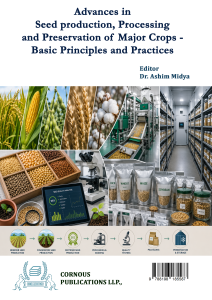
Editorial Book
Book Title: Advances in Seed production, Processing and Preservation of Major Crops: Basic Principles and Practices
PAID ACCESS | Published on : 05-Jan-2026 | Pages: 17-27 | Doi : 10.37446/edibook032024 /17-27
Seed Production Technology in Groundnut
- Sujatha K
- Professor and Head, Department of Seed Science & Technology, Agricultural College & Research Institute, Tamil Nadu Agricultural University, Madurai, Tamil Nadu, India.
- Nilavarasi R
- Research Scholars, Department of Seed Science & Technology, Agricultural College & Research Institute, Tamil Nadu Agricultural University, Madurai, Tamil Nadu, India.
- Elamparithi R
- Research Scholars, Department of Seed Science & Technology, Agricultural College & Research Institute, Tamil Nadu Agricultural University, Madurai, Tamil Nadu, India.
Abstract
Groundnut, is one of the important oilseed crop, plays a pivotal role in agricultural economies, particularly in tropical and subtropical regions. The optimization of cultivation practices is essential to address the challenges of climate variability, pest pressures, and declining soil fertility. This study outlines a scientifically validated package of practices for groundnut farming for seed production, micro nutrients deficiency and control measures and aimed on maximizing yield potential and ensuring crop sustainability. The practices discussed include optimal land preparation techniques, precision sowing, integrated nutrient management, effective irrigation strategies, and advanced pest and disease control measures. Special focus is given to the selection of high-yielding and disease-resistant varieties, as well as the timing of critical operations to align with local agro-ecological conditions. The implementation of these practices is projected to enhance groundnut seed productivity while maintaining soil health and reducing environmental impacts.
Keywords
Conservation agriculture, drip irrigation, organic farming, sustainable agriculture
References
Bertioli, D. J., Leal-Bertioli, S. C. M., & Stalker, H. T. (2016). The peanut genome: The history of the consortium and the structure of the genome of cultivated peanut and its diploid ancestors. In Peanuts (pp. 147–161). AOCS Press. https://doi.org/10.1016/B978-0-12-801440-1.00007-6
Deotale, R. D., Suryapujary, S. M., Ghadge, P. P., Baviskar, S. B., & Girish Kumar, G. K. (2007). Evaluation of macro- and micro-nutrient deficiency symptoms in groundnut (Arachis hypogaea L.).
Mayeux, A. (2001). Atelier de formation-échange: Dossier technique sur les normes de production, de stockage et de distribution des semences d’arachide en milieu paysannal.
Ndjeunga, J., Ntare, B. R., Waliyar, F., & Ramouch, M. (2006). Groundnut seed systems in West Africa: Current practices, constraints and opportunities. International Crops Research Institute for the Semi-Arid Tropics (ICRISAT).
Nigam, S. N., Giri, D. Y., & Reddy, A. G. S. (2004). Groundnut seed production manual. International Crops Research Institute for the Semi-Arid Tropics (ICRISAT).
Nigam, S. N., Rao, V. R., & Gibbons, R. W. (1983). Utilization of natural hybrids in the improvement of groundnuts (Arachis hypogaea). Experimental Agriculture, 19(4), 355–359.
https://doi.org/10.1017/S0014479700013097
Trivedi, R. K., & Gunasekaran, M. (2013). Indian minimum seed certification standards. Central Seed Certification Board, Department of Agriculture and Cooperation, Ministry of Agriculture, Government of India.
Indexing In




Types of Books We Publish




Uniqueness of our Publication

DOI Assignment

ISBN Registration

Online Publication

High Visibility

Open & Closed Access
DOI Assignment
ISBN Registration
Online Publication
High Visibility