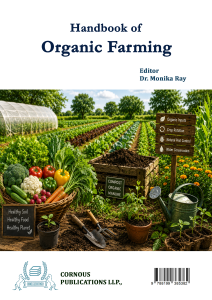
Editorial Book
Book Title: Handbook of Organic Farming
PAID ACCESS | Published on : 23-Nov-2026 | Pages: 117-123 | Doi : https://doi.org/10.37446/edibook142024/117-123
Salicylic Acid and Brassinosteroids Application Enhances Crop Yield Under Saline Stress
- M. Srikanth
- Ph.D. Scholar, Department of Crop Physiology, Agricultural College, Bapatla, ANGRAU, Andhra Pradesh, India.
Abstract
Climate change in recent times increases abiotic stress mainly drought and salinity. Saline lands formed mainly in coastal areas by inundation of ocean currents. The hindering of plant growth and development by salinity stress which causes serious threat to crops indirectly effects global food security, the substantial influence on yield parameters of crop. Salinity effects different phages of crop growth i.e. photosynthesis, nutrient absorption, and various biological process such as enzymatic activity and osmolytes ultimately reduces crop yield. Utilizing the advantages of growth regulators like BRs and SA by external application reduce the yield loss under salinity stress.
Keywords
Salicylic acid, Brassinosteroids, Growth regulators Crop, yield, Saline stress
References
Ahmad, R., Hussain, S., Anjum, M. A., Khalid, M. F., Saqib, M., Zakir, I., Hassan, A., Fahad, S., & Ahmad, S. (2019). Oxidative stress and antioxidant defense mechanisms in plants under salt stress. In Plant abiotic stress tolerance: Agronomic, molecular and biotechnological approaches (pp. 191–205). Springer. https://doi.org/10.1007/978-3-030-06118-0_8
Allakhverdiev, S. I., Sakamoto, A., Nishiyama, Y., Inaba, M., & Murata, N. (2000). Ionic and osmotic effects of NaCl-induced inactivation of photosystems I and II in Synechococcus sp. Plant Physiology, 123(3), 1047–1056. https://doi.org/10.1104/pp.123.3.1047
Bhattacharya, A. (2021). Effect of soil water deficit on growth and development of plants: A review. In Soil water deficit and physiological issues in plants (pp. 393–488).
Boorboori, M. R., & Li, J. (2025). The effect of salinity stress on tomato defense mechanisms and exogenous application of salicylic acid, abscisic acid, and melatonin to reduce salinity stress. Soil Science and Plant Nutrition, 71(1), 93–110.
Chakraborty, K., Basak, N., Bhaduri, D., Ray, S., Vijayan, J., Chattopadhyay, K., & Sarkar, R. K. (2018). Ionic basis of salt tolerance in plants: Nutrient homeostasis and oxidative stress tolerance. In Plant nutrients and abiotic stress tolerance (pp. 325–362). Springer.
Demetriou, G., Neonaki, C., Navakoudis, E., & Kotzabasis, K. (2007). Salt stress impact on the molecular structure and function of the photosynthetic apparatus–The protective role of polyamines. Biochimica et Biophysica Acta (BBA) - Bioenergetics, 1767(4), 272–280. https://doi.org/10.1016/j.bbabio.2007.02.020
Gruszka, D. (2013). The brassinosteroid signaling pathway–New key players and interconnections with other signaling networks crucial for plant development and stress tolerance. International Journal of Molecular Sciences, 14(5), 8740–8774. https://doi.org/10.3390/ijms14058740
Hossain, A., Krupnik, T. J., Timsina, J., Mahboob, M. G., Chaki, A. K., Farooq, M., Bhatt, R., Fahad, S., & Hasanuzzaman, M. (2020). Agricultural land degradation: Processes and problems undermining future food security. In Environment, climate, plant and vegetation growth (pp. 17–61). Springer.
Hosseinifard, M., Stefaniak, S., Ghorbani Javid, M., Soltani, E., Wojtyla, Ł., & Garnczarska, M. (2022). Contribution of exogenous proline to abiotic stresses tolerance in plants: A review. International Journal of Molecular Sciences, 23(9), 5186.
Isayenkov, S. V., & Maathuis, F. J. (2019). Plant salinity stress: Many unanswered questions remain. Frontiers in Plant Science, 10, Article 80. https://doi.org/10.3389/fpls.2019.00080
Jyostnarani, P., Priya, H., Devashish, P., Geeta, K., Aman, J., Ramkrushna, C. V., Prasad, K., Teikur, M., Kartik, P., Krishna, J. K., & Padmanabh, D. (2025). Role of brassinolide in enhancing plant tolerance to salinity stress.
Kesawat, M. S., Satheesh, N., Kherawat, B. S., Kumar, A., Kim, H. U., Chung, S. M., & Kumar, M. (2023). Regulation of reactive oxygen species during salt stress in plants and their crosstalk with other signaling molecules–Current perspectives and future directions. Plants, 12(4), 864.
Keya, S. S., Mostofa, M. G., Rahman, M. M., Das, A. K., Sultana, S., Ghosh, P. K., Anik, T. R., Ahsan, S. M., Rahman, M. A., Jahan, N., & Tran, L. S. P. (2023). Salicylic acid application improves photosynthetic performance and biochemical responses to mitigate saline stress in cotton. Journal of Plant Growth Regulation, 42(9), 5881–5894.
Li, Y., Li, H., Li, Y., & Zhang, S. (2017). Improving water-use efficiency by decreasing stomatal conductance and transpiration rate to maintain higher ear photosynthetic rate in drought-resistant wheat. The Crop Journal, 5, 231–239.
Lu, C., & Vonshak, A. (2002). Effects of salinity stress on photosystem II function in cyanobacterial Spirulina platensis cells. Physiologia Plantarum, 114(3), 405–413. https://doi.org/10.1034/j.1399-3054.2002.1140310.x
Medrano, H., Tomás, M., Martorell, S., Flexas, J., Hernández, E., Rosselló, J., Pou, A., Escalona, J. M., & Bota, J. (2015). From leaf to whole-plant water use efficiency (WUE) in complex canopies: Limitations of leaf WUE as a selection target. The Crop Journal, 3(3), 220–228.
Nazar, R., Iqbal, N., Syeed, S., & Khan, N. A. (2011). Salicylic acid alleviates decreases in photosynthesis under salt stress by enhancing nitrogen and sulfur assimilation and antioxidant metabolism differentially in two mungbean cultivars. Journal of Plant Physiology, 168(8), 807–815.
Praveena, J., Dash, S., Behera, L., & Rout, G. R. (2020). Brassinosteroids: A multifunctional phytohormone of plant development and stress responses. Current Journal of Applied Science and Technology, 39, 174–196.
Quamruzzaman, M., Manik, S. N., Shabala, S., & Zhou, M. (2021). Improving performance of salt-grown crops by exogenous application of plant growth regulators. Biomolecules, 11(6), 788.
Rao, M. J., Duan, M., Zhou, C., Jiao, J., Cheng, P., Yang, L., Wei, W., Shen, Q., Ji, P., Yang, Y., & Conteh, O. (2025). Antioxidant defense system in plants: Reactive oxygen species production, signaling, and scavenging during abiotic stress-induced oxidative damage. Horticulturae, 11(5), 477.
Rao, Y. R., Ansari, M. W., Sahoo, R. K., Wattal, R. K., Tuteja, N., & Kumar, V. R. (2021). Salicylic acid modulates ACS, NHX1, SOS1 and HKT1;2 expression to regulate ethylene overproduction and Na+ ion toxicity that leads to improved physiological status and enhanced salinity stress tolerance in tomato plants cv. Pusa Ruby. Plant Signaling & Behavior, 16(11), 1950888.
Salehi, H., Miras-Moreno, B., Tolisano, C., Del Buono, D., Araniti, F., Zuluaga, M. Y. A., Ganugi, P., Fiorini, A., Pii, Y., & Lucini, L. (2026). Brassinosteroids alleviate salinity stress in tomato by modulating redox balance, ion homeostasis, and metabolomic adjustments. Plant Physiology and Biochemistry, Article 111354.
Siddiqui, H., Hayat, S., & Bajguz, A. (2018). Regulation of photosynthesis by brassinosteroids in plants. Acta Physiologiae Plantarum, 40(3), 1–15. https://doi.org/10.1007/s11738-018-2639-2
Stepien, P., & Klobus, G. (2005). Antioxidant defense in the leaves of C3 and C4 plants under salinity stress. Physiologia Plantarum, 125(1), 31–40. https://doi.org/10.1111/j.1399-3054.2005.00534.x
Tahjib-Ul-Arif, M., Siddiqui, M. N., Sohag, A. A. M., Sakil, M. A., Rahman, M. M., Polash, M. A. S., Mostofa, M. G., & Tran, L. S. P. (2018). Salicylic acid-mediated enhancement of photosynthesis attributes and antioxidant capacity contributes to yield improvement of maize plants under salt stress. Journal of Plant Growth Regulation, 37(4), 1318–1330.
Vardhini, B. V., Anuradha, S., Sujatha, E., & Rao, S. S. R. (2010). Role of brassinosteroids in alleviating various abiotic and biotic stresses–A review. Plant Stress, 4(1), 55–61.
Waheed, A., Zhuo, L., Wang, M., Hailiang, X., Tong, Z., Wang, C., & Aili, A. (2024). Integrative mechanisms of plant salt tolerance: Biological pathways, phytohormonal regulation, and technological innovations. Plant Stress, 14, 100652.
Wahid, N., Wahab, S., Khan, M. N., Ullah, B., Razzaq, A., Kaplan, A., Hayat, K., Ozdemir, F. A., & Ahmad, Q. (2025). Phytohormonal mechanisms for resilience against salinity stress in oilseed crops. In Oilseed crops under abiotic stress: Mitigation strategies and future perspectives (pp. 283–319). Springer Nature Singapore.
Yang, W., Zhou, Z., & Chu, Z. (2023). Emerging roles of salicylic acid in plant saline stress tolerance. International Journal of Molecular Sciences, 24(4), 3388.
Yin, X., Tang, M., Xia, X., & Yu, J. (2021). BRASSINAZOLE RESISTANT 1 mediates brassinosteroid-induced Calvin cycle to promote photosynthesis in tomato. Frontiers in Plant Science, 12, 811948. https://doi.org/10.3389/fpls.2021.811948
Zhao, C., Zhang, H., Song, C., Zhu, J. K., & Shabala, S. (2020). Mechanisms of plant responses and adaptation to soil salinity. The Innovation, 1(1).
Indexing In




Types of Books We Publish




Uniqueness of our Publication

DOI Assignment

ISBN Registration

Online Publication

High Visibility

Open & Closed Access
DOI Assignment
ISBN Registration
Online Publication
High Visibility