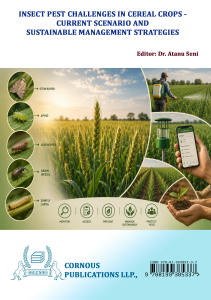
Editorial Book
Book Title: Insect Pest Challenges in Cereal Crops - Current Scenario and Sustainable Management Strategies
PAID ACCESS | Published on : 03-Feb-2026 | Pages: 1-11 | Doi : 10.37446/edibook212025/1-11
Role of Natural Predators and Parasitoids in Managing Wheat Insect Pests
- S. M. Chavan
- Assistant Research Scientist (Entomology), Agriculture Experimental Station, Navsari Agricultural University, Navsari, Gujarat, India.
Abstract
Wheat is the most prominent grain globally. Insect pests can inflict significant harm during the crucial growth stages of heading and flowering. Pink stem borer, Sesamia inferens (Walker); aphid, Rhopalosiphum padi Linnaeus, Schizaphis graminum Rondani, R. maidis and Macrosiphum miscanthi (Tak.); shoot fly, Atherigona soccata (Rondani); hessian fly, Mayetiola destructor (Say); army worm, Mythimna separata (Walker) and termite, Odontotermes obesus (Rambur) are the insect pests of wheat. The population of pests in wheat ecosystems is considerably influenced by the presence and efficiency of their natural enemies like predators viz., Coccinelids, Coccinella septempunctata (L.), Menochilus sexmaculatus (F.), Hippodamia variegata (Goeze), Episyrphus balteatus (De geer), H. convergens, Cydonia vicina nilotica Mul., Cydonia vicina isis Cr., Scymnus sp.; Rhyzobius litura Fab., spiders; Oxypes spp., Lycosa pseudoannulata; marmalade hoverflies, Episyrphus balteatus De Geer; rove beetle, Paederus fuscipes, Paederus alfierii; Syrphid fly, Metasyrphus corolla (Fab.); Minute pirate bugs, Orius sp.; earwig Euborellia stali (Dohrn); Chrysoperla carnea (Steph.), and parasitoids viz., Aphelinus abdominalis Dalman and Aphidius avenae Haliday, Trichogrammaa sp., Lysiphlebus testaceipes; Cotesia spp.; tachnid fly, Sturmiopsis inferens, Neotrichoporoides sp.; N. nyemitawus, Theocolax elegans Westwood and Platygaster hiemalis Forbes. Adoption of different cropping system, ecological engineering can improve biological control.
Keywords
Wheat, Insect pests, Natural enemies, Parasitoids, Predators, Ecological regulation
References
Ali, A., Desneux, N., Lu, Y., & Wu, K. (2018). Key aphid natural enemies showing positive effects on wheat yield through biocontrol services in northern China. Agriculture, Ecosystems & Environment, 266, 1–9.
Altieri, M. A., Wilson, R. C., & Schmidt, L. L. (1985). The effects of living mulches and weed cover on the dynamics of foliage- and soil-arthropod communities in three crop systems. Crop Protection, 4(2), 201–213.
Anonymous. (1992, April 22). Parasitic and predaceous insects used to control insect pests: Exemption from a tolerance. Federal Register, 57(78), 14645–14646.
Anonymous. (2015). CPSC AGRESCO Report, ARS, AAU, Arnej.
Awadalla, S. S., Ghanim, A. A., Abd Allah, F. E., & Abdel-Aziz, A. (2018). The main insect pests attacking wheat plants and their associated predators in Sakha District, Kafr Elsheikh Governorate. Journal of Plant Protection and Pathology, Mansoura University, 9(2), 97–101.
Baladhiya, H. C., Sisodiya, D. B., & Pathan, N. P. (2018). A review on pink stem borer, Sesamia inferens Walker: A threat to cereals. Journal of Entomology and Zoology Studies, 6(3), 1235–1239.
Barriton, A. T., Libetario, E. M., & Litsinger, J. A. (1987). An earwig predator of Asian pink stem borer (PSB) in upland rice. International Rice Research Newsletter, 12(1), 19.
Butter, N. S. (1978). Apanteles ruficrus Haliday—an efficient parasite of armyworm, Mythimna separata (Walker) on wheat. Science and Culture, 44, 181–182.
Crespo-Herrera, L. A., Singh, R. P., & Åhman, I. (2015). Field population development of bird cherry-oat aphid and greenbug (Hemiptera: Aphididae) on wheat-alien substitution and translocation lines. Euphytica, 203, 249–260.
DeBach, P. (1964). Biological control of insect pests and weeds (1st ed.). Chapman and Hall.
Dhaliwal, G. S., Jindal, V., & Dhawan, A. K. (2010). Insect pest problems and crop losses: changing trends. Indian Journal of Ecological Sciences, 37, 1–7.
Elliott, N. C., Giles, K. L., Baum, K. A., Brewer, M. J., Elzay, S., & Royer, T. A. (2024). Aphid biological control by parasitoids in winter wheat and canola in heterogeneous agricultural landscapes. In Arthropod management and landscape considerations in large-scale agroecosystems (pp. 104–118).
FAOSTAT: Food and Agriculture Organization of the United Nations. (2019). Food and agriculture data. http://www.fao.org/faostat/en/#home
Farook, U. B., Khan, Z. H., Ahad, I., Maqbool, S., Yaqoob, M., Rafieq, I., Rehman, S. A., & Sultan, N. (2019). A review on insect pest complex of wheat (Triticum aestivum L.). Journal of Entomology and Zoology Studies, 7(1), 1292–1298.
Flinn, P. W., & Hagstrum, D. W. (2001). Augmentative releases of parasitoid wasps in stored wheat reduces insect fragments. Journal of Stored Products Research, 37(2), 179–186.
Freier, B., Triltsch, H., Mowes, M., & Moll, E. (2007). The potential of predators in natural control of aphids in wheat: Results of a ten-year field study in two German landscapes. Biocontrol, 52(6), 775–788.
Froggatt, W. W. (1912). Parasitic enemies of the Mediterranean flour moth, Ephestia kuehniella, Zeller. Agricultural Gazette of New South Wales, 23, 307–311.
Godhani, P. H. (1987). Bionomics, varietyl susceptibility and chemical control of wheat stem borer Sesamia inferens Walker (Lepidoptera: Noctuidae). Gujarat Agricultural University.
Here are the additional references converted to APA 7th edition format:
Jadhav, M. M., Chander, S., Saharan, M. S., Suroshe, S. S., & Rajna, S. (2023). Assessment of avoidable yield losses due to insect pests and diseases in wheat (Triticum aestivum). Indian Journal of Agricultural Sciences, 93(11), 1186–1190.
Jasrotia, P., Bhardwaj, A. K., Katare, S., Yadav, J., Kashyap, P. L., Kumar, S., & Singh, G. P. (2021). Tillage intensity influences insect-pest and predator dynamics of wheat crop grown under different conservation agriculture practices in rice-wheat cropping system of Indo-Gangetic plain. Agronomy, 11(6), 1087.
Khalid, L., Aslam, A., Raza, A., Amjad, R., Aslam, M., & Muhammad, B. H. (2022). Wheat pest management (Aphid and Armyworm) through natural enemies in climate change scenario. Global Scientific Journal, 10(9), 738–743.
Knutson, A., Boring, E. P., Michels, G. J., & Gilstrap, F. (2010). Biological control of insect pests in wheat. Texas A&M AgriLife Extension.
Kumar, K., Kumhare, A., Bajpai, R., & Shah, A. K. (2023). The study of insect pest association and their seasonal incidence on wheat under Acacia nilotica based agroforestry system. The Pharma Innovation Journal, 12(10), 2473–2475.
Landis, D. A., Wratten, S. D., & Gurr, G. M. (2000). Habitat management to conserve natural enemies of arthropod pests in agriculture. Annual Review of Entomology, 45(1), 175–201. https://doi.org/10.1146/annurev.ento.45.1.175
Luo, K., Zhao, H., Wang, X., & Kang, Z. (2022). Prevalent pest management strategies for grain aphids: Opportunities and challenges. Frontiers in Plant Science, 12, Article 790919. https://doi.org/10.3389/fpls.2021.790919
Ma, K., Hao, S., Zhao, H., & Kang, L. (2007). Strip cropping wheat and alfalfa to improve the biological control of the wheat aphid Macrosiphum avenae by the mite Allothrombium ovatum. Agriculture, Ecosystems & Environment, 119(1-2), 49–52. https://doi.org/10.1016/j.agee.2006.06.009
Moschini, V., Migliorini, P., Sacchetti, P., Casella, G., & Vazzana, C. (2012). Presence of aphid predators in common wheat (Triticum aestivum L.) in organic and conventional agroecosystems of Tuscany. New Mediterranean, (4), 57–60.
Muhammad, A., Ahmad, S., Muhammad, S., Abdin, Z., & Maqsood, S. (2018). Population dynamics of aphids and their natural enemies associated with strip intercropping in wheat crop. Pakistan Journal of Zoology, 50(4), 1225–1230.
Mukhtar, Y., Shankar, U., & Wazir, Z. A. (2023). Prospects and challenges of emerging insect pest problems vis-à-vis climate change. Indian Journal of Ecology, 50(4), 1096–1103.
Munyuli, M. B. T., Kyamanywa, S., & Luther, G. C. (2008). Effects of groundnut genotypes, cropping systems and insecticides on the abundance of native arthropod predators from Uganda and Democratic Republic of Congo. Bulletin of Insectology, 61(1), 11–19.
Munyuli, M. B. T., Luther, G. C., & Kyamanywa, S. (2007). Effects of cowpea cropping systems and insecticides on arthropod predators in Uganda and Democratic Republic of the Congo. Crop Protection, 26(1), 114–126. https://doi.org/10.1016/j.cropro.2006.04.010
Patel, R. K. (1972). Observations on incidence of wheat stem borer, Sesamia inferens Walker. Pesticides, 6(1), 14.
Pawar, P., Baskaran, R. K. M., Sharma, K. C., & Marathe, A. (2023). Enhancing biocontrol potential of Trichogramma chilonis against borer pests of wheat and chickpea. iScience, 26(4), Article 106512. https://doi.org/10.1016/j.isci.2023.106512
Pimentel, D. (1997). Pest management in agriculture. In D. Pimentel (Ed.), Techniques for reducing pesticide use: Environmental and economic benefits (pp. 1–11). John Wiley and Sons.
Ranjith, M., Bajya, D. R., Manoharan, T., & Ramya, R. S. (2018). Biodiversity of insect pests and natural enemies affiliated with wheat (Triticum aestivum) ecosystem in Haryana. Indian Journal of Agricultural Sciences, 88(1), 157–158.
Raodeo, A. K., Tikar, D. T., & Chundurwar, R. D. (1972). Record of natural parasites of sorghum shoot fly, Atherigona varia soccata Rond. Current Science, 41(11), 430–431.
Rivers, A., Barbercheck, M., Govaerts, B., & Verhulst, N. (2016). Conservation agriculture affects arthropod community composition in a rainfed maize–wheat system in central Mexico. Applied Soil Ecology, 100, 81–90.
Rivers, A., Mullen, C., Wallace, J., & Barbercheck, M. (2017). Cover crop-based reduced tillage system influences Carabidae (Coleoptera) activity, diversity and trophic group during transition to organic production. Renewable Agriculture and Food Systems, 32(6), 538–546.
Sharma, H. C. (2016, February 4–5). Climate change vis-à-vis pest management. Paper presented at the Conference on National Priorities in Plant Health Management, Tirupati, India.
Sharma, H. C., & Davies, J. C. (1983). The oriental armyworm, Mythimna separata (Walk.), distribution, biology and control, a literature review (Miscellaneous Report No. 59). Centre for Overseas Pest Research.
Shearin, A. F., Reberg-Horton, S. C., & Gallandt, E. R. (2014). Direct effects of tillage on the activity density of ground beetle (Coleoptera: Carabidae) weed seed predators. Environmental Entomology, 43(4), 1140–1146.
Singh, B. U., & Sharma, H. C. (2002). Natural enemies of sorghum shoot fly, Atherigona soccata Rondani (Diptera: Muscidae). Biocontrol Science and Technology, 12(3), 307–323.
Singh, B., & Kular, J. S. (2015). Incidence and management of pink stem borer (Sesamia inferens) in rice-wheat cropping system. Journal of Insect Science, 15(Sp. Issue), 142–145.
Singh, G., & Sharma, S. (2023). An evaluation of variable doses of tachnid fly, Sturmiopsis inferens for the management of Sesamia inferens under field conditions in rice and wheat. Journal of Biological Control, 37(3), 159–166.
Tylianakis, J. M., Didham, R. K., & Wratten, S. D. (2004). Improved fitness of aphid parasitoids receiving resource subsidies. Ecology, 85(3), 658–666. https://doi.org/10.1890/03-0222
Vandenborre, G., Smagghe, G., & Van Damme, E. J. M. (2011). Plant lectins as defense proteins against phytophagous insects. Phytochemistry, 72(13), 1538–1550.
Walkunde, S. S., Patil, S. D., & Bhoite, B. S. (2019). Seasonal incidence of major insect-pest and their biocontrol agent of wheat crop. Journal of Pharmacognosy and Phytochemistry, 8(5), 1210–1213.
Wang, G., Ji, X., Wang, W., & Yong, L. (2010). Community dynamics of wheat aphid natural enemies in wheat-oilseed rape or wheat-garlic intercropping fields. Journal of Environmental Entomology, 32(3), 295–298. https://doi.org/10.1016/S1002-0721(10)60377-8
Wratten, S. D., Berndt, L., Gurr, G., Tylianakis, J., Fernando, P., & Didham, R. (2002). Adding floral diversity to enhance parasitoid fitness and efficacy. In Proceedings of the First International Symposium on Biological Control of Arthropods (pp. 211–213). Honolulu, Hawaii.
Yang, F., Xu, L., Wu, Y.-K., Wang, Q., Yao, Z.-W., Zikic, V., Tomanovic, Z., Ferrer-Suay, M., Selfa, J., Pujade-Villar, J., Traugott, M., Desneux, N., Lu, Y.-H., & Guo, Y.-Y. (2017). Species composition and seasonal dynamics of aphid parasitoids and hyperparasitoids in wheat fields in northern China. Scientific Reports, 7(1), Article 13989.
Zhang, H., & Li, J. (1996). Sources and dispersal of Allothrombium ovatum larvae (Acari: Trombidiidae) in cotton fields and effects of larval mites on Aphis gossypii (Homoptera: Aphididae). Systematic & Applied Acarology, 1, 65–71.
Zhou, H., Chen, J., Cheng, D., Francis, F., Liu, Y., & Sun, J. (2012). Effects of ecological regulation of biodiversity on insects in agroecosystems. Plant Protection, 38(1), 6–10. https://doi.org/10.3969/j.issn.0529-1542.2012.01.002.
Indexing In




Types of Books We Publish




Uniqueness of our Publication

DOI Assignment

ISBN Registration

Online Publication

High Visibility

Open & Closed Access
DOI Assignment
ISBN Registration
Online Publication
High Visibility